The Treaty Of Versailles
By Michael Every of Rabobank
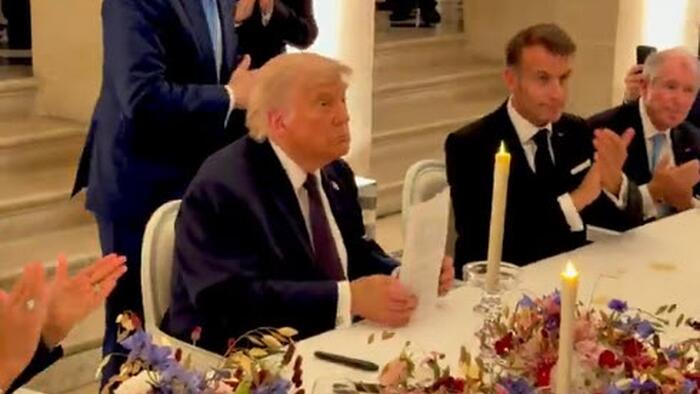
Yesterday, President Trump signed the US-Iran MoU in Versailles. It’s not a treaty, but the parallel with the one signed by Germany there on June 28, 1919, is notable: post-WW1, French Marshal Foch is widely credited with saying, “This is not a peace. It is an armistice for twenty years,” because he saw it as too lenient on the loser of that war.
‘Bravo’ says Macron after Trump signs Iran MoU at Versailles dinner. ‘Great job’ pic.twitter.com/5nDjGku4xS
— Danny Kemp (@dannyctkemp) June 17, 2026
This MoU is also lenient on Iran, who thinks it won, and again doesn’t look like peace, just an armistice for 20 weeks – which ends two days after the US midterm elections. Indeed, even as Trump was touting the importance of the deal to avoid “economic catastrophe,” he underlined he’ll bomb Iran again if they don’t honor it.
Yet what they honor depends on whose MoU version you read. The 14-point text the US released to CNN differs in important regards from what Bloomberg was running with and the Iranian version:
Trump also thanked China and Russia for remaining “neutral” in the war, adding “it’s OK” for Iran to have some ballistic missiles, as the Wall Street Journal estimates Iran could earn up $60bn from oil revenues ahead. What that’s spent on (reconstruction, Chinese or Russian arms, or shaheed drone factories to use locally and send to Russia, etc.) is also critical.
Understandably, Iran hawks are lamenting this all as a “disaster” or “catastrophe.” Even Bloomberg underlines what was flagged here months ago: if this MoU is a TACO not a can-kicking exercise until November, it will “unravel geopolitics”, the US creating a power vacuum others will try to fill.
That’s as South Korea’s President Lee just asked Trump to solve the North Korea issue… but they already have a nuke, so what do they get given – access to Anthropic AI?
As all is in flux, the US is also working with Europe to again back Ukraine, whose drone tech now means they hold some good cards, even as the EU reopens official communication channels with the Kremlin. It seems likely that US sanctions could soon go back on Russian oil, which would see the energy complex reshuffled again.
In market terms, the IEA is now seeing a gradual Hormuz recovery tipping into a significant 2027 oil surplus, flipping the narrative entirely – unless war restarts in 20 weeks. Most things remain a passenger to that dynamic.
Ironically, but as expected, the market is trading that possible Mou TACO as dollar positive even as it actually undermines the global architecture that holds the dollar up: but since when did FX look at the long term?
In other geoeconomics, as Europe seems set for a sustained trade war vs. China ahead, the G7 agreed to set up a critical minerals alliance platform to cut their reliance on China – which, as explained here before, logically implies trade decoupling downstream too and the emergence of geopolitical trade blocs.
Meanwhile, in a changing world, the Fed under Chair Warsh is ripping treaties up, not signing them. As our US strategist notes, the FOMC left rates unchanged as expected, with an easing bias dropped, but with an unusually short statement. Indeed, Warsh just terminated forward guidance – which is arguably not such a bad idea given what happens in the Middle East is pivotal to what happens to inflation, and central banks have no idea at all about what will transpire there(?)
In cyclical terms, the June Summary of Economic Projections had already revealed that half of the FOMC participants (who submitted a forecast) expected to hike before the end of the year. Warsh did not submit his.
More importantly, in structural terms, Warsh announced the establishment of five task forces on: Fed communications (is so much needed?); the balance sheet (is so much needed?); improving data (more, better is needed, and Warsh prefers real-time numbers over backwards looking surveys); productivity and jobs (will AI allow for rate cuts?); and inflation frameworks (where things will get even more interesting).
Just as many suspect there is more drama ahead in Hormuz, and that it will never go back to being what it was until recently, the same may be true for the Fed.