Ave Maria: Myth and history
In the final days of Socrates’s life, as he waited for his execution in an Athenian prison, his closest friend, Crito, visited him, waking him from a glorious dream. In that dream, a woman in white had appeared to him, assuring him that on the third day following, he would reside in the land of Pythia, the heavenly homeland of his ancestors.
Athens had turned against Socrates because he had favored the word and teachings of God over those of the city. He had preached that one should never do evil, even when evil has been done; that man must, in every circumstance and in every moment, do good. As such, there can be no such thing as an evil done in the name of a good. Such an act, no matter how well-intentioned, would always corrupt the good. Though Socrates did not use the words “turn the other cheek,” he might very well have. That the early Christians found in Socrates a representation of Christ should not come as a surprise.
In the Aeneid, the goddess Venus, “lustrous among the cloudbanks,” descends from the heavens and gives Aeneas a suit of celestial armor, a sword, a breastplate, a spear, and a shield upon which was written the whole future history of Rome, with which he can defeat his Latin foes. It is one of the most glorious passages in Western literature.
In Lakota mythology, a woman in white, the White Buffalo Woman, appears to two warriors wandering the majestic Great Plains. She offers them the law and the virtues by which their people could live. One warrior immediately drops to his knees in respect, while the other warrior lusts after her in his heart. The latter falls dead. The former, blessed, becomes a messenger of the Seven Sacred Rites to his people.
In the Arthurian legends, a glorious woman, aglow in a white light, emerges from the lake and hands the young Celt the sword Excalibur, with which he can unite his divided people into a Christian kingdom, dedicated to doing good in the world. She is, properly, the Lady of the Lake, Notre Dame du Lac.
What if these were not four separate women, but one mythic manifestation appearing across time and cultures?
In his profound epic poem, The Ballad of the White Horse, G.K. Chesterton finds King Alfred the Great, the first truly English king, a devout Christian, who is immensely frustrated with God. Here he was, defending England against the heathen Vikings, and yet, in battle, the two sides kept coming to a draw. Why wouldn’t God help his people? When he is alone in a glade, a woman appears to him. As Chesterton records it: “Out of the mouth of the Mother of God, like a little word go I / For I go gathering Christian men from sunken pavement, ford, and fen / To die in battle, God knows when, by God, I know why.”
And, what does the Mother of God tell Alfred? That his duty is to fight the good fight, no matter the cost and no matter the outcome. The battle is his, but the war is God’s. One must also note that while Christ is The Word, we, made in His image, are little words.
In the Gospel of St. Luke, the angel Gabriel appears to the Blessed Virgin Mary, a young Jewish girl. At first, she’s terrified. Then, calmed by the angel’s words and his glorious invitation, she responds in perfect humility and grace: “My soul doth magnify the Lord.” In other words, Mary’s perfect submission is not about Mary but about God. Her soul, a mirror, reflects, without flaw, the divine.
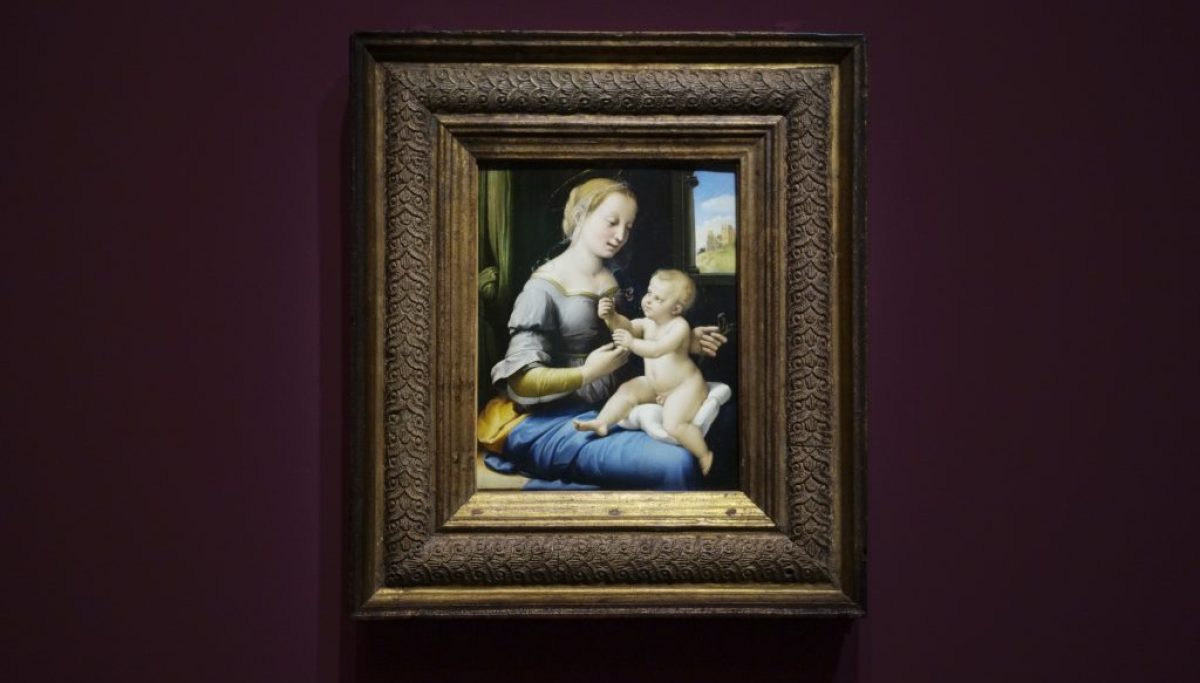
After nine months of being the New Tabernacle, she gives birth to the Incarnate Word, the Christ child, born in the dregs of a manger, truly in the lowest conceivable spot. There, we can imagine the Virgin Mary, enlightened by the white glow of grace, surrounded by her husband, animals, and visiting shepherds. Though utterly real, it is the stuff of myth. And, let us not forget, a myth is not an untrue story, but a true story that contains the supernatural and the unexplained.
BEYOND ELF AND DIE HARD: THE MOST UNDERRATED CHRISTMAS MOVIES
In the month after C.S. Lewis’s conversion to Christianity, in the autumn of 1931, he confided to a friend: “Pagan stories are God expressing Himself through the minds of poets, using such images as He found there, while Christianity is God expressing Himself through what we call ‘real things.’” In other words, Christianity did not overturn that which had come before it, but instead baptized what it could of it. Hence, you’re reading this on a Thursday, the day of which our northern Germanic ancestors worshipped Thor, the god of justice, but I’m guessing not a single one of you made offerings to Thor this morning. Thursday, though the pagan name remains, has been baptized.
On this Christmas day, let us contemplate the Mother of Jesus. Perhaps, just perhaps, if God is the author of our story, He has, naturally, made a consistent and coherent universe. In such an understanding, it’s not too far-fetched to believe that God has shown forth his grace to Socrates and to Alfred, to you and to me, all through a woman in white. Ave Maria.
Bradley J. Birzer is a professor of history at Hillsdale College and a proud graduate of the University of Notre Dame du Lac in South Bend, Indiana.