Schumer’s Senate gamble tests Democrats’ narrow 2026 path
Senate Democrats are projecting growing confidence about their chances to reclaim the upper chamber in 2026, outlining an expanded battleground map they say offers multiple routes back to the majority, even as the underlying electoral math remains unforgiving.
A new memo released Tuesday by the Democratic Senatorial Campaign Committee argues that disciplined recruiting, favorable midterm dynamics, and costly Republican primaries have put more states in play than expected. With Republicans holding a 53-47 majority, Democrats would need to flip at least four GOP-held seats while successfully defending every seat they already control.
That path runs through expected targets like Maine and North Carolina, but also hinges on at least one upset in redder territory such as Iowa, Ohio, or Alaska, while holding vulnerable Democratic seats in Georgia and Michigan, both of which backed President Donald Trump in 2024.
The DSCC memo, authored by Executive Director Devan Barber, credits the party’s confidence to what it describes as “star recruits in marquee races” and early signs of Republican weakness. Among the committee’s top examples is former Rep. Mary Peltola, whose Senate bid against Republican Sen. Dan Sullivan (R-AK) has become central to Democrats’ strategy in Alaska.
The committee calls Peltola “the only person who could pose a threat” to Sullivan and argues her candidacy is the “final puzzle piece” needed for a possible upset, citing early polling that shows a closely divided race.
Other key recruits highlighted by Democrats include former North Carolina Gov. Roy Cooper, Maine Gov. Janet Mills (D-ME), and former Sen. Sherrod Brown (D-OH). Democratic leaders view these candidates as capable of competing in politically diverse states where few Democrats have recently broken through.
Still, strategists caution that the party’s expanding ambitions leave little room for error. Aside from Maine, Democrats are targeting states Trump carried, in some cases by wide margins. Trump notched double-digit victories in Ohio and Alaska in 2024. Democrats have not won a Senate race in North Carolina since 2008. And Sen. Susan Collins (R-ME) held her Maine seat by nearly nine points in 2020, even as Joe Biden carried the state.
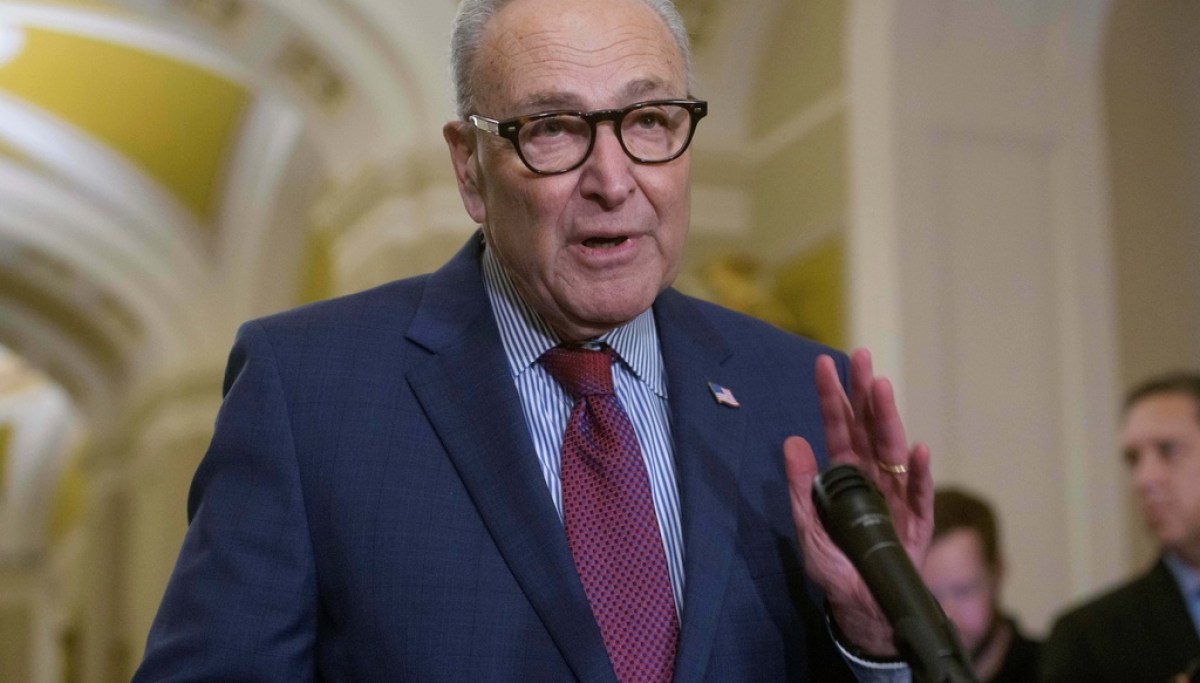
That tension sharpened this week when Senate Minority Leader Chuck Schumer (D-NY) told Axios that Democrats will win Senate races in North Carolina, Maine, Ohio, and Alaska.
“If we lose the Senate by one seat, and Trump puts two 40-year-olds on the Supreme Court … you won’t be happy,” Schumer said, describing his pitch to prospective candidates and arguing that “patriotism” motivated several to enter the race.
Those remarks elevate the personal stakes for Schumer, who is staring down a pivotal cycle for his leadership as he looks ahead to a possible 2028 reelection bid amid lingering questions about his long-term grip on the caucus.
“This is a major test for Schumer, and there’s a lot on the line,” said a Democratic strategist, who spoke on the condition of anonymity to discuss internal party dynamics. “I’d rather see this level of confidence expressed behind closed doors than publicly. If Democrats fall short, there could be real blowback for the leader.”
Democrats are also navigating internal friction over how aggressively national leaders should shape primary contests. Critics say party leadership and the DSCC have at times ceded too much control, while others complain Washington insiders still wield outsize influence.
The tension has been particularly visible in Texas, where Rep. Colin Allred’s (D-TX) sudden exit reshaped the race and cleared the way for Rep. Jasmine Crockett (D-TX), a prominent Trump critic, to enter the field. In Maine, Senate leaders worked aggressively to recruit Mills but were unable to prevent additional candidates from jumping into the race, including Graham Platner, a progressive oyster fisherman whose viral online presence and controversies have drawn national attention.
The DSCC memo argues that Republican turmoil outweighs those challenges, pointing to retirements in Iowa and North Carolina, bruising GOP primaries in New Hampshire and Georgia, and an expensive intraparty fight in Texas that national Republicans have struggled to contain.
DNC LAUNCHES VOTER REGISTRATION PUSH AMID HOUSE 2026 TENSIONS
Republicans dismiss Democrats’ outlook as detached from political reality.
“Democrats’ battleground map is littered with failed career politicians no longer aligned with the values of their states and messy, nasty primaries,” Joanna Rodriguez, the communications director for the National Republican Senatorial Committee, said in a statement to the Washington Examiner.
She said Republican senators are delivering “safer communities, more money in voters’ pockets, and more opportunities for working families.”