Minnesota: Federal law shouldn't apply to us
MINNESOTA: FEDERAL LAW SHOULDN’T APPLY TO US. There was another shooting in Minneapolis on Wednesday. An Immigration and Customs Enforcement officer shot an illegal immigrant from Venezuela in a wild scene that began with an ICE “targeted traffic stop.” This is from a statement by the Department of Homeland Security:
“In an attempt to evade arrest, the subject fled the scene in his vehicle and crashed into a parked car. The subject then fled on foot. The law enforcement officer caught up to the subject on foot and attempted to apprehend him when the subject began to resist and violently assault the officer. While the subject and law enforcement were in a struggle on the ground, two subjects came out of a nearby apartment and also attacked the law enforcement officer with a snow shovel and broom handle. As the officer was being ambushed and attacked by the two individuals, the original subject got loose and began striking the officer with a shovel or broom stick. Fearing for his life and safety as he was being ambushed by three individuals, the officer fired a defensive shot to defend his life. The initial subject was hit in the leg.”
Both the officer and the illegal immigrant are hospitalized.
It doesn’t take a scholar to catch the tone of defensiveness in the DHS statement. This shooting was really, really justified, it says, just in case you are one of those who think the fatal shooting of Renee Good last week was not.
In parts of Resistanceworld, there is growing anger at ICE, not just for its law enforcement operations targeting people in the country illegally, but for its refusal to go away. In Minneapolis, for example, the subtext of the anger seems to be: We’re tracking you. We’re blowing whistles. We’re blocking you with our cars. We’re getting into shoving matches with you. Some of us are doing more than that. And yet you won’t go away. What is it you don’t understand? We don’t want you here. Go.
It’s a weird attitude toward federal law enforcement — the notion that if people in some neighborhoods don’t like a law, then it should not be enforced in those areas. But that is reality in Minnesota these days.
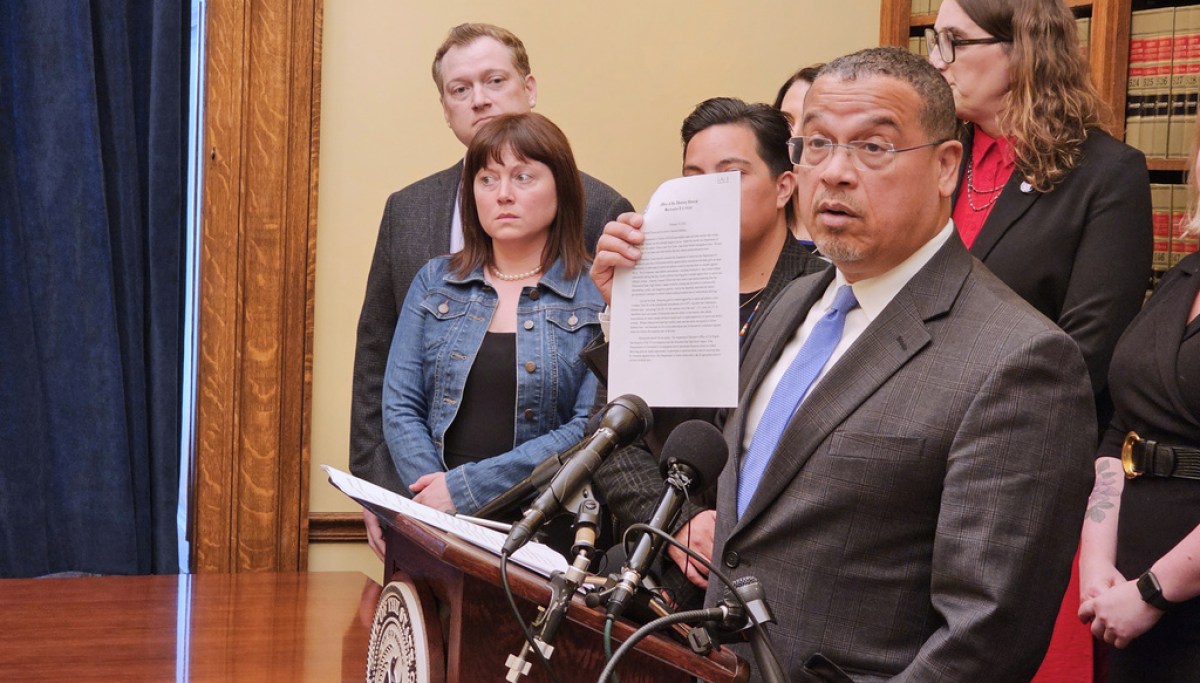
A similar sense of indignation — how dare they enforce the law! — courses through the lawsuit Minnesota Attorney General Keith Ellison filed this week against top ICE and DHS officials.
The suit, which goes on for 80 pages, begins with a long complaint about ICE’s mobilization in Minneapolis. It is “a federal invasion of the Twin Cities,” the suit reads, “driven by nothing more than the Trump administration’s desire to punish political opponents and score partisan points.” ICE’s actions “appear designed to provoke community outrage, sow fear, and inflict emotional distress,” the suit continues, “and they are interfering with the ability of state and local officials to protect and care for their residents.”
And so on. The lawsuit argues that the 10th Amendment “gives the state of Minnesota and its subdivisions, including the cities of Minneapolis and Saint Paul, inviolable sovereign authority to protect the health and wellbeing of all those who reside, work, or visit within their borders.”
It’s what a number of analysts have diplomatically called a “novel” argument. Minnesota is basically asking a judge to use the 10th Amendment to bar a federal law enforcement body, ICE, from enforcing federal immigration law in a city and state. It seems like a crazy argument, and it is. “What they’re asking is that the federal government cannot use their law enforcement authority in a city,” CBS legal analyst Joe Tamburino said. “It would be like asking the federal court to bar the FBI, the ATF, the U.S. Marshal Service, Secret Service.”
When asked whether there is legal precedent to do that, CNN analyst Elie Honig answered, “None. “There is no example … of a judge prohibiting a federal law enforcement agent from enforcing federal law in a given state. The reaction that we’ve heard from various Minnesota officials, including Attorney General Keith Ellison, when confronted with this lack of precedent and lack of case law, is essentially, ‘Well, this is really bad, though. Well, this is an invasion.’ There is plenty of dramatic language in the complaint, but that doesn’t change the legal calculus. You can’t just take a situation that has no legal precedent and no legal support and say, ‘Well, yes, but our situation is really, really bad, therefore we get to invent new law.’”
On Wednesday, a federal judge declined Minnesota’s request to issue a temporary restraining order against ICE. Next week, each side will have to make more detailed arguments. But don’t look for this to go very far. Meanwhile, the fight for the federal government’s right to enforce federal law goes on in Minneapolis and its surrounding areas.