‘Have you ever smelled a cadaver?’ Family recounts horror after Costa Rican man deported in vegetative state
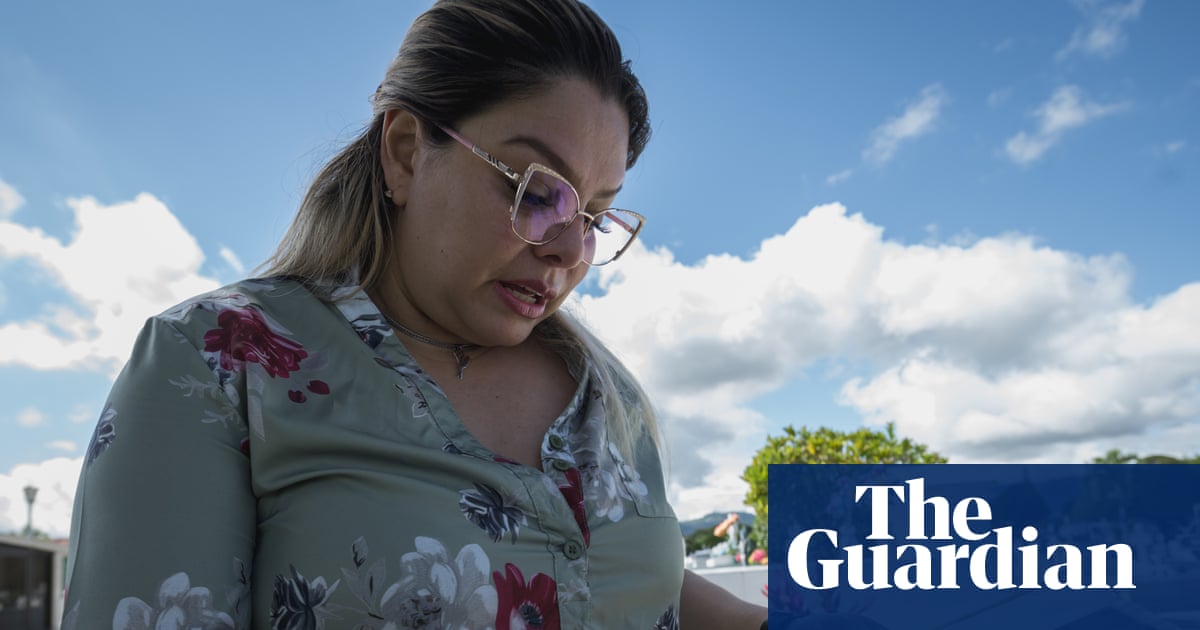
A few days before Christmas in Pérez Zeledón, a city in Costa Rica, Greidy Mata stared at two photographs of her late brother. In one image, Randall Gamboa Esquivel flashed a smile prior to his immigration to the United States a year before. In the second, he was lying in a hospital bed in a vegetative state, after being deported back home.
Dinner was served, but Mata seemed indifferent. She kept switching between one photograph and the other until she suddenly recounted that a year ago, in what would become the last family reunion, Gamboa announced he would be leaving for New Jersey.
He had previously lived undocumented in the US from 2002 to 2013. But the US was a different country now, his relatives had warned him. A Democratic administration was transitioning out of the White House after losing the2024 presidential election to Donald Trump, who promised to launch an immigration crackdown of unprecedented proportions.
But Gamboa was determined to seek work in the US, stay for a number of years, save some money and eventually return to Pérez Zeledón, his home town three hours south of the nation’s capital, San José, to buy a home, according to Mata. In December of 2024, Gamboa crossed the US-Mexico border but was swiftly detained by US immigration authorities for re-entering American soil unlawfully, which is considered a felony.
Gamboa was held at two different detention facilities in south Texas. Nearly 10 months later, in September 2025, the US government flew the 52-year-old back to Costa Rica on an air ambulance in a vegetative state and a few weeks later he died.
While Gamboa did not die in US custody, he was detained and deported during a time when the second Trump administration has aggressively expanded detention and deportation levels. US Immigration and Customs Enforcement (ICE) was holding more than 68,000 detainees last month, a record high for the agency, amid widespread complaints over conditions in detention and lack of official oversight.
Much of what happened to Gamboa over his last weeks in federal custody in Texas remains a mystery to his family, Mata said. When the US government flew him back to Costa Rica, he was non-responsive, as detailed in US medical records shared with the Guardian.
“When I saw my brother at the airport, I thought he had been tortured in some type of way because he was ill-nourished, had skin ulcers and dried blood on his body and had a strong odor,” Mata said in Spanish, pausing to take deep breaths.
“Have you ever smelled a cadaver? That’s how my brother smelled when he was deported,” she said.
The Guardian approached the Department of Homeland Security about Mata’s comment about torture but did not receive a response.
Mata said that Gamboa at first spoke frequently with various family members while in ICE custody. But communication stopped abruptly on 12 June. That would be the last conversation between Gamboa and his family, although they didn’t know it at the time.
Greidy Mata Esquivel. Photograph: Emi Kondo/The GuardianMata showed the Guardian a video recording of that last conversation. His firm voice and message still echo to his loved ones. “Family, how are you? I love you all very much. Blessings to everyone, I miss you all. Soon I will be out of here, with faith in God, everything is going to be OK. Bye,” the message said.
Gamboa looked cheerful and sounded optimistic. Then, as weeks went by and Mata didn’t receive any more calls, she grew worried and decided to contact the Costa Rican consulate in Houston, Texas.
In less than two weeks from that last call, Gamboa’s health evidently deteriorated. Medical records show that Gamboa was transferred from the Port Isabel detention facility to the Valley Baptist medical center in Harlingen, south Texas, on 23 June.
But relatives were in the dark. Mata said the Costa Rican consulate in Houston was able to get hold of ICE, and she said an unnamed consulate staffer told her that ICE had said Gamboa didn’t want to speak with his family. Mata added that in her opinion her government had been reluctant to intervene or seek answers from the US government about her brother.
Costa Rica’s Ministry of Foreign Affairs declined an interview request from the Guardian to discuss Gamboa’s case. It also didn’t answer a series of questions including whether any of their consular officers visited Gamboa during his hospitalization in Texas. The Guardian also requested an interview with Catalina Crespo-Sancho, the Costa Rican ambassador to the US, but her office did not respond.
Asked about Gamboa’s detention and plight, Tricia McLaughlin, assistant secretary at the Department of Homeland Security, the parent agency of ICE, said: “While in custody, medical professionals diagnosed him with unspecified psychosis and hospitalized him at Valley Baptist Hospital so he could get proper mental health and medical care.”
Greidy Mata Esquivel, sharing a photo of herself with her brother while he was in the hospital after arriving back in Costa Rica. Photograph: Emi Kondo/The GuardianMcLaughlin did not address questions about any communication between her agency and Costa Rican officials or Gamboa’s family regarding his health. The Guardian also asked DHS whether Gamboa had received other medical diagnoses while in custody and whether the agency had any records of him consenting to medical treatments. DHS did not respond to those inquiries.
On a recent December afternoon in San José, the Costa Rican capital, the Guardian met with Omar Guevara, who was detained in early 2025 by ICE after being pulled over on his way to work in Punta Gorda, in south-west Florida, where he was then living. He says he was stopped for speeding, and court records show he was held for driving without a valid license.
Guevara, a Nicaraguan-born man with Costa Rican citizenship, was transferred to several US detention facilities until he ended up in ICE’s Webb county detention facility in south Texas in May 2025.
There, Guevara met Gamboa.
On some of their recreational breaks, they spoke about San José, Pérez Zeledón, their families – missing them and gallo pinto, the Costa Rican rice-and-beans breakfast staple, Guevara said.
“The first time I met him, he looked like he had lost some weight on his face, but he walked and exercised a bit. The last I knew of him was that he had been taken to the hospital due to an infection,” said Guevara, 47, who was deported to Nicaragua last November.
“Then when I came back to Costa Rica, I saw the news about Randall and I was surprised to know that the authorities said he refused to speak with his family. I think that’s a lie because he spoke about how much he loved his family,” he said.
On 30 June, six days after he was admitted into Valley Baptist medical center, Gamboa was “seen resting comfortably, quietly in bed, with [an] immigration detention officer at bedside, and in no acute distress”, according to his medical records.
Psychiatric consultation notes from the hospital also said that Gamboa answered “in one, two word brief responses” and was “more likely to engage in conversation when spoken to in Spanish”. Gamboa had denied having suicidal ideation, homicidal thoughts or hallucinations, according to the medical notes.
Photos of Randall Gamboa showing his state in the hospital before he died. Photograph: Emi Kondo/The GuardianBut by 7 July, Gamboa had been diagnosed with at least 10 conditions, medical documents show, including sepsis.
Other conditions outlined in the records include protein malnutrition and toxic encephalopathy.
“A lawyer whom we asked for help located him and called us saying: ‘I found him in a bed, he follows you with his eyes, but can’t talk, he is in a vegetative state,’” Mata said.
According to the medical reports, a doctor who visited Gamboa on 2 August wrote: “The patient appears to be in a hospital catatonic state. He doesn’t move or respond.”
The Guardian recently also spoke with the lawyer whom the family tasked with finding Gamboa, Cathy Potter, whose law firm is based in Harlingen. She confirmed she visited Gamboa on 9 August.
“Me and my assistant, who spoke Spanish, tried to ask some questions, but he was incommunicative, there was no way there was going to be a [court] hearing. We went on with the removal proceedings and ICE took responsibility for paying for the air ambulance,” Potter said.
On 26 August, at an immigration court in Los Fresnos, Texas, the judge, Paul Hable, ordered Gamboa’s deportation to Costa Rica, according to a document seen by the Guardian.
Omer Badilla, the director of the Costa Rican government’s migration agency, said his office was notified that Gamboa was being deported, but didn’t receive any details regarding his health.
“I am convinced that the precarious conditions under which my brother was detained worsened his health – and no one will change my mind about that,” said Mata, speaking at her family’s home in Pérez Zeledón.
DHS’s McLaughlin has spoken of quality healthcare provided to all ICE detainees, including screenings, access to medical appointments and 24-hour emergency care.
Gamboa died on 26 October surrounded by his family at a hospital in Pérez Zeledón.
The cause of Gamboa’s death has not been disclosed yet. The Guardian reviewed his Costa Rican death certificate, on which the cause of death was left blank. The day he died, Mata received a note from the Costa Rican authorities that said: “The causes of death are still under investigation.”
Confusion remains, Mata said, as she walked in the cemetery where her older brother is buried.
A municipal cemetery in Pérez Zeledón, where Randall Gamboa is buried. Photograph: Emi Kondo/The Guardian“The forensic investigation into Mr Gamboa’s death requires the results of a series of related studies such as a histological study, a neuropathological study and a review and summary of the medical records associated with his hospitalization, all of which are currently under way,” said a spokesperson from the Judicial Investigation Department of Costa Rica.
The spokesperson said forensic investigations must be completed within 120 days of a body entering the morgue.
It was the brightest hour of the morning when Mata kneeled and said a prayer in front of Gamboa’s tombstone. She was accompanied by her son and aunt. In a cemetery that overlooked the Talamanca mountains and lush rainforests, silence felt heavy, almost unbearable.
Just then, Donald Sanchez, who has been a groundskeeper for more than two decades at the cemetery, approached. He had known Gamboa a little. Sanchez paid his condolences to the family and stressed that Gamboa had seemed happy and healthy when he last saw him shortly before he left for the US in December 2024.
“On the Day of the Dead [2 November], at least 100 people came to the cemetery and asked where Randall was [buried]. You could tell people loved him and that Pérez Zeledón was shaken by his death,” he said.
Sanchez added: “I once had a dream of going to the US, but after what happened to him, I don’t think so. And I know of others that wouldn’t either. It’s like there’s hate toward immigrants in the US.”