US sees surge in violence against journalists under Trump, report says
The United States has seen a dramatic increase in violence against journalists since Donald Trump again took office.
Most of the reporters and photographers who were allegedly attacked by law enforcement officials were covering protests over the Trump administration’s efforts to deport undocumented immigrants, according to the Freedom of the Press Foundation, a non-profit that tracks such incidents.
The US press have suffered about as many assaults this year as in the previous three years combined, the organization states in a new report.
That rise is largely because whenever there is significant civil unrest, journalists cover it, which makes them more vulnerable to attacks. But anti-media rhetoric from the US president and other public leaders has also increased hostility towards journalists, which can lead to more violence, according to press freedom advocates and journalism researchers.
Trump has repeatedly lambasted the mainstream US media, baselessly accused it of lying about him and his policies and repeatedly insulted several journalists in public.
“When the president models ridicule and delegitimization, it signals to supporters that journalists are fair targets,” said Lars Willnat, a Syracuse University professor who has studied the impact of political polarization on perceptions of journalists. “That shift matters because violence becomes easier to justify once journalists are seen as political combatants rather than neutral observers.”
In 2025, millions of people protested against what they saw as the administration’s authoritarian actions, including allegedly deporting people without due process.
Law enforcement ostensibly seeking to control crowds have instead sometimes indiscriminately used batons or fired at journalists, even though it was obvious they were there to document the events, according to reporters who have been struck.
The foundation has reported 170 assaults against journalists – most of which occurred at protests concerning the administration’s immigration policies – this year before 16 December. From 2022 to 2024, there were a total of 175 assaults.
The foundation states that it only reports “incidents that can be verified by first-person accounts or cross-referenced by multiple news sources”.
During “Operation Midway Blitz”, an immigration crackdown in the Chicago area, journalists were assaulted 34 times over six weeks outside a detention facility in Broadview, Illinois, according to the foundation.
While it is, of course, Trump behind the deportations, journalists’ treatment at protests cannot necessarily be connected to the president’s words, the press advocates say.
The foundation launched an incident tracker in large part because of journalists who were arrested and assaulted during 2014 protests in Ferguson, Missouri, said Stephanie Sugars, a senior reporter with the foundation who authored the recent report; Barack Obama was then the president.
“We have routinely found” since the tracker launched in 2017 “that protests are the most dangerous place for journalists in the US”, Sugars said.
While Trump has called journalists the “enemy of the people”, it’s hard to determine whether there is a “direct line of causation” between his rhetoric and the uptick in assaults, Sugars said.
“Trump does not have personal control over every police department,” Sugars said.
Still, the “policies and rhetoric of both him and his administration … reflect that hostility towards the press as well and could be seen as condoning other aggressions”, Sugars said.
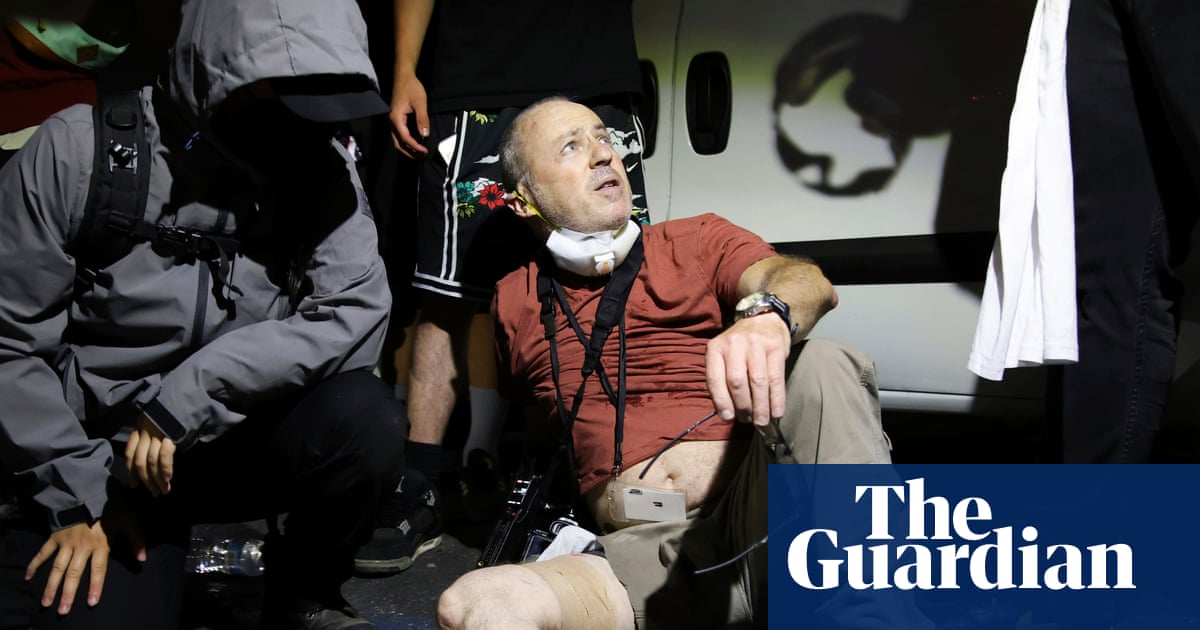
Nick Stern, a Los Angeles photographer, suffered serious injuries twice this year because of law enforcement attacks, he said.
He was covering a protest against Immigration and Customs Enforcement (ICE) on 7 June in Compton when an officer allegedly fired an explosive device that landed near him, even though he was 40ft (12 meters) away from a barricade, wearing a press badge and holding a camera, a lawsuit states. A casing entered his thigh, and he needed emergency surgery and was hospitalized for four days, Stern said.
“It was completely unjustified,” he said.
After a couple months off because he had difficulty walking, he returned to cover an anti-ICE protest outside a detention center in Los Angeles. An officer struck him in the face with a baton even though he showed him his press ID, Stern said.
He has filed lawsuits against the Los Angeles police department and Los Angeles county sheriff’s department over the first incident and plans to file one against the sheriff’s department concerning the second one. (His attorney’s office stated that they did not know the identity of the shooter in the first incident but that officers from both departments were there, so they filed lawsuits against both.)
Asked about the June incident, an LAPD spokesperson referred to a news release stating that the department would be “investigating allegations of excessive force”. A sheriff’s department spokesperson shared a statement from June that it was still reviewing video footage of the incident to determine whether the use of force was reasonable. The spokesperson said the department did not have a statement about the August incident.
Raven Geary, a Chicago journalist, was covering a September protest outside the Broadview detention facility when an ICE officer fired a pepper ball that struck her face.
Geary was wearing a press pass but “a lot of the agents had been seeing us as press for weeks … so they definitely knew that they were shooting at journalists”, she said.
Geary, fellow reporters, journalism organizations and protesters filed a class-action lawsuit against ICE and the Department of Homeland Security, among others, claiming the defendants violated their first amendment rights to gather news – and in the cases of the activists, to peacefully protest – and fourth amendment rights against excessive force.
In October, a federal judge issued a temporary restraining order prohibiting the defendants from “using physical force against” anyone they “reasonably should know is a” journalist unless they have probable cause to determine they committed a crime.
The defendants claimed that “the Chicagoland area is in a vise hold of violence … which justifies the unprecedented swath of indiscriminate uses of force unleashed on journalists”, the judge stated in a later opinion. “That narrative simply is untrue.”
The defendants appealed the ruling.
Despite his injuries – and the fact that at age 61, he says, he is “too old for this [stuff]” – Stern continues to cover protests.
“We’ll look back at this as a time when the US went through such turmoil,” Stern said. “It needs to be documented.”