Alexander Hamilton
Americans are known for our impatience. As a nation, we have always lived in the future, not the past. However, sometimes that impatience can overreach and mistake motion for wisdom. Yet even then it reflects something deeply rooted in our national character: a belief that we are the masters of our own destiny. The future is not simply inherited from circumstance; it is something we are responsible for shaping.
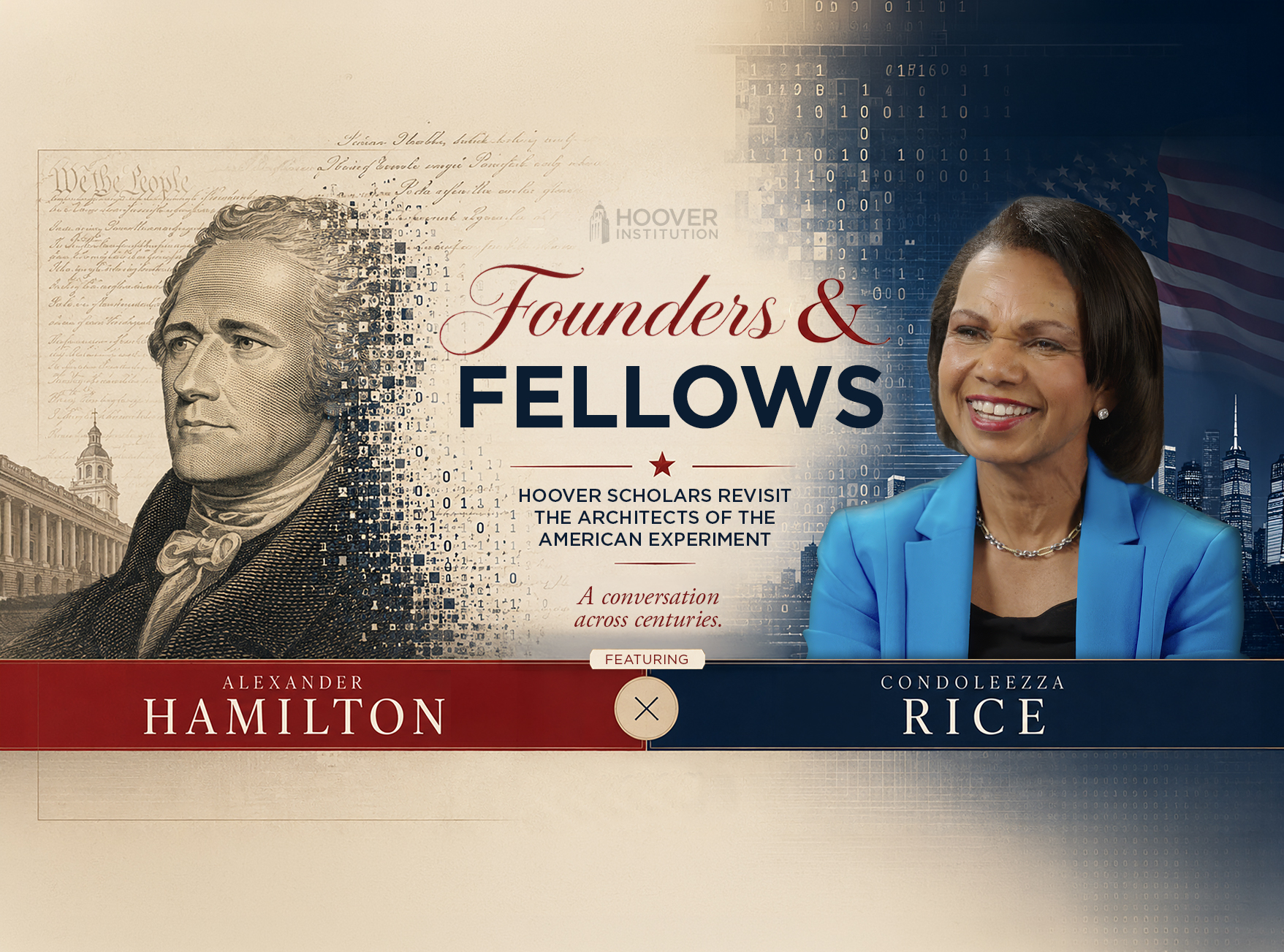
This essay is part of Founders & Fellows, a series in which Hoover scholars explore the enduring relevance of the Founding Era and examine how the principles that animated the nation’s creation continue to inform contemporary policy challenges.
When I think about that instinct in our founding, I find myself returning again and again to Alexander Hamilton.
Hamilton is not an uncomplicated figure. While he was admired for his brilliance, his peers also found him to be arrogant, stubborn, and excessively combative. Even now, he provokes arguments about power, finance, democracy, ambition, and the role of government itself. He wrote with urgency because he believed our young republic stood much closer to failure than many of his contemporaries cared to admit.
In Federalist, no. 70, Hamilton argued for what he called “energy in the executive.” By today’s standards, that might sound troubling, but he meant something very practical by it. A government responsible for protecting the country had to be capable of decisive action. Delay could carry consequences of its own. Confusion could become vulnerability.
Hamilton understood instability in his personal life long before he understood it politically. He was born in the Caribbean, without the advantages that defined status in his time. He was an orphan, an immigrant, and decidedly not part of the American elite. Like many today, he entered American life without inherited standing and without the assumption that doors would open for him. But he moved forward anyway. That experience shaped him, and there is a sharpness in his writing that reflects it. He did not take order for granted, because he had seen how easily it could disappear.
His upbringing shaped the way he thought about national life, too. Hamilton distrusted fragility. He distrusted systems held together by sentiment alone. He wanted something more durable. He knew America would need structures that could withstand conflict, uncertainty, and human weakness. The financial system he built was an attempt to create permanence.
His determination to build durable institutions remains tangible even today. Anyone who has ever envisioned stepping into the shoes of their predecessors—even more than two centuries later—can appreciate what the founders achieved. We know that the democratic experiment, while less fragile today than in those times, remains a work in progress. It requires a daily commitment to solving difficult problems while remaining mindful of the principles and values that have sustained us.
Whenever I walk through the halls of the Treasury and pass the statue and portraits of Hamilton, I can feel his presence. I can say the same when I encounter the images of my predecessor at State, Thomas Jefferson.
Those two founders—Jefferson and Hamilton—often sparred over the future of the country. Their differing views about how best to shape America are still reflected in our enduring debates about executive authority, democratic governance, and the limits of political power. Yet whatever their disagreements, they shared a belief that this radical experiment of self-governance through institutions, embodied most importantly in the Constitution, could work.
We sometimes forget how uncertain the success of the United States actually was. We speak of the founding as though the outcome were inevitable. But it wasn’t. At that time, the early republic carried enormous debt, regional loyalties remained stronger than national ones in many places, and foreign powers expected the experiment to fail. Hamilton saw those dangers clearly, and he responded by trying to bind the country together through institutions strong enough to survive political disagreement.
He believed that credibility mattered, that public credit and economic strength mattered. Those ideas were sometimes dismissed as overly administrative, but Hamilton understood something essential: Nations that cannot sustain financial confidence eventually lose strategic confidence as well. Power rests partly on whether others believe you are capable of keeping your commitments.
That insight has not faded with time. The modern world still punishes weakness. It still tests whether democratic governments can move with clarity and discipline to meet events as they unfold. Hamilton would have recognized many of our current challenges and frustrations. We live again in a moment where confidence in our institutions feels strained.
Like the complexities of our founding, Hamilton’s strengths had limitations of their own. He worried deeply about political volatility and moments when public judgment might shift too quickly. He did not trust the breadth of democratic participation as we understand it today.
American history would ultimately move well beyond his assumptions, though not often smoothly. The country expanded politically, socially, and culturally in ways Hamilton could never have envisioned. More and more Americans claimed ownership of the constitutional system he helped construct. As the definition of citizenship widened, so did the reach of political participation. What is remarkable is that the structure itself proved flexible enough to absorb those changes. Imperfectly, sometimes under extraordinary strain, and with many ugly scars as a result, it endured.
The balance between order and liberty has never been, and will never be, settled in American life. Every generation revisits it under new conditions. That tension is part of Hamilton’s relevance. At the Hoover Institution, scholars often return to the founding for this reason. The past is useful not because it provides easy answers. It is useful because it sharpens the questions.
Hamilton belongs in that process, not just as a symbol but as a mind that still challenges our assumptions. He forces us to confront the uncomfortable truth that good intentions do not govern a country. Structures govern a country. Incentives govern a country. The durability of institutions matters, because moments of crisis arrive for every nation, whether expected or not.
Alexander Hamilton never doubted that such moments would come, and he wrote as a man determined to prepare us for them. I am grateful to all of the founders for their devotion to liberty—even if I find Hamilton a little more complex, just like the America that he loved.
Condoleezza Rice is the Tad and Dianne Taube Director of the Hoover Institution and the Thomas and Barbara Stephenson Senior Fellow on Public Policy. She is also the Denning Professor in Global Business and the Economy at Stanford University’s Graduate School of Business. She served as the nation’s sixty-sixth secretary of state.