ICE Breaks Daily Arrest Record in South Texas
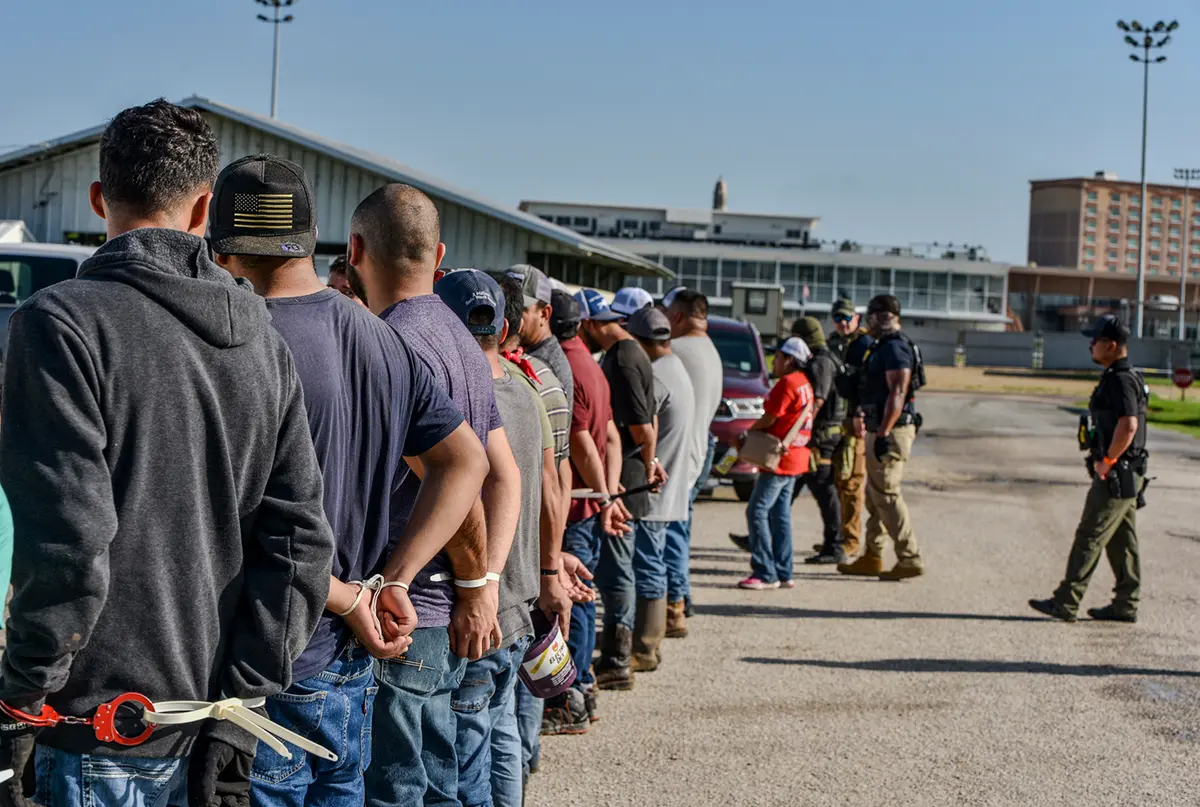 ICE arrested more than 80 illegal aliens during worksite enforcement operation at Louisiana racetrack in 2025. Courtesy of DHS
The Immigration and Customs Enforcement’s (ICE) Harlingen field office in Texas arrested 238 illegal immigrants on June 18, setting a record for single-day targeted arrests for the division.
The office, located in the Rio Grande Valley, oversees the South Texas region. The individuals were arrested as part of an operation aimed at removing criminal illegal immigrants from communities to increase public safety, ICE said in a July 14 statement. The agency conducted the operation in partnership with local, state, and federal law enforcement officials.
Among the arrested are a criminal illegal immigrant from Mexico convicted of sexual battery and attempted kidnapping, another Mexican national convicted of possessing marijuana with the intent to distribute the substance, and a Mexican criminal alleged to be a Paisas gang member with convictions for assault and possessing a controlled substance.
Paisas is a criminal group with ties to Mexico’s Gulf Cartel, a designated Foreign Terrorist Organization.
The arrested individuals stand to face additional criminal charges for illegally reentering the United States.
ICE reiterated that it was focused on arresting and removing illegal immigrants from the country, especially those with criminal records, consistent with the mandate set out by President Donald Trump.
Related Stories

“The ICE mission continues to focus on enhancing public safety and restoring integrity to our nation’s immigration system,” ICE Harlingen Field Office Director Juan Agudelo said in a statement.
On June 22, ICE said its Houston office arrested 735 criminal illegal immigrants in May, collectively accounting for 1,711 criminal convictions.
This included 625 individuals convicted for at least one criminal offense that harmed, killed, or put innocent people at risk. Twenty-five were members or associates of various transnational and prison gangs, including MS-13.
Among the arrested were those accused of murder, rape, arson, child predation, and drug trafficking.
“The public needs to know that the aliens we’re targeting aren’t the harmless economic migrants that the mainstream media and elected officials try to portray,” ICE Enforcement and Removal Operations acting Field Office Director Gabriel Martinez said in a statement.
“These are violent criminals who repeatedly violate our laws and there’s no doubt if we don’t arrest and deport them from the U.S., they will continue to commit crimes and more Americans will become victimized as a result.”
In a July 14 statement, Lauren Bis, acting assistant secretary of the Department of Homeland Security’s Office of Public Affairs, said ICE was arresting and removing the “worst of the worst” from American communities, risking their lives to apprehend them, and that nearly 70 percent of ICE arrests involve illegal aliens charged or convicted of a crime in the country.
Deporting Illegal Immigrant CriminalsIn March last year, the Deport Alien Gang Members Act was introduced, which seeks to make U.S. citizens linked to criminal gangs inadmissible to the United States. Such individuals already in the country would be deemed deportable.On June 2, the U.S. Conference of Catholic Bishops sent a letter to House Judiciary Committee Chairman Rep. Jim Jordan (R-Ohio) and ranking member Rep. Jamie Raskin (D-Md.), raising concerns over the Act.
“The bill in no way accounts for those forced to engage in covered activities under duress, creating conflicts with existing law, even as criminal enterprises frequently rely on such tactics to exploit vulnerable persons,” the group said.
“For this reason, we are especially concerned about the lack of safeguards in the bill for minors and victims of human trafficking.”
On June 3, the House Committee on the Judiciary passed the Act, with the bill going to the House floor for a vote, according to a statement from the office of Rep. Tom McClintock (R-Calif.), who authored the legislation.
According to the statement, the bill plugs loopholes that have allowed gang members to secure immigration benefits never intended for criminals.
“Under this legislation, gang members would be ineligible for asylum, temporary protected status, special immigrant juvenile status, and various other forms of immigration relief,” the statement said.
“These humanitarian protections were created to assist vulnerable individuals fleeing persecution or hardship; not to provide safe haven for members of organized criminal enterprises.”
We had a problem loading this article. Please enable javascript or use a different browser. If the issue persists, please visit our help center.