House Republicans Say ABA Is Pushing DEI on Law Schools
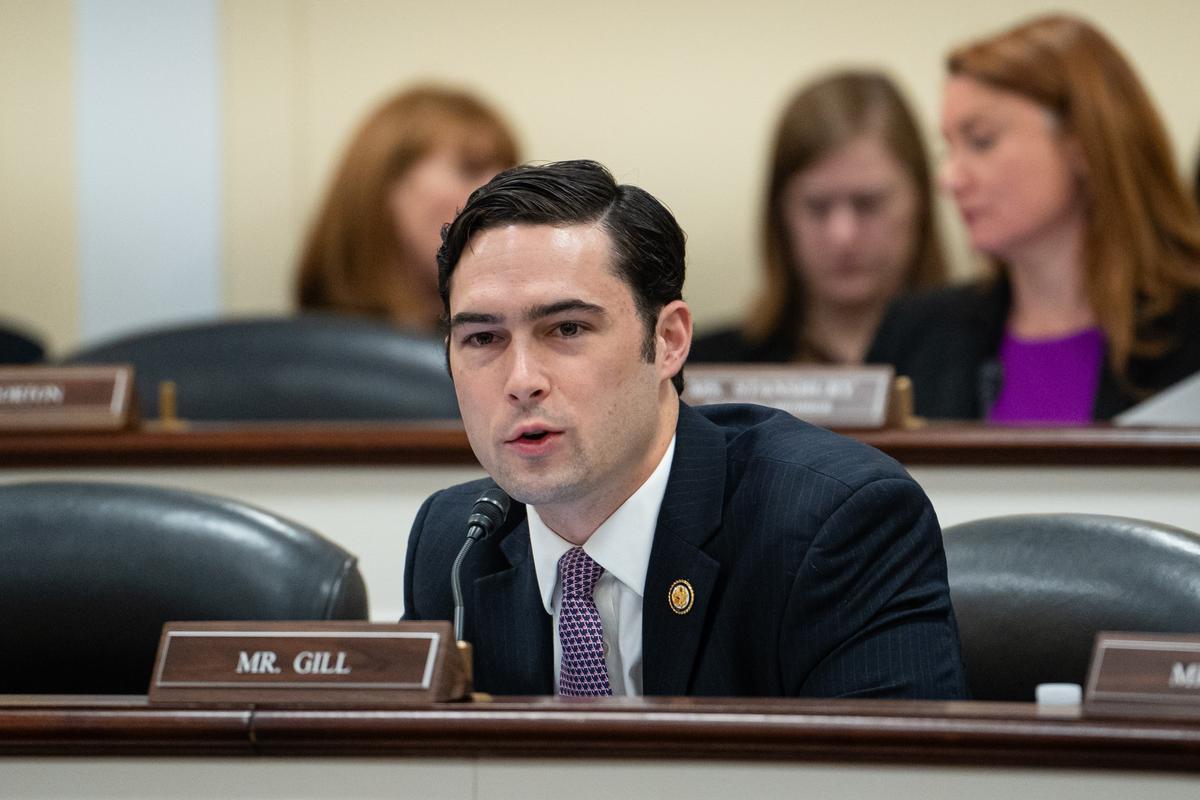 Rep. Brandon Gill (R-Texas) speaks at the Subcommittee on Delivering on Government Efficiency (DOGE) hearing in Washington on Feb. 12, 2025. Madalina Vasiliu/The Epoch Times
Republicans on a congressional task force accused the American Bar Association (ABA) of using its role as the nation’s sole law school accreditor to impose allegedly discriminatory diversity, equity, and inclusion (DEI) policies.
Their statements were aired at a public meeting of the House Oversight Committee’s Task Force on Defending Constitutional Rights and Exposing Institutional Abuse on July 22 regarding the ABA’s role in accrediting law schools
The hearing came after President Donald Trump signed an executive order in April 2025 aimed at reforming higher education, saying the ABA promoted “unlawful ‘diversity, equity, and inclusion’ requirements.” The order directed the U.S. Department of Education to evaluate whether the ABA should be suspended or terminated as the government’s law school accreditor. The department has not yet released its recommendations.
The ABA is currently considering repealing standards that require law schools to educate students about racism, bias, and so-called cross-cultural competency. Cross-cultural competency can be defined as the ability to understand, communicate with, and interact appropriately with individuals from different cultural backgrounds.
In 2022, the association began requiring law schools to conduct bias training when students enter law school and again when they are about to graduate. An internal memo said the standard has not “effectively achieved its purpose.” Supporters defend the anti-bias training as useful for students.
The ABA is the foremost accreditor for U.S. law schools and establishes formal standards that most states tie to bar eligibility. A law school accreditor sets minimum quality standards for law schools so that graduates are properly trained and prepared to take the bar exam in most states. Accreditation advocates say without accreditation, a law school’s degrees lose credibility, and its graduates may have difficulty becoming licensed as attorneys.
Related Stories

ABA standards nowadays typically include DEI-related requirements, which supporters say promote fairness and social cohesion. Critics say they promote illegal racial preferences in school admissions, curricula, and hiring.
Republicans on the panel say the ABA has employed its accreditation power to force DEI policies that they say violate equal protection principles and federal civil rights laws. They say this has led to discrimination against merit-based applicants, diminished academic standards, and promoted ideological conformity in legal education.
Democrats and other critics say ABA policy rollbacks on DEI would set back diversity in the legal profession, which they argue remains disproportionately white and male compared to the general population of the United States.
The chairman of the task force, Rep. Brandon Gill (R-Texas), said at the hearing that the ABA, which has been “ideologically captured by radical leftists, has continuously pursued discriminatory DEI practices.”
The ABA has required law schools to consider race as a factor in student admissions, he said.
Gill said the ABA implemented its Standard 206, which requires law schools to take action to advance diversity and inclusion in recruitment, admissions, student programming, and hiring regarding gender, race, and ethnicity.
“The implementing guidance for Standard 206 says that even if those DEI practices are illegal under a constitutional provision or statute, that illegality is ‘not a justification for a school’s noncompliance with Standard 206,’” he said.
Even after the Supreme Court found in 2023 that race-based college admission policies violate the 14th Amendment, the ABA “doubled down and told law schools it would continue to enforce its DEI standards in the accreditation process,” he said.Through Standard 206, the ABA “used its institutional power to bully law schools to also require mandatory DEI-related courses in addition to instituting race-based policies in admissions,” Gill said.
Only after Trump took executive action and “threatened the ABA’s accreditation monopoly” at the federal level, did the ABA “begrudgingly” begin considering repealing its DEI requirements, he said.
Standard 206 was temporarily suspended in February 2025, and under pressure from the Trump administration and Republican-led states, the ABA Council voted to repeal the standard in May 2026. If the ABA House of Delegates concurs—the consideration process may take months—the standard will be deemed repealed. That body is expected to meet in August.
Rep. Lateefah Simon (D-Calif.) said the task force’s efforts were misplaced.
The panel is focusing on DEI even though “last year, fewer than one in 10,000 Americans applied to an ABA-accredited law school,” and “10 million Americans will lose their health insurance” because of “the deepest cuts in Medicaid in our nation’s history.”
The task force is aiming “to collect a political debt for the president,” she said.
The diversity standard examined today “was a part of the ABA’s effort to reckon” with historical injustices in the country, she said.
The Constitution is “endangered … when oversight becomes retaliation, and when Congress mistakes grievance for governance,” Simon said.
ABA President Michelle Behnke told the hearing that “diversity and excellence are not mutually exclusive.”
DEI initiatives “enhance merit within the legal profession,” and help lawyers to “tap into the varied experiences and perspectives of people from every background and every community,” she said.
Although the country has made progress, “women, lawyers of color, and other groups remain drastically under-represented in the American legal community,” Behnke said.
Under questioning from Gill, Behnke defended DEI policies.
Gill asked whether race should play a role in law school admissions, pressing Behnke to provide a yes or no answer.
Instead, Behnke said the ABA wasn’t directly responsible for admissions decisions and affirmed the group’s longstanding support for diversity programs.
She added that the ABA does not support policies that the Supreme Court has determined to be illegal.
Reuters contributed to this report.We had a problem loading this article. Please enable javascript or use a different browser. If the issue persists, please visit our help center.