Young Americans Are Turning Antisemitic
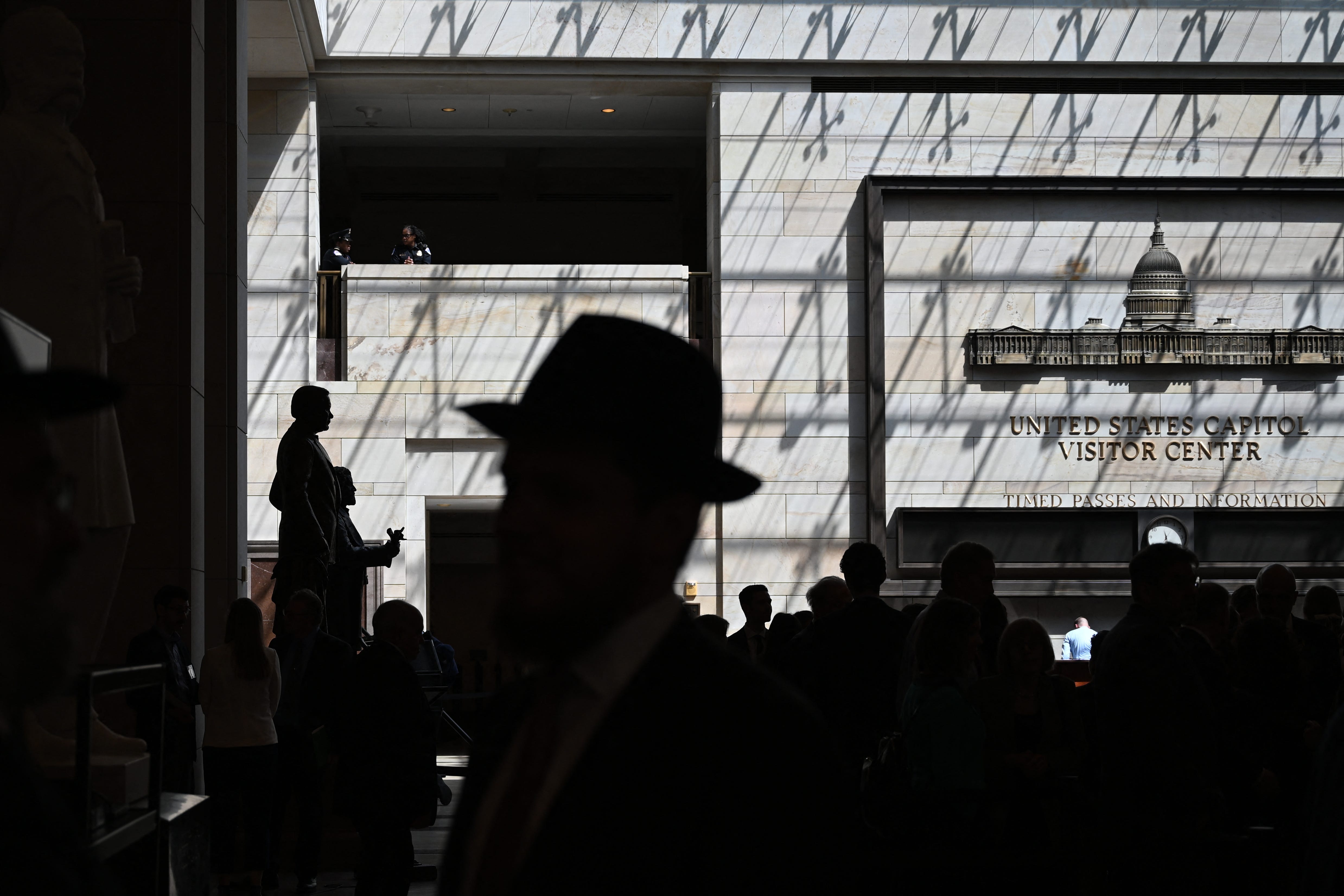 Visitors and guests attend the National Commemoration of the Days of Remembrance at the U.S. Capitol, hosted by the Holocaust Memorial Museum in Washington, D.C., April 23, 2025. (Photo by Alex Wroblewski/AFP via Getty Images)
SATURDAY’S DEVASTATING ARSON ATTACK on the only synagogue in Jackson, Mississippi, has been the latest in a string of reports that highlight the depressing extent to which antisemitism is now in the news. Last week, a pro-Palestinian rally outside a synagogue in Queens, New York that included chants of “We support Hamas here” was condemned as “disgusting and antisemitic” by Alexandria Ocasio-Cortez, the generally pro-Palestinian New York congresswoman. And in the wake of protester Renee Good’s fatal shooting by an ICE agent in Minnesota, the leading online fundraiser for the agent featured text blaming “anti-American traitors like Minneapolis mayor Jacob Frey (who is Jewish)” for inciting conflict. (Later, the parenthetical was deleted.)
There has been plenty of acrimonious debate on whether antisemitism is really on the rise, whether it’s a bigger problem on the right or the left, and when anti-Israel animus turns into antisemitism. A mostly overlooked survey released in late December tackles these questions—and suggests some complicated and disturbing answers.
The survey, from the Yale Youth Poll, drew on a national sample of nearly 3,500 registered voters with an oversampling of those under 35 and contained a battery of questions that tried to tease out negative attitudes toward Israel and negative attitudes toward the American Jewish community.
One stark fact that emerges from this poll is that there has been a generational shift in a direction that has been both anti-Israel and anti-Jewish.
For instance: Only 24 percent of respondents 18 to 22 (and fewer than 30 percent of all respondents under 45) said that Israel should exist as a Jewish state—compared to 47 percent of those 45 to 64 and nearly two-thirds of those 65 and older. What’s more, 15 percent of those under 30 thought that Israel shouldn’t exist at all, a fringe view for those 45 and older. About a third in the younger age groups picked “not sure.”
These numbers also closely track the age breakdown on the question of whether “the American Jewish community has a positive or negative impact on the United States”:
Moreover, about 40 percent of voters under 30 (compared to about 26 percent of those aged 45 and up) agreed with at least one of three statements the poll used to measure antisemitism: “Jews in the United States are more loyal to Israel than to America”; “It’s appropriate to boycott Jewish American-owned businesses to protest the war in Gaza”, and “Jews in the United States have too much power.” More than 20 percent in the under-30 group agreed with two of those statements; only about 10 percent of those over 45 did.
And younger voters were far more accepting of actions that target American Jews in response to Israeli policies. Thus, 22 percent of those under 35 said that it was not antisemitic to bar a Jewish student with pro-Israel views from a theater group, compared to 11 percent across all age groups. And 26 percent of those under 35, compared to 16 percent of those of all ages, felt it was not antisemitic to boycott “Jewish American-owned businesses” to protest the war in Gaza.
The published survey results do not make clear exactly how much the hostility toward Israel correlates with hostility toward the American Jewish community, but it’s clear that some correlation is there.
Why the generation gap? As Atlantic writer Yair Rosenberg points out, “In the 20th century, the Holocaust and World War II profoundly and positively reshaped American attitudes toward Jews, but young people today have no first- or secondhand memory of that experience.” Younger people, Rosenberg notes, are also more likely to get their information from nontraditional media with few or no gatekeepers and far more leeway for racist material. (Some blame must be laid at the door of the educational system as well.) Granted, some of the shift toward negative views of Israel—such as the belief that Zionism is about building “a nation-state where Jews get more rights than others,” also far more prevalent with young voters—may be related to that country’s shift in a more hardcore nationalist direction, including the controversial 2019 “nation-state law” which has been widely criticized, even by many Israelis and Zionists, as a step back from equality. But that doesn’t explain the simultaneous growth in anti-Jewish feeling.
What about antisemitism’s political profile? For the overall sample, the survey found no consistent ideological or partisan split in agreement with antisemitic statements. (Predictably, conservatives and Republicans were far more supportive of aid to Israel than liberals and Democrats.) But the picture was quite different for young adults. For those under 35, conservatives were distinctly more likely than liberals or moderates to agree with one or more of the antisemitic statements presented to respondents. In the self-identified “extremely conservative” group, the results were genuinely shocking—though probably not to those closely watching these trends. Nearly two-thirds agreed with at least one antisemitic statement; nearly half agreed with two.
Does this get the left off the hook? Certainly not. (Rep. Ocasio-Cortez’s post condemning the pro-Hamas synagogue protest was attacked by popular progressive streamer Hasan Piker, whose hateful language about Jews has drawn fire before.) But the right has a serious problem, in case that wasn’t obvious from the recent leaks of racist chats among Young Republican activists. The Mississippi arson suspect, a 19-year-old Christian who ran a “scripture-based fitness” website and referred to Beth Israel as a “synagogue of Satan”—a phrase that some note has been popularized by Candace Owens—seems to fit the far-right profile as well.
Meanwhile, Donald Trump meekly disavows antisemites in MAGA ranks without naming any names, just a couple of days after the latest White House visit by increasingly uncloseted Jew-hater Tucker Carlson; Vice President JD Vance attacks those who would “deplatform” antisemites; and Megyn Kelly is the latest MAGA pundit just asking questions about whether the Jews killed Charlie Kirk.
Instead of looking in the mirror, some right-wing influencers used the Yale Youth Poll to go after their favorite target—“migration from the Third World”—because the poll showed that nonwhite respondents were generally less supportive of the idea of Israel as a Jewish state. (Nonwhites were also more likely than whites to agree with at least one antisemitic statement, though the racial differences for young adults were negligible.) And a few, including a Texas GOP official, used this finding to suggest that Jews were paying the price for promoting such immigration.
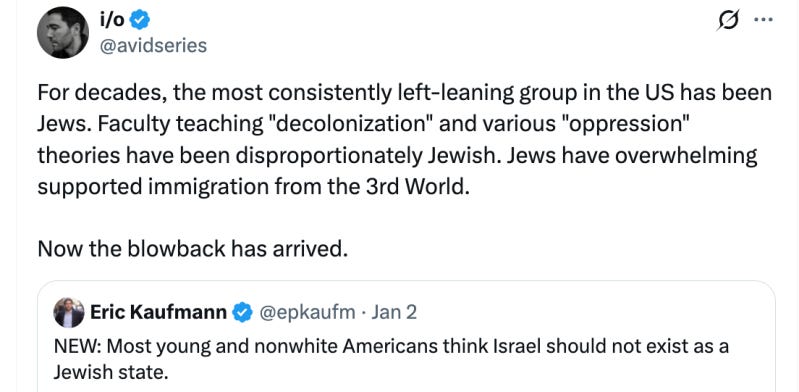
Using a survey on antisemitism to promote an antisemitic trope and blame antisemitism on Jews themselves: I think the word for that is chutzpah.