The Freedom Caucus Is Cooked
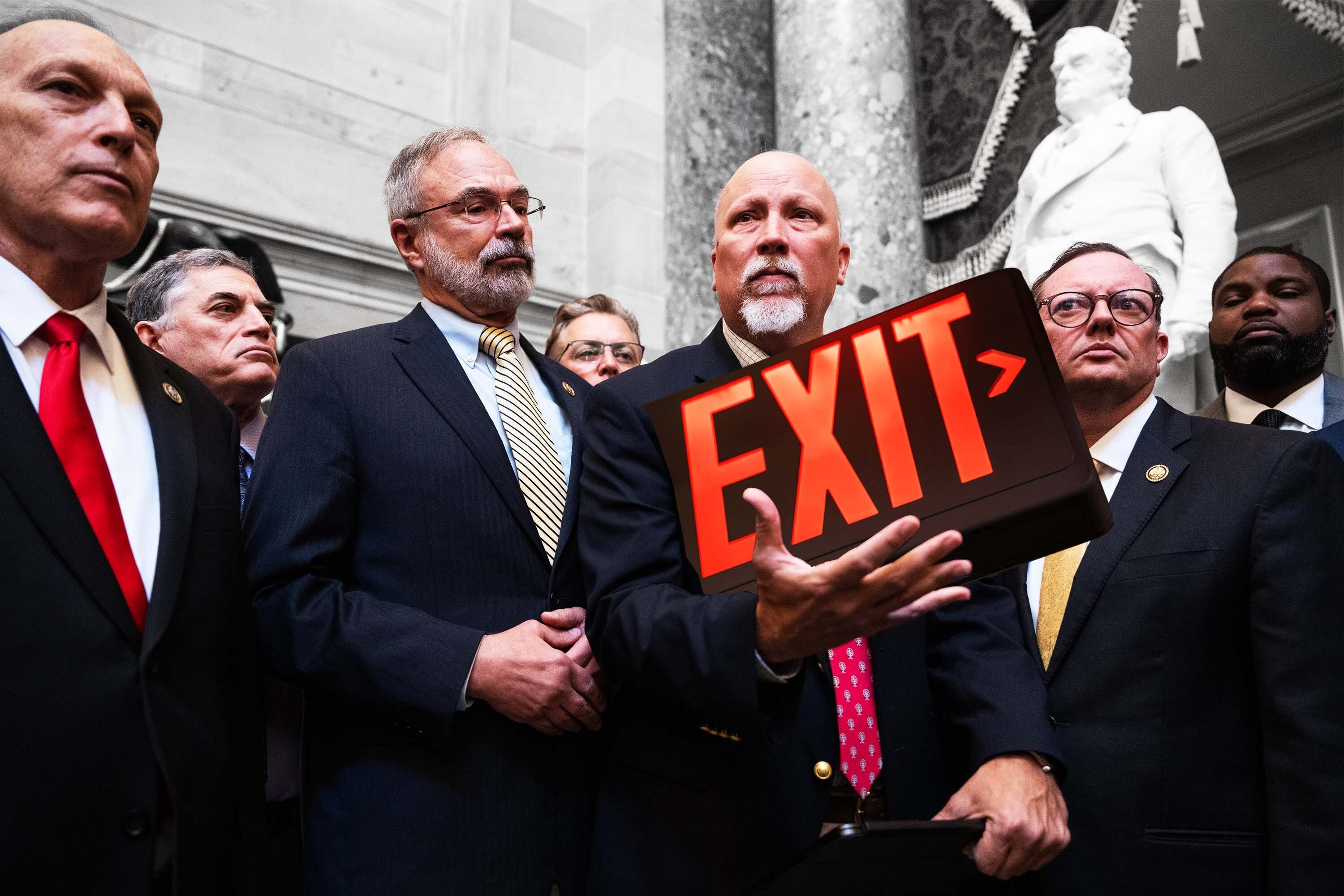 (Photo illustration by The Bulwark / Photos: Getty, Shutterstock)
The House Freedom Caucus, a group of former congressional rebels who have over the past few years evolved into Trump lackeys, is on the verge of total irrelevance. In a scenario where House Republicans become the minority, the caucus will lose whatever semblance of leverage it has, and current members know it; half a dozen of them will be leaving Congress at the end of the year.
Founded in early 2015, the caucus has routinely disrupted regular business by noisily complaining that their leaders made too many concessions before eventually committing to support must-pass legislation. They have had some impact along the way. Its most rogue members took down a speaker of the House. And during Donald Trump’s second term as president, Freedom Caucus members played a pivotal role in forcing the release of the government’s Jeffrey Epstein files by way of a discharge petition.
But these displays of power and rebellion have largely been isolated incidents, and they have become more isolated over time.
A quick refresher:
I could list many more examples, but there would not be enough space left over for this newsletter to be about anything else. The group’s recent squishiness is owed to the fact that Trump can easily work them over with a White House visit or a phone call. And it has prompted a running joke in the Capitol Hill press corps that they’d be better described as the House Folding Caucus.
The self-neutering has been remarkable. The entirety of the caucus’s power comes from its ability to stall important votes on must-pass legislation, knowing that party leadership needs them to be brought on side for that legislation to pass out of the chamber. Under Trump, they’ve surrendered that influence. In the event of a Democratic wave election, they will lose it completely.
“I think if we do lose the House, obviously, everybody in the conference—not just Freedom Caucus—loses leverage,” Rep. Eli Crane (R-Ariz.) told me. “But the joke within the Freedom Caucus is that when we’re in the minority, everybody becomes Freedom Caucus. Because everybody votes ‘no’ on everything.”
Crane’s view of the landscape is one shared by other HFC members. Far from reassessing how they’ve bungled things while in the majority, many wax whimsical about life in the minority.
“One thing I think we’ve always tried to do is make sure that the newer, younger men and women get mentored,” Rep. Andy Biggs (R-Ariz.), who’s running for governor, told me Monday. “I don’t think you’re gonna have a big hiccup.”
Rep. Jim Jordan (R-Ohio), a former HFC chairman who is well positioned to run for minority leader in a Democratic-controlled House, told me he didn’t think Republicans would lose the House this cycle. But if they did, he added, it could do wonders for the HFC ranks. “When they did [lose the House] back in 2018, you saw the Freedom Caucus—saw a number of us—who were really engaged on the weaponization of government and all the oversight work we did.”
It goes without saying that HFC members have the ability to engage in oversight right now, too. In fact, they have more power—since the majority party on the oversight committees can set committee agendas and issue subpoenas. But what Jordan was getting at is actually something core to the HFC experience: power doesn’t come from acts of Congress, it comes from political messaging.
“In the minority, you’re trying to craft a message and push back on all the crazy policies that the Democrats—or the left—are trying to do,” he said. “I think that’s the key element in this campaign . . . pointing out all the crazy positions they have, and we’re for the common-sense position.”
But if being in the minority may seem liberating, many Freedom Caucus members aren’t sticking around for it. Instead, they’re heading for the exits. So far, at least six members—and four former members who’ve already left the group—are not seeking re-election. In addition, one member and one former member resigned during the 119th Congress. There are currently 32 HFC members at this moment, well below the high of 45 it had in 2022.
Asked whether they view this exodus as more a result of the group’s declining record of accomplishments or a happy graduation to better endeavors, the Freedom Caucus members I chatted with didn’t sound very chippy.
“I prefer to think of it as seeding out,” Biggs said. “People are going on to other ways to serve and go home. And I’m also a big believer that much more than ten years here is really not the ideal.”
“It is interesting that we have so many guys running for governor, attorney general, we got one guy running for Senate,” Crane told me. “It’s kinda cool to see as a new guy—you definitely feel like you’re losing a lot of talent and experience. So it’s kind of that next-man-up mentality.”
The Freedom Caucus will most likely spend at least the next two years—possibly longer—in obscurity. That may just be what they want. Or it may just be a just outcome for their behavior.
The Los Angeles mayoral primary is moving to a runoff between the Democratic incumbent and a progressive challenger, and because a very-online conservative upstart candidate failed to make the cut, conservatives are once again claiming without evidence that the election was corrupted by fraud. President Donald Trump, House Speaker Mike Johnson, an online chorus of DMV-based political operatives, and many others across MAGA world seem incapable of imagining that Spencer Pratt, a technically nonpartisan but MAGA-coded reality TV heel, could lose to Democrats in a city in which Democrats regularly defeat Republicans by more than 30 points.
While exiting the Capitol Monday night, I caught up with Rep. Darrell Issa (R-Calif.), a conservative who’s represented Southern California off and on for the last quarter of a century. I asked him whether he bought into the theory that L.A. was rigging its election to make incumbent Mayor Karen Bass face a more difficult re-election fight against a liberal challenger than she would have had against Pratt.
“I mean, they kept counting until they won,” Issa said. “What’s new about that? We have a corrupt system. They mail ballots to people who are dead, people who have moved, and then they count them endlessly. The system is inherently flawed in California.”
“It doesn’t mean that the outcome would’ve been the same or different,” Issa added. “We won’t know that. But what we do know is that we’re the only state in the union that will still be counting—that we don’t have an election day, we have an election month.”
Issa’s comments are slippery. He repeated virtually every conspiratorial Republican talking point about fraudulent elections with the caveat that the outcome probably wouldn’t have changed if the state’s election system were set up differently. Perhaps he wants to keep relations decent with some folks in his state’s political establishment while not being totally ostracized from Trump land. Or perhaps he just knows there aren’t contingents of shy MAGA voters in Los Feliz or Silver Lake.
Outside the Capitol Monday night, Sen. Adam Schiff (D-Calif.) said that the president’s claims of a rigged election were both “disgraceful” and nothing new.
“This is just palpable falsehoods—lies—about California elections,” Schiff said. “[Trump] understands that, but he is still willing to denigrate the California election system to try to cast doubt on it, to try to inflame the public, maybe set the pretext to intervene in the midterms if the vote is not going his way.”
However, Schiff added that California needs to figure out a swifter method for counting ballots to instill confidence in its process and tamp down on the fraud conspiracies.
“Everyone understands how the California voting system works. We vote by mail,” Schiff said. “It takes a long time to count the ballots and yes, we can improve the speed and we should address that and address resources to improve how quickly we process the ballots. But there’s no evidence of the kind of fraud the Republicans [are claiming].”
Something tells me that nothing the state does will ever be enough to satisfy its critics on the right.
The United States Constitution prohibits titles of nobility for Americans. Still, some Yanks want their own coats of arms as a sort of cosplay.
Helen Lewis writes in the Atlantic:
Today, if you can find an ancestor who was “armigerous”—noble enough to bear arms—then you have an inherited right to their coat of arms. Otherwise, you can design your own, complete with chevrons, castles, and all the heraldic animals that you desire. Ingram said his heart “sinks a bit” when someone wants a lion: “There’s so many lions already.” He appreciates those who choose something unusual, such as a frog or a flamingo. A more traditional choice might be a mythical beast, such as a unicorn, a griffin, or an enfield—“sort of like a fox but with the legs of a chicken.”
The demand for arms is so high that scammy companies have sprung up online, claiming to award arms and even titles. “I went to several different vendors on the internet only to be let down in the process,” Harry Rossander, a retired Army Corps of Engineers lieutenant colonel in Rapid City, South Dakota, told me. He eventually ended up with a design of a bald eagle perched on a tower, registered with a college of heraldry in America.
Maybe it’s because my family came from the poorest province in one of the poorest regions of Italy, but I don’t think you should be rocking a coat of arms in the year of our Lord two-thousand and twenty-six. It’s embarrassing.