Traffic cones and barrels are spying on you — what are they hiding? | Blaze Media
A person who took a recent viral video caught something suspicious about several barrels next to a highway: They were watching him.
When a citizen pulled off to the side of an Arizona highway, he saw yellow barrels that are seemingly inconspicuous, but upon closer inspection, he saw they had slots carved out for multiple camera lenses.
'Often the same systems employed by state and local law enforcement nationwide.'
The cameras tucked in the barrel were pointed in both directions and had a power source plugged into them that the man in the video claimed "just goes off in the distance."
What are they?The video has been viewed more than 1.5 million times on X, and while it is unclear exactly where the barrels are located, they match the description of setups along U.S. Route 60, east of Apache Junction, Arizona. This remote stretch over 100 miles from the U.S.-Mexico border is where is where Border Patrol authorities are setting up automated license plate recognition cameras.
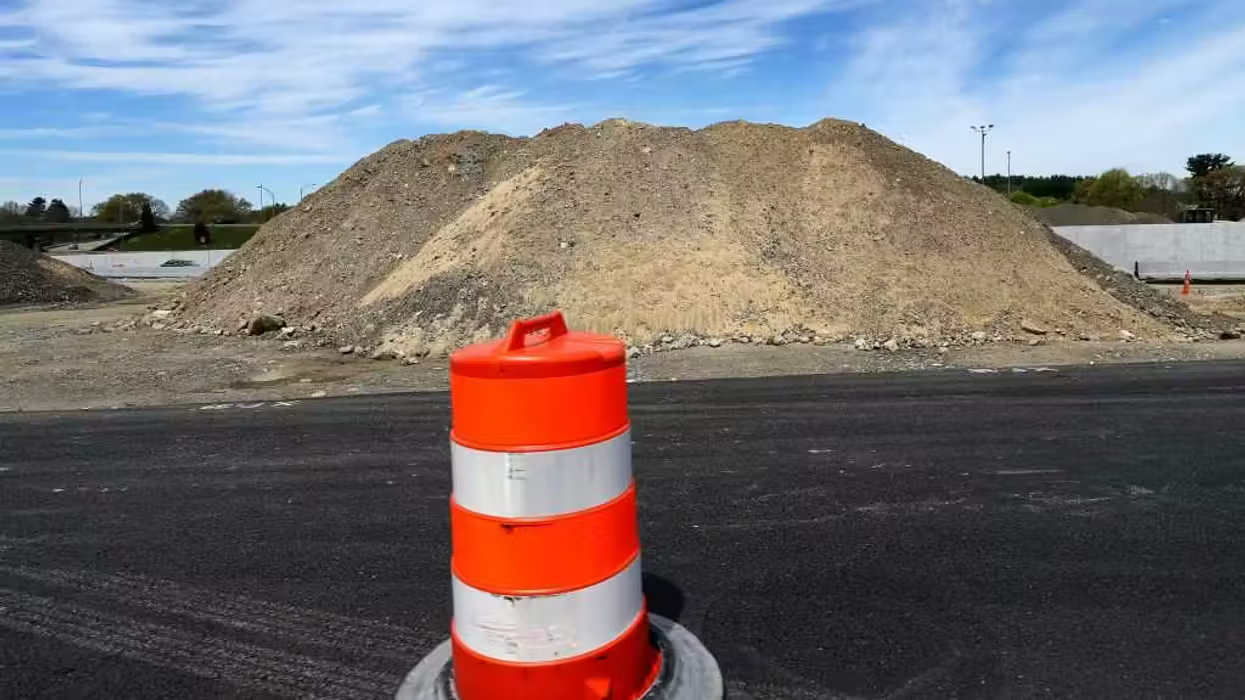
As reported by AZ Mirror, the disguised cameras look so much like traffic/construction markers — they indeed are construction markers, just with holes cut out — that the Arizona Department of Transportation asked Customs and Border Protection to stop using them because they could confuse drivers.
RELATED: Big Brother on the road: Backlash grows against license plate surveillance
Plate readers are often "disguised along highways in traffic safety equipment like drums and barrels," the Associated Press wrote in November 2025.
The AZ Mirror further noted that cameras have been spotted in orange traffic cones, yellow barrels, speed trap signs, and on the backs of overhead highway signs.
The same style of barrels in the viral video appears in CBP documents and permits dating back as far as 2019, with the documents providing a breakdown of the solar-powered cameras that go inside the barrels, complete with a battery and cellular unit.
"USBP monitoring equipment will be placed in the barrel and weighed down by sand. Barrel camera will have a power supply with solar panel placed thirty feet from the white line [at the road]," read a 2019 permit.
Another set of documents showed the same technology being used in cylindrical cones typically seen for road construction.
RELATED: License plate readers or surveillance? The number of AI cameras in the US is shocking
 David L. Ryan/Boston Globe/Getty Images
The AP reported last year that CBP has been tracking license plates to catch human smugglers as far back as 2017 in "an area of interest or smuggling route."
"Once the investigation is complete, or the illicit activity has stopped in that area, the covert cameras are removed," a document stated.
The CBP's mission is "complex and relies on a layered mix of personnel, technology, and infrastructure to detect illicit activity while supporting lawful trade and travel," the federal agency said, per the AZ Mirror.
The statement explained that the CBP approach uses license plate readers that are "often the same systems employed by state and local law enforcement nationwide" to identify threats and disrupt criminal networks.
Border Patrol said it does not provide the operational applications of its license plate readers to the public, nor does it disclose the specific number or locations of its cameras, citing "national security reasons."
Who is monitoring them?KOLD 13 News in Arizona, like other outlets, reported that Flock Safety cameras have been operating in Arizona regions like Sierra Vista and South Tucson. However, while these two jurisdictions ended their contracts with the surveillance company in May, Flock has operated many of the cameras being used by CBP.
The AP reported that while Flock is one of several companies used by border agents, CBP had access to at least 1,600 of Flock's license plate readers across 22 states at one time.
As previously reported by Blaze News, Flock is used by more than 5,000 law enforcement agencies and has more than 100,000 ALPR cameras deployed in the United States.
Other camera companies being used by Border Patrol include Rekor and Vigilant Solutions. Rekor launched in 2019 with an announcement that it had recorded a whopping 30 million plate reads per week.
Like Blaze News? Bypass the censors, sign up for our newsletters, and get stories like this direct to your inbox. Sign up here!