The Wingman
 Listen−1.0x+Seek0:0040:41
Read more about the Democrats who might run for president in 2028 here.
“My wife, Gabby, was shot in the head.”
Obviously, I knew this. Senator Mark Kelly’s wife, the former congresswoman Gabby Giffords, was shot in the head and grievously wounded in a mass shooting outside a Tucson Safeway in 2011. It was one of the most notorious acts of political violence in America.
In several recent conversations with Kelly, however, I was struck by how often and how bluntly he repeated these exact words. Kelly, a retired Navy pilot and former NASA astronaut, seems to appreciate the curt repetition of the statement: My wife was shot in the head. It captures how stark and defining this incident was, and continues to be, in his life.
The near-assassination ended Giffords’s career in Congress and his in space. She was left with acute damage to the area of her brain that controls speech. Kelly was compelled by circumstance to create a new course for himself as a caregiver to his wife, Democratic senator, possible candidate for president, and severe critic of President Trump and his defense secretary, Pete Hegseth.
Fifteen years after the shooting, Kelly and Giffords remain a singular entity in American public life. I went to Arizona to join them at a series of events around Phoenix. We met at a coffee shop. It was a Friday afternoon, with triple-digit heat, and had already been a grind of a day for both of them. From our meeting, they would go to a reception, followed by a dinner, and then Giffords would fly to Louisiana, where she would attend a memorial service for eight children who’d been slaughtered in a mass shooting a few weeks earlier.
Interviewing Giffords and Kelly was like nothing I’ve ever experienced in 25 years of reporting on politics. In our time together, I kept snagging on the same inescapable question: How would their unparalleled dynamic play within the merciless spectacle of a presidential campaign?
“I’m Gabby.”
She says this by way of introduction, and as a wistful acknowledgment of her name’s cruel irony. Even by politician standards, Giffords was quite the chatterbox. In their joint memoir, Gabby: A Story of Courage, Love, and Resilience, Kelly estimates that before she was shot, Giffords did about 60 or 70 percent of the talking between them. Kelly was the reticent one in the couple, happy to let his wife gobble up the silences. The massacre left Giffords with a condition known as “non-fluent aphasia.” It does not affect intelligence, or ability to comprehend events or remember stories—only to relay them. After Tucson, Kelly says, he started carrying 95 percent of their conversations.
During my visit, Kelly often finished Giffords’s sentences and elaborated on what she was trying to say. She speaks in bursts of words and short fragments. It’s evident when she is trying to express something but her voice is not cooperating. She shakes her head, moves her mouth, rocks back and forth.
When we were first getting settled at the café, Kelly walked over with a blueberry muffin and a large cup of ice water.
“Drink your water!” Giffords declared. “China. Drink more water.”
What did this mean?
“You know what people say in China when you sneeze?” Kelly explained. “Drink more water.”
Giffords chuckled—which she does a lot. Kelly often joins her. They share a dry, absurdist, and understandably dark sense of humor. It’s a bit of a platitude to say this about political couples, but Kelly really does project as a different person around his spouse. His usual solo mode is quiet intensity. With Giffords present, he becomes much more engaged, as if he’s trying to draw out whatever he can of his wife’s former extroversion.
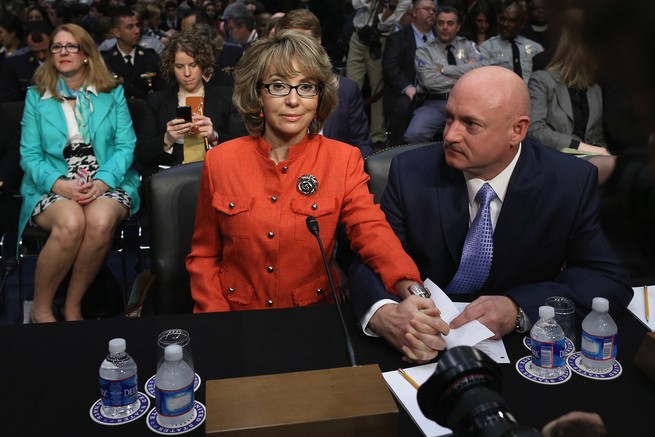 Mark Wilson / GettyGabby Giffords and Mark Kelly appear at a Senate Judiciary Committee hearing about gun control in 2013.
“They’re very symbiotic,” Senator Kirsten Gillibrand, a close friend of the couple who was elected to Congress with Giffords in 2006, told me. As an example, Gillibrand said that Giffords might throw out a single word to prompt Kelly to tell a whole story.
I watched this pattern several times. At one point, Kelly mentioned a trip that he and Giffords had taken to Western China early in their relationship.
“China,” Giffords said. “Gorilla. Monkey.”
“Oh, panda,” Kelly said, and took it from there. They had visited a panda preserve. For $80, visitors could be photographed holding a newborn.
“Then Gabby’s like, ‘I want to hold the baby panda,’” Kelly told me. A woman at the preserve told Kelly that for $35, she could offer a photograph with a less adorable panda. Kelly referred to it as a “raccoon,” but it was in fact a scruffy little red panda. Or “Budget Panda,” as Giffords called it.
“Danger, danger,” Giffords said.
“Oh yes, it’s endangered,” Kelly said. They still have the photo of Giffords holding Budget Panda.
“She has a smile on her face,” he said of Giffords. “But you know what she’s really thinking?”
“Fuck!” Giffords said, and they laughed again.
Giffords can be mischievous in what she encourages Kelly to say, sometimes leading him into impolitic stories. At one point, I asked Kelly whether he gets more questions about what it’s like to be a fighter pilot, an astronaut, or a senator.
“Oh, diapers,” Giffords interjected.
Kelly translated: “How do you go to the bathroom in space? I get a lot of those questions.”
“Skull,” Giffords said at another point.
“Yeah, we still got Gabby’s skull,” Kelly explained. “Like, her real skull.”
After she was shot, doctors performed an emergency craniectomy on Giffords, removing a large portion of her skull to reduce pressure on her swelling brain. Kelly asked the doctor what would happen to the original chunk of bone. “It will go in the incinerator,” the doctor told him. “And I was like, Gabby’s in a coma right now. I think she might want it.”
“We stuck it in the freezer,” Kelly told me—in a Tupperware container. They still have it too. “Next to the turkey,” Kelly said.
I thought this might be a joke, but it was not. Kelly seemed to notice me looking perhaps slightly taken aback. “It’s not in the freezer we use every day,” he clarified. “It’s a separate freezer.”
Here are some things that Mark Kelly has survived: a turbulent and sometimes violent childhood, 39 combat missions in Desert Storm, a missile blowing up just above his plane, and four space-shuttle voyages (two as mission commander). He has also braved the near-murder of the person he loves most and watched her get deluged with death threats for years afterward.
It is fair to observe that Pete Hegseth cannot scare him.
Kelly, who is 62, presents as a somewhat reserved, even sheepish, figure, which can belie the crowded and suspenseful life he has led—and the chilling conflict he now finds himself in with his own government. He also has a knack for understatement.
“I mean, it’s not great to wake up one morning and to find out the president wants you hanged,” Kelly said.
He was referring to a series of Truth Social posts from Trump last November. Kelly and five of his Democratic colleagues in the House and Senate had made a video reminding U.S. service members of their duty not to obey illegal orders. Trump responded by accusing the lawmakers of sedition and threatening to seek their execution. When I asked Kelly how he first learned of the president’s foreboding pronouncement, Kelly conceded that he did not in fact “wake up” to the news. He had been sitting next to another one of the video participants, his Senate colleague Elissa Slotkin of Michigan, during a mid-morning briefing on Venezuela. A security officer walked over and passed Slotkin a note from an aide.
“It says something like, ‘President called for your arrest,’” Kelly told me.
Slotkin left the room, came back a few minutes later, and informed Kelly that Trump had called for his arrest too. Slotkin confirmed this account to me. “I just slid the note over to him,” she said. “And we just had a whole conversation with our eyes.”
In addition to the president issuing a “punishable by DEATH!” decree via Truth Social, he also called for the video participants to be “ARRESTED AND PUT ON TRIAL.” Hegseth followed up with a letter of censure to Kelly, seeking to reduce his military rank and pension, and threatening “criminal prosecution.” (Of the lawmakers involved, only Kelly served more than 20 years in the armed forces, and thus has retired-military status and a continuing relationship with the Department of Defense.)
On a cloudy morning in early May, I sat with Kelly and Giffords in the back of a sedan headed to a federal courthouse in Washington. Kelly would be appearing before a panel of appeals-court judges in connection to a lawsuit he had filed against Hegseth to block his intended punishments.
“I think this is the first time in our country’s history that a president has ordered, or has called for, the execution of members of Congress,” Kelly told me.
This is the kind of historical distinction that you’d think would shake even the most jaded naval aviator. Yet during the short ride to the courthouse, he and Giffords appeared quite unbothered by any of this. Kelly spent much of the drive talking about how people often ask him his view on whether Pluto meets the criteria for being a full-size planet. The topic then shifted (as topics do) to the cryonically frozen head of the baseball legend Ted Williams, which is currently housed at the Alcor life-extension facility in Scottsdale, Arizona. “I’m Ted Williams’s head’s senator,” Kelly pointed out.
Kelly started reading headlines from his phone about an old controversy involving the allegedly shoddy treatment of the Splendid Splinter’s remains: “Williams’ Head Abused at Facility,” he declared merrily.
“It’s hard to get me nervous,” Kelly said as we arrived at the courthouse. “You think about, like, Trump saying he wants me hanged,” he told me later—“all right, I’ll deal with it.”
This was the inescapable subtext of pretty much everything we discussed over several hours of interviews: Adversity is extremely relative to Kelly. It is a notion that he internalized a long time ago, but especially after Giffords was shot.
If anything, being targeted by Trump and Hegseth appears more invigorating than ominous to Kelly. Not to be crass, but if you’re a Democrat, having Trump call for your execution can be excellent for business. Especially so if you are a Democrat who, like Kelly, is “seriously considering” a presidential run.
Since arriving to the Senate in 2020, Kelly’s storybook résumé and the goodwill he’s accrued as Giffords’s spouse have granted him a high level of admiration that has yet to translate to a high level of excitement for him as a potential standard-bearer. He was a finalist to be Kamala Harris’s running mate in 2024, but was passed over. He is seen as a serious and respected lawmaker, steeped in such matters as national defense and border security. But in his relatively brief time in Washington, he has struggled to acquire main-character status or a readily identifiable fight that could burnish the profile of an ascendant national candidate.
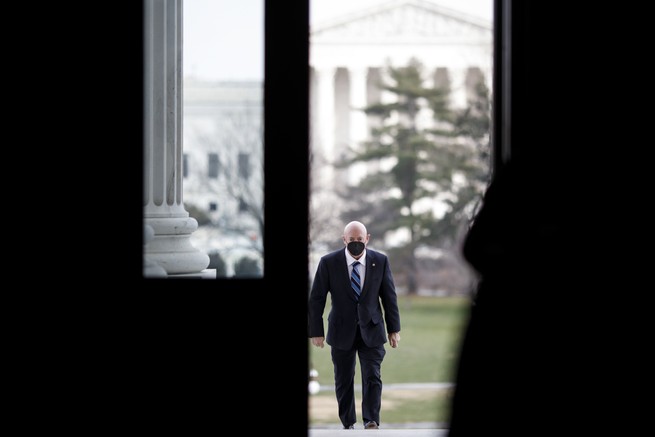 Ting Shen / Bloomberg / GettyKelly was elected to the Senate in a special election in 2020, filling the seat that had been held by John McCain.
He sounds eager to be viewed as a cause célèbre. “This is not about me,” Kelly often insists, as politicians are wont to do (usually at events featuring themselves, and devoted to their career advancement).
At his May 7 court hearing, Kelly was trailed by about a dozen reporters and cameras, and a campaign-worthy entourage. After the session, which lasted about 90 minutes, he delivered a brief, ostentatiously defiant speech in front of the courthouse entrance on Constitution Avenue. “The secretary of defense picked the wrong guy,” Kelly said.
He was flanked by Giffords; his younger daughter, Claire (one of two grown kids from his first marriage); a former Navy colleague; and several other veterans and retired service members. The courthouse loomed directly behind him, and American flags flew overhead while, at the next building over, a massive likeness of Trump’s face dominated the front of the Labor Department’s headquarters.
“They’re trying to send a message to other retired veterans, and really to all of us,” Kelly said. “If you say something that the president, or this administration, does not like, they’re going to come after you.”
As much as Kelly might be milking this attention, being subjected to such a high-level threat can arouse serious menace from the acolyte mobs. After Trump’s posts about the lawmakers in the video, Slotkin told me that her father, in the last weeks of his life, was swatted in the middle of the night. Kelly said he received more death threats in a single day than he would typically get in several months. (For what it’s worth, White House Press Secretary Karoline Leavitt later insisted that Trump in fact did not want the lawmakers to be executed.)
Kelly told me that he tries not to worry, because he is oriented to probabilities. “I’m a believer in math,” Kelly said. “So, when you look at Desert Storm, you look at all the combat missions flown, and the number of people killed—flying on the space shuttle is probably 10 times more dangerous.” And both, certainly, are much more dangerous than his current profession, he said. Statistically speaking, the universe of contemporary U.S. politicians who have actually taken a bullet is minuscule.
“But not in my family,” Kelly noted. “I thought I had the risky job—until January 8th of 2011.”
Giffords was scheduled to hold one of her regular “Congress on Your Corner” meetings with constituents in front of a Tucson Safeway that day. She had just been elected to her third term, even as Republicans had retaken control of the House in a torrent of Tea Party–driven anger over the Affordable Care Act. At about 10:10 a.m., a few minutes into the event, a gunman named Jared Lee Loughner opened fire.
Kelly was in Houston, training for a space-shuttle mission. He learned of the shooting in a call from one of Giffords’s staffers. As he flew to Tucson with his mother and his two teenage daughters, NPR reported that Giffords had died. Kelly, typically a non-demonstrative engineer, retreated to the airplane bathroom and sobbed. When he emerged 20 minutes later, he called the hospital and learned that Giffords was in fact still clutching to life. University Medical Center in Tucson corrected the media reports.
Giffords woke from a medically induced coma about a week later. Loughner’s bullet had ripped through the left hemisphere of her brain, entering over her left eye and exiting out the back of her skull. She could barely move, and could speak only a few words at a time, though it was clear that her brain worked well enough to know that something unimaginable had occurred. “What is happening to me?” she kept saying.
Kelly was diligent in documenting this period in which it all changed, taking video of her ordeal from close in. Giffords was hooked up to tubes and monitors, and her head was shaved. Some of the footage appears in the 2022 documentary Gabby Giffords Won’t Back Down. The video shows, more than anything visible today, Giffords’s despair. As happens with aphasia, she perseverates on random words. “Chicken, chicken, chicken” keeps tumbling out. At one point, she puts her head down and just cries.
The shooting scrambled each of their plans entirely. Although Kelly had already traveled multiple times into space and seemingly reached the pinnacle of his career, Giffords had very much been rising in hers. She was hailed as a natural politician, a performer from a young age who had starred in music and theater productions. (Gwyneth Paltrow is her second cousin.) She grew up in the Tanque Verde Valley, northeast of Tucson, and after college in California and a stint in New York, returned home to run her family business, El Campo Tire. She built her local celebrity as a motormouthed pitchwoman, appearing in TV ads in which she would order viewers to “Race into the El Campo Service Center today, before the offer is gone!” Giffords launched her first campaign in 2000, for the Arizona House of Representatives. Six years later, at 36, she won her U.S. House seat and was immediately touted as a future senator. She was a vibrant speaker, hawkish on border security, and, yes, a proud gun owner.
Kelly and Giffords met in 2003, on a trip to China for an international conference of young leaders. She was a state legislator, and he was at NASA. They reconnected at another conference, this one in Arizona, a year later, by which point Kelly was divorced and Giffords was single. In November 2004, Giffords was doing research for death-penalty-related legislation and invited Kelly to join her on a tour of an Arizona state prison in Florence. “We went to death row on our first date,” Kelly says. He recalls at one point stepping into the actual gas chamber.
Before long, Giffords started showing up to Kelly’s rocket launches in Houston. Kelly came to Giffords’s campaign events in Tucson. As political sidekicks went, Kelly jumped straight out of the catalog: the sturdy astronaut, content to toil in the wings with his intricate machinery. He sent her emails from space. “Tell my wife I love her very much; she knows,” Kelly said, quoting David Bowie’s “Space Oddity,” while appearing via video at a U2 concert, from the International Space Station.
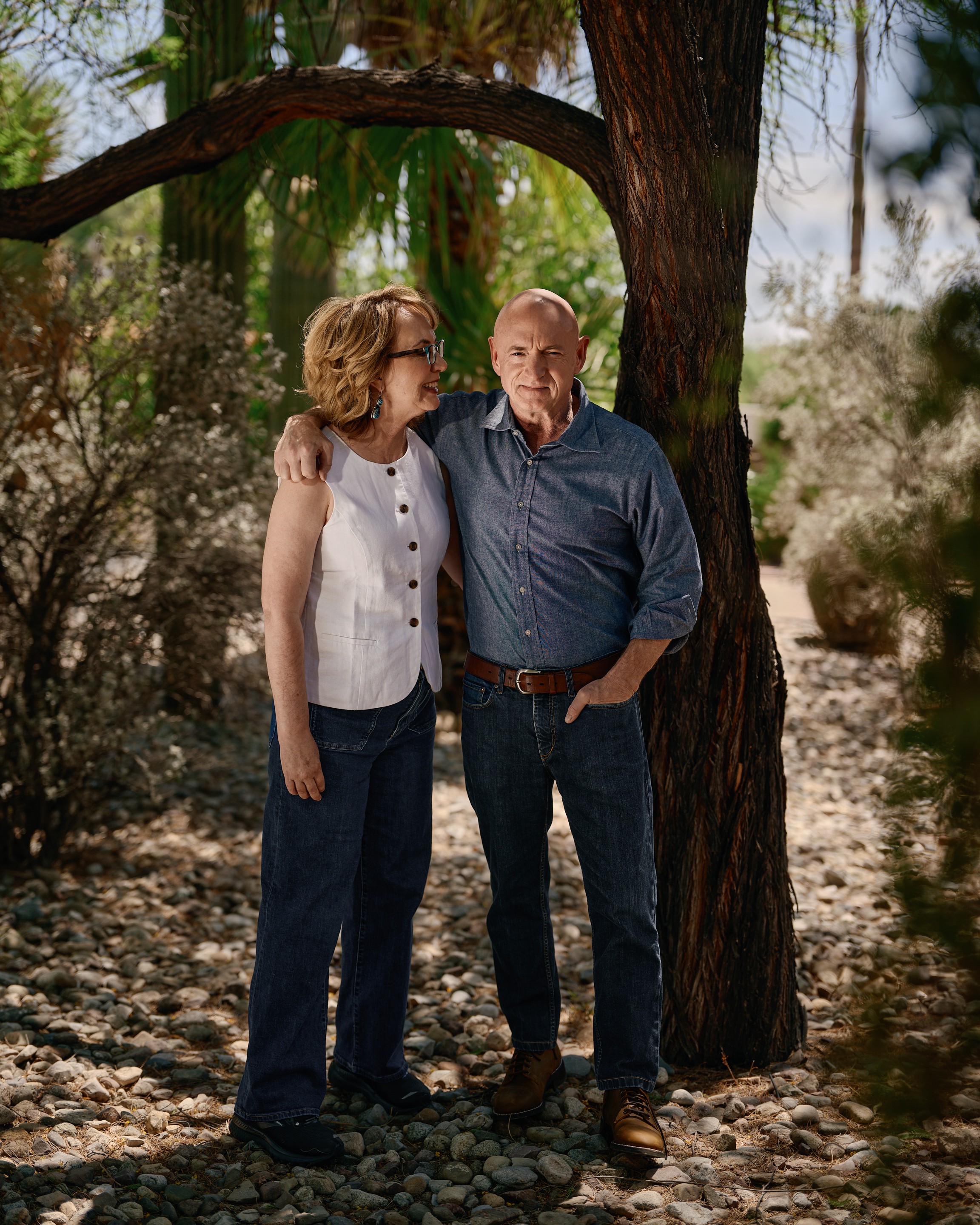 Philip Cheung for The Atlantic“Certainly, if I was not married to Gabby, I would not be sitting here,” Kelly said of his role in the Senate.
Beyond the storybook optics, Giffords and Kelly were also well-matched workaholics with high-velocity careers. It was a commuter arrangement: After they were married, Kelly continued to live in Houston, while Giffords split time between Washington and Arizona. “We did not live together until the day she got shot,” Kelly told me.
Before the shooting, the couple had been trying to have children. Giffords, then 40, desperately wanted to become a mother and was undergoing fertility treatments at Bethesda Naval Hospital. She’d had an appointment to have an embryo implanted on Monday, January 10. After the shooting, that dream, too, quickly faded. She embarked instead on a prolonged and agonizing rehabilitation.
In addition to her difficulty speaking, Giffords was left with severely limited peripheral vision in one eye, and suffered partial paralysis and motor impairment on the right side of her body. She uses a walking stick, sometimes a wheelchair for longer distances. Flights can be difficult. She travels with a full-time health aide. Yet Giffords keeps a punishing schedule, much of it connected to her anti-gun-violence organization. She meets with victims and families, attends vigils and funerals, and spends more than half of her time on the road.
Periodically, Giffords breaks into song. Although the speech part of her brain was ravaged, the music area remains intact, Kelly told me. Lyrics flow more easily for her than words.
“The sun will come out tomorrow,” she sang on the topic of the Democrats’ prospects in the midterms this fall. “Bet your bottom dollar that tomorrow, come what may!” On other occasions, when I referred to something that had occurred the day before, Giffords would chime in with, “Yesterday, all my troubles seemed so far away.”
“Yesterday” and “Tomorrow” are Giffords’s go-to refrains. Her life with Kelly carries a hard line of demarcation between the before and the after.
Kelly grew up in West Orange, New Jersey, in an Irish Catholic household of little outward affection and high tumult. Richard and Patricia Kelly—both police officers—were at constant odds. “One of the worst feelings in the world is, you’re in a deep sleep and then you slowly wake up to your parents screaming at one another and throwing things,” Scott Kelly, Mark’s identical twin brother, told me. “We were raised in that environment of, you know, a lot of cops, alcohol, some violence, definitely a lot of drunkenness.” The twins’ general approach, for much of their youth, was to try to protect their mother as best they could and stay occupied outside the house. After getting their driver’s licenses, the Kelly boys worked as EMTs, rushing in ambulances to the scenes of shootings, stabbings, and car crashes.
Mark said he never realized there was anything unusual about his upbringing. “When you’re a kid, that’s your experience,” he told me. “So, you’re not so sure, like, Is this normal or not normal? And you realize later it’s not normal.”
Kelly described his father as an alcoholic, but one who did not drink every day and rarely at home: “It was, like, a Friday, Saturday-night thing at the bar with his cop friends.” In some ways, Kelly added, he looked up to his father. Richard Kelly coached his sons’ Little League teams, worked as a detective, and “was putting bad guys in jail.” He also investigated mobsters, Mark told me. (New Jersey in the ’70s and ’80s, go figure.) With some pride, Kelly noted that in The Sopranos, Tony went to West Orange High School.
In his memoir with Giffords, Kelly writes that he and Scott were “borderline juvenile delinquents” growing up, always getting into trouble, accidents, and fights. They were late academic bloomers. Mark was the first to become captivated by a career in outer space; his twin, younger by six minutes, became an astronaut as well. Mark had no interest in politics, let alone a career in it. He wanted to pursue the moon, not the swamp.
But after the horror of January 2011 and Giffords’s forced retirement, Kelly began to get mentioned as a potential political candidate himself. He first ran for Senate in 2020 to fill the seat vacated by John McCain’s death in 2018; he defeated Republican Martha McSally, and was reelected to a full six-year term in 2022. I asked Kelly what had made him decide to run for office. First off, he said, he was concerned about “the trajectory of our country with Donald Trump in the White House.” This did not exactly make him a brave and lonely voice in the Democratic wilderness. But Kelly traces his particular aha moment to a get-out-the-vote rally that he attended in Phoenix before the 2018 midterms. A woman, probably in her 30s, approached him.
“She just stands next to me and says, ‘Hey, my son has Down Syndrome. And I’m terrified he’s going to lose his health insurance. Would you please consider running for the U.S. Senate?’” Kelly told the woman he would think about it.
As political origin stories go, this one feels quite labored. It seemed dubious to me, given that Kelly’s name had come up in the past, that it had never occurred to him to run for something until a woman he met at a GOTV rally brought it up. “I don’t know if I wanted to be in the Senate badly enough,” he told me. “But when I focus on something, I work really hard at it.”
Kelly makes frequent cracks about the astonishing sequence of events that landed him in his current peacocking profession. Before a taped interview at a Phoenix TV studio, he pulled out a makeup brush and applied foundation to dull the shine of his bald head. “I used to be the commander of the space shuttle,” he said, shaking his head. “Now I carry my own makeup.”
After the interview, Kelly headed off on a visit to the John S. McCain III VFW Post 7401, a half hour away in Chandler. When we arrived, he spent about 10 minutes serviceably glad-handing his way through a front bar area, dressed in an old flight jacket and camouflage cap with NAVY in big print across the front. At least two of the people Kelly met urged him to run for president. He said he’d not yet decided, though he is taking many of the so-called necessary steps, including traveling to South Carolina, Nevada, and New Hampshire in recent months.
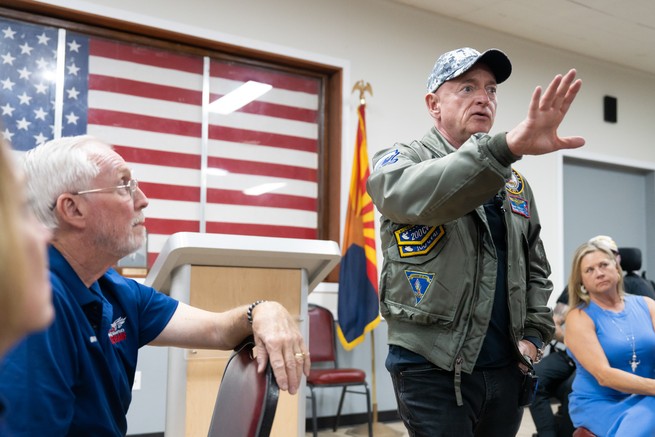 Rebecca Noble / GettyKelly speaks at John S. McCain III VFW Post 7401 on May 8 in Chandler, Arizona.
His speeches need work. Kelly’s voice is more conversational than booming. His words sync awkwardly with robotic hand motions. When Kelly tries to amplify, it sounds like he’s straining. He’s used to working in tight places rather than big rooms.
At the VFW, Cindy McCain, the widow of the late senator, introduced Kelly. He moved quickly to his skirmish with the administration. “I said something the president didn’t like,” he said. “Anybody see this?” Nods and scattered applause across the room. “And the president said I should be hanged, executed, prosecuted,” Kelly said. He paused for effect. “The guy couldn’t even get the order right!”
Kelly’s main message was grounded in the old soldiers’ credo: that “to fight for a cause larger than yourself,” as McCain used to say, was its own reward. It was a friendly audience. He took questions, and came well briefed and well versed in legislative detail.
One question, however, exposed a weakness. A woman named Jennifer Worthy told a gutting story about her husband, Marine Sergeant Joseph Worthy, who was battling Stage 4 colon cancer. He had fought in Desert Storm, where he was almost certainly exposed to lethal toxins from burning oil fields. At the end of her question, Jennifer choked up. Her husband, she said, was getting chemotherapy treatment right at that hour. She asked Kelly if he would take a picture with her that she could bring back. He nodded yes, and the crowd broke into applause as Jennifer wiped away more tears.
For a politician, the instinctive move in this situation is easy: hug the woman. She was standing about 10 feet away and clearly in crisis. It should not take an elite pain-feeler like Bill Clinton to recognize this. But Kelly came off oddly oblivious. He stood in place and kept glancing around the room. He retreated into his sound bites and talked about himself: how treacherous it was for him to fly missions during the Gulf War after Saddam Hussein’s forces set fire to the oil fields. “I was there on an aircraft carrier, the USS Midway,” he said. “I’m flying around there, and the sky is black.” (Kelly did pose for a photo with Worthy and had a brief visit with her after his remarks.)
When we spoke later, Kelly acknowledged that his political personality is a work in progress. His background, he says, sets him apart from that of most other senators. In a body dominated by lawyers and debate-team types, he “brings the training of an engineer, the clarity of a tactician from his time as a naval aviator, and the cool-under-pressure of an astronaut,” his Democratic colleague Jon Ossoff, of Georgia, told me. Kelly excels in quiet, stressful, and often collaborative environments—like a spacecraft or, as Ossoff said, the Senate Intelligence Committee, where he and Kelly serve together.
Still, it’s hard to imagine a successful presidential candidate that doesn’t possess at least some knack for the performative conviviality required of big-ticket politicians.
“In my defense,” Kelly told me, “if you look at people that are, like, the normal stereotypical engineers on, like, a spectrum”—he made a hand motion, presumably to convey a spectrum of personality types—he grades himself as more gregarious than most. “I’m much more comfortable now giving random people hugs,” Kelly said.
By contrast, Kelly told me at the coffee shop in Phoenix, Giffords is always giving random people hugs—whether or not they want to be hugged.
“Airport,” Giffords said.
“She gives a lot of hugs at the airport,” Kelly confirmed. He turned to her.
“Well, I mean, you just kissed a dude on his face, like, an hour ago,” he said. “Who was that guy?”
He nudged his wife and shook his head. She smiled.
The three of us spoke for a while about the brutality of politics these days. How do they tolerate it?
“Servant, servant, servant,” Giffords said.
“You can’t live your life paranoid,” Kelly added.
I took this to mean, basically, that they are servants to a cause greater than themselves. And it comes with occupational hazards they both know too well.
“Gabby, do you worry about somebody else coming up to you and shooting you?” Kelly asked her. She shook her head.
“I mean, if somebody decided to walk up to me and shoot me, not much I can do about it,” Kelly said. “Space shuttle blows up? Not much I can do about it.”
“So sad,” Giffords said.
It’s easy to sense an undercurrent of Kelly wanting to excel in politics in order to realize the full ambitions of his wife. He talks a lot these days about how he will not be “silenced” by Hegseth, and how he is standing up for others in doing so. (“There are 2 million retired service members like me that they want to silence,” he says repeatedly.) One parallel Kelly does not draw explicitly, but that is evident to anyone who is familiar with Giffords’s story, is that he will not be silenced by the defense secretary just as his wife would not be silenced by her would-be assassin. “Mr. Loughner, you may have put a bullet through her head, but you haven’t put a dent in her spirit,” Kelly told the gunman in 2012 at his sentencing hearing. (Loughner is serving seven consecutive life terms in prison, plus an additional 140 years tacked on for the victims he injured and maimed.)
Listening to Kelly and Giffords, I was periodically struck by how their endeavors have been interwoven. “Certainly, if I was not married to Gabby, I would not be sitting here,” Kelly told me during one of our conversations in his Senate office. “And if she wasn’t shot, I mean, I wouldn’t be here, right?”
I wasn’t entirely sure at first what point Kelly was making. That if he hadn’t ever been attached to Giffords, he would not have been elected on his own? Or that most people know him only as a grieving spouse, and he was elected out of sympathy? When I asked Kelly to elaborate, he explained that if not for the shooting, he thinks his wife would have eventually been elected to the Senate. But because that was not possible for her, being Giffords’s husband had afforded him the statewide name recognition and political organization to do it himself.
Our last stop of the day in Arizona was a fundraising dinner for the state Democratic Party, officially christened the “Gabby Giffords Gala.” Kelly and Giffords headlined the program, which included a procession of local elected officials in front of about 1,000 party activists and appendages. In keeping with their professions, Kelly and Giffords have to do a lot of these banquets. They usually stand onstage together, and Kelly does most of the talking. Giffords might say a few words at the end, usually halting phrases:
“I chose to make a new start—to move ahead.”
“Do not look back.”
“Setbacks are hard.”
“I tell myself, move ahead.”
Giffords received her customary standing ovation at the banquet, along with chants of “Gabby, Gabby, Gabby.” Kelly then helped her down from the podium.
Kelly and Giffords are an inspiring couple to be around, and also not an easy one. A special kind of burden goes with being the surviving protagonists of a national tragedy. In general, when you say you’re running for president, the feel-good story ends. If we’ve learned anything over the past 10 years, it is the extraordinary capacity of people to be cruel in politics.
Kelly told me that he goes onto social media sometimes. He forces himself to read comment sections. “It thickens your skin a little bit,” he explained. “I see what they say.” I wondered how he would handle a political adversary going after his wife—calling her names, saying heartless things about her disability, deploying the kind of hateful language that Trump has empowered many of his supporters to use. It’s easy to imagine.
I asked Kelly, straight up, if he thought America was ready to have a disabled first lady.
“Hey,” he said, “in my opinion, we have a disabled president right now.”
He pivoted back to Giffords: how much of a role model she is, with all she has overcome. “The way she connects with people is unlike anybody else I’ve ever known,” Kelly said. “Before she was injured, people used to compare her with Bill Clinton.” His wife, he told me, can handle herself. “She’s been in this business,” he said. “And she had, you know, like the worst thing that any politician could have happen, right? She gets shot in the head.”
Kelly keeps his official letter of censure from Hegseth taped to the door of his Senate office. I hadn’t noticed it until he mentioned it to me. The document—dated January 5, 2026—is addressed to “Captain Kelly” and printed on “Department of War” stationery. It is three pages long, one of them crooked. Kelly told me that he hung the missive sloppily on purpose, to reflect his lack of respect for its contents and sender. Perhaps, he said, he should smear it with ketchup.
I asked Kelly why he displays the letter on his door.
“I think that, you know, the seriousness of this whole thing,” he said. “It’s good for me to be reminded of what’s at stake, and who these people are.”
Politically at least, it also can be good to remind as many people as possible that the Trump administration is targeting Mark Kelly. Kelly raised $12.5 million in the last quarter of 2025, much of it after November 24, when the Defense Department announced that it was investigating “serious allegations of misconduct” by the lawmakers in the “illegal orders” video. Kelly brought up his lawsuit against the defense secretary at every public event of his that I attended. (The panel of three D.C. judges has yet to announce a decision, although two of them signaled strong opposition to punishing Kelly at the May 7 hearing.) He always took care to identify the case by its docket name, Kelly v. Hegseth. I once referred to the litigants in the wrong order—Hegseth v. Kelly—and Kelly immediately corrected me.
In Phoenix, I asked Giffords the obligatory question: Does she want Kelly to run for president?
“All of it,” she said. “Yeah, go for it.”
“We’re a team” is another mantra of hers.
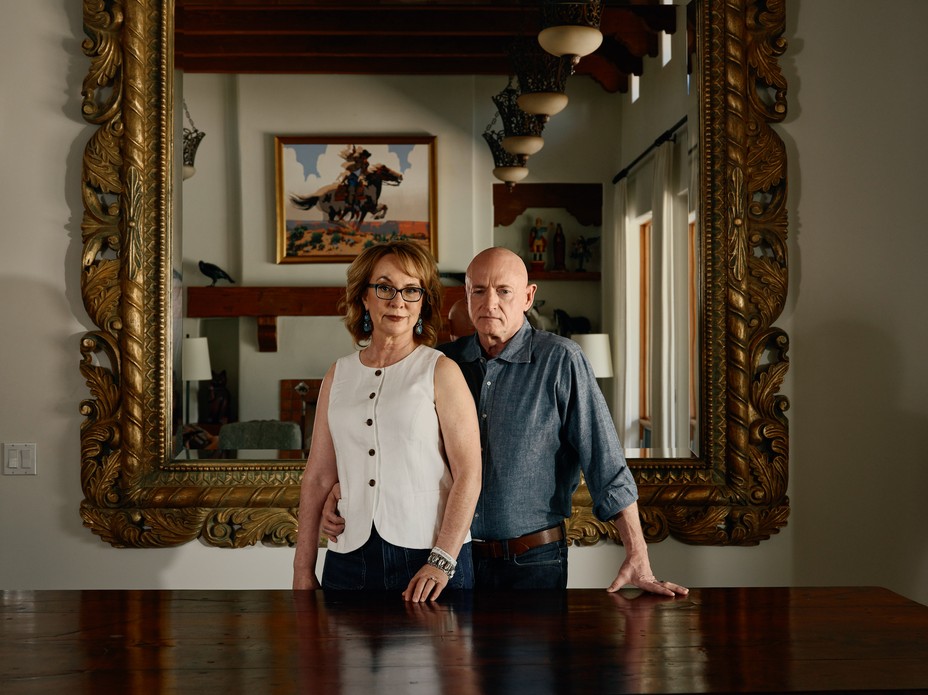 Philip Cheung for The AtlanticGiffords and Kelly at their home in Tucson
Scott Kelly told me that he also wants his brother to run in 2028—and not just because then Mark could become the first identical-twin astronaut ever to reach the White House (unless I’m overlooking someone). “I’ve known him my whole life,” Scott said. “He doesn’t have the type of ego that he would think he can fix every problem and would be the savior to this country.” On the contrary, his brother is low-key, collaborative, and analytical. This might be precisely what the country is primed for after the Trump experience, Scott said.
During an office interview with Kelly in June, I asked him for an update on his thinking about running for president. His official position remained “considering it.” But he also made the point, in a variety of ways, that once he gets locked into an idea, he tends to go ahead and launch it. I took this to mean he is more likely than not to run.
As we were discussing this decision, Kelly talked about the experience of getting close to being Harris’s running mate in 2024. He clearly wanted it, more so than passed-over running mates usually admit. He was one of two runners-up—along with Pennsylvania Governor Josh Shapiro—for the job that eventually went to Minnesota Governor Tim Walz.
In her campaign memoir, 107 Days, Harris lists a few concerns that she had about Kelly. One was that he had never experienced an “oh shit moment” in his political career. This is quite a remarkable statement. Harris added that she “couldn’t afford to test Mark Kelly in that ugly grinder” of a national campaign.
Kelly told me that he’d only “read parts” of Harris’s memoir. Presumably, these were the parts that corresponded to mentions of “Kelly, Mark.” He smiled when I suggested this and did not deny it. When I brought up that Harris said she was concerned that he wasn’t tested as a national candidate, Kelly grew more openly annoyed than I might have expected, given how beside the point the topic is now.
“What does that mean?” Kelly said. “I ran one of the most competitive Senate races in the country, in a swing state,” he continued. “My Senate races were harder than her Senate races.”
He also noted, sarcastically, that some people apparently found it charming that Walz asked for Diet Mountain Dew to drink during his VP interview. “Shapiro and I asked for water,” he said, smirking.
As I spent time around Kelly, I concluded that he would have been a good choice for Harris—and not just because he’d probably have done less harm than Walz did. Kelly struck me as having an ideal vice-presidential temperament. My question, then, is whether he could plausibly sell himself as the ringmaster in the chaotic circus of a modern presidency. In this age of infinite spotlights, people are obsessed with finding “alphas.” It helps to be a showman, and not to be boring. Trump is proof of how far that can get a person—and also where it can lead the country.
One last note on Harris’s running-mate decision: The former vice president wrote that another concern she had was that she did not want to subject Kelly’s military record to the kind of scrutiny, or smears, that presidential campaigns can invite. This packed a certain richness, given how Walz’s military record—or his overstatement of it—created its own recurring migraine for Harris. But when I asked about this, Kelly shifted to his current predicament. “I would be ecstatic if Pete Hegseth managed to get all of my military records and stick it online,” he told me.
He would go further. “Mark has made it clear to me that he is willing to be in prison to defend the Constitution,” Ossoff told me.
Kelly made this clear to me too. If “they actually sent me to prison, I’ll be fine,” he told me. “I’ll continue to fight back against these people.”
I mentioned that it would seem unlikely at this point that Kelly would be sent to jail over the “illegal orders” video. The government, after all, already failed once to win an indictment against the lawmakers. Kelly agreed, but then went on to describe scenarios in which it could happen: If, Kelly suggested, his lawsuit against Hegseth goes to the Supreme Court and they rule against him, the Pentagon could then have other punishment options. “I could wind up in a nonjudicial punishment process in the Navy,” he said. “And you know, that’s a big pain in the ass.”
“I tell you what they could do; they could try to indict us again,” Kelly continued. “Then, maybe do it in a place where maybe they get enough grand jurors. And then I wind up getting charged with seditious conspiracy.”
I joked that if Kelly did wind up in prison, he would probably raise $50 million within a week. He reiterated that he was not scared of imprisonment. His wife is not worried about it either, he said.
“We’ve been through a lot,” Kelly told me. “And you know, if they lock me up, I’m sure she’d come visit me.”
About the Author Mark LeibovichFollowMark Leibovich is a staff writer at The Atlantic.Explore More TopicsMark Kelly