Why is it so hard for liberals to take the W?

Anyone who has ever won an argument knows that victory is rarely served with an admission of failure. Instead, the goalposts shift, the vanquished discard their earlier positions, and a once-controversial view becomes mainstream. You shouldn’t be churlish when you find yourself on the winning side, but it is still important to be clear about what arguments and ideas have been proven correct.
So, while screaming “I told you so” is both off-putting and unhelpful, it’s also unhelpful to be so gracious in victory that people learn the wrong lessons. Which is what I’m worried is happening with the Yes In My Backyard (YIMBY) movement right now.
A decade ago, nearly every faction of the American political spectrum was virulently anti-YIMBY. In superstar cities and suburbs across the country, local elected officials across the political spectrum ranged from being blithely unaware of the housing supply crisis and tacitly supporting exclusionary zoning laws to staunchly opposing faster private-market development.
In 2018, one of the first prominent YIMBY elected officials, Scott Wiener, proposed SB 827, a transit-oriented development bill that would have required cities to permit small apartment buildings near major transit stops.
It was opposed by tenant groups, the Sierra Club, DSA Los Angeles, homeowners associations, prominent local elected officials in California, the Beverly Hills and Palo Alto city councils, Mayor Eric Garcetti, and others. Under such crushing opposition, it died in committee with both Democrats and Republicans voting no.
Seven years later, not only has California passed similar legislation (SB 79), so too have Washington, Colorado, Massachusetts, Utah, Connecticut, Chicago, Minneapolis, Austin, and New York City… just off the top of my head.
It’s not just transit-oriented development, of course. The fundamental precepts of YIMBYism — that exclusionary zoning is bad, that undersupply is at the heart of the housing crisis, that private-market development is necessary — are now championed by everyone from the democratic socialist mayor of New York City to the Trump-supporting governors of Montana and Florida.
And yet, some people, including some YIMBYs, have begun to worry that not enough progress is being made:
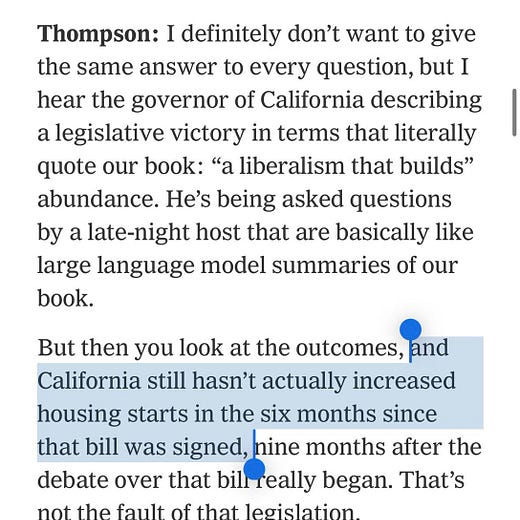
Derek Thompson, coauthor of Abundance and a regular columnist here at The Argument, recently noted on The Ezra Klein Show that if you look at the housing starts in California, Abundance’s performance is lackluster. He argued that in the six months since the state passed SB 79, “California still hasn’t actually increased housing starts.”
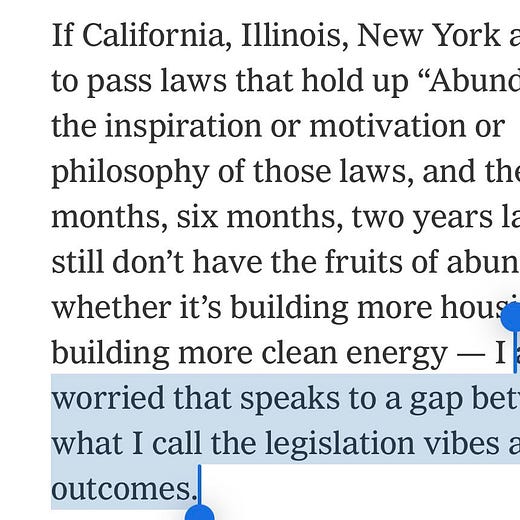
Klein agreed, saying earlier in the episode that looking at the housing numbers over the past decade, you can’t even see evidence of the YIMBY movement’s work.
These comments were seized on by anti-YIMBY voices as proof that pro-housing policy doesn’t work.

Hal Singer@halsinger
This the closest you’ll see an abundance bootlicker admit that they’ve misdiagnosed the housing affordability problem. They got the deregulation that developers/investors sought, but they didn’t get any lift in housing starts—a necessary element to reducing prices under their
9:31 PM · Apr 28, 2026 · 26K Views
22 Replies · 30 Reposts · 173 Likes
I find myself baffled at the presumption that YIMBY legislation hasn’t succeeded. I think it has succeeded; any honest accounting shows that, and pro-housing voices should stop being so bashful about this.
No one ever said the California housing crisis could be solved in a year. In fact, many of us have been warning that the fix will be the work of decades, and we risk inculcating the idea that YIMBYism has failed when all evidence shows that it is most definitely working.
Washington state has passed some of the most ambitious pro-housing reforms in the nation. In 2024, Seattle set a record for housing completions: Builders opened 12,730 units through October alone, already the most of any calendar year in two decades and well past the prior high of 10,937 set during the 2019 Amazon boom. What’s even more remarkable is that Seattle kept production booming during the worst financing environment for new construction since the Great Recession.
But, to be honest, while this sort of eyeballing a graph can provide suggestive evidence, it’s not smart to rely on it when trying to tease out the exact impact of specific pieces of legislation. The problem with looking at a graph of housing starts in California and concluding that YIMBY legislation hasn’t had an effect is that you’re not measuring the counterfactual. We don’t know how much housing would have been built without YIMBY legislation — perhaps even fewer units would have been built! That’s why God gave us economists and causal inference.
Perhaps the world’s most comprehensive major zoning reform success story happened in 2016 in New Zealand. The country had seen its home prices increase by roughly 50% between 2009 and 2016, spurring dramatic action. Lawmakers upzoned about 75% of Auckland’s residential land, roughly tripling the zoned capacity of the city. Because these are such major reforms, they are a really good case for teasing out what the effect of upzoning actually is.
Economists looked at Auckland and found that the major housing reforms there took two years before the data revealed a statistically significant above-trend amount of housing. The effect was massive: Within six years, the reforms produced an additional 43,500 housing permits and rents ended up about 28% lower than they would have been without it.
Auckland wasn’t a fluke; São Paulo overhauled its zoning that very same year, and it took a year for permits to visibly surge in the data and the actual housing showed up three to four years down the line.
Closer to home, in New York City, upzoned neighborhoods took three years to show a difference from pre-trend construction rates.
It’s useful to think through why it takes so long for new housing to get built. Upzoning legislation is not a mandate to build; it’s just granting the first step in a long line of permissions developers need to get in order to begin building.
Even in places with sky-high demand, developers need to understand the new legal environment, purchase parcels of land, pull together financing for a project, and often get permits from local governments to commence building. And all of that can be derailed by shocks to the construction labor force (check), building materials (check), and general economic instability (check!).
That’s why, even in places like New York City or Los Angeles, where there is incredibly high demand, there are still parcels of land that have not been developed. There are just a lot of barriers to growth!
The Atlantic’s Rogé Karma conducted a thoughtful investigation of why California in particular has had a hard time getting housing units built. Karma found that “the problem in California is … even as [legislators] removed some regulatory barriers, they created new ones. In trying to accomplish every objective and accommodate every interest, all at once, California set up its housing agenda to fail.”
Despite the ideological victory of the YIMBY movement, there are significant anti-growth headwinds. The most difficult barrier to growth is that decision-making on housing is heavily decentralized, so even if you do get state action, localities have infinite tools at their disposal to delay implementation or create an inhospitable environment for developers.
“A liberal is a man too broad-minded to take his own side in a quarrel,” Robert Frost once quipped.
Open-mindedness is good, epistemic humility is good, and changing your mind in light of new evidence is good, but excessive self-effacement is a scourge. The whole point of all these high-minded liberal norms about reasoning isn’t to display them for their own sake, it’s to get us all closer to the truth. More specifically, these are instruments to protect against one specific failure mode: overconfidence.
Liberals, and by this I mean those of us in the tradition of Rawls and Mill, rightly worry about being insufficiently open to new ideas. Lots of very well-meaning liberals supported ideas like scientific racism and eugenics, the inferiority of women, and the exclusion of religious minorities. It’s good to maintain the constant self-discipline of recognizing that you could be wrong and missing something hugely important.
But what happens when liberals are right? The norms that guard relentlessly against overconfidence don’t actually help with the opposite problem of excessive doubt. In fact, they can actually hurt, causing people to end up underweighting a conclusion that is actually true.
If everyone were a liberal, this would be less of a problem, but we’re in a discursive environment where most political factions barely care about being correct at all. When people see that someone on their side is wrong, they tend to shrug and ignore it because at least their team is directionally correct.
Take Vice President JD Vance, who popularized the story of Haitians eating pets in Springfield, Ohio. When pressed about the veracity of his argument, he retreated to: “If I have to create stories so that the American media actually pays attention to the suffering of the American people, then that’s what I’m going to do.”
Who cares if it’s not literally true that Haitians are eating dogs in Springfield? What matters is that immigrants are destroying our way of life, and that’s what you need to focus on.
This isn’t a quirk of the populist right. The same move runs through every faction that has made up its mind in advance. When people — including yours truly — pointed out that private equity was not the root of the housing crisis, that didn’t stop left-populists from doubling down on casting private equity firms as responsible for high home prices.
Senate Democrats have introduced roughly a dozen such bills, from the HOPE for Homeownership Act to the American Homeownership Act, each premised on the idea that hedge funds are "driving up home prices." The obsession with this myth almost brought down the 21st Century ROAD to Housing Act, the most significant piece of federal housing legislation in a generation.
 Everybody hates renters
And while I don’t advocate for liberals discarding all our principles, we should recognize that humility doesn’t mean you can’t recognize when you’re almost certainly correct about something. YIMBYs spent two decades insisting that the housing crisis was a supply crisis, that zoning was the culprit, and that building more would bring costs down. They were called developer shills and told that supply doesn’t filter, that prices would never be affected by zoning reforms. And then Auckland, Minneapolis, Austin, São Paulo, and Seattle proved that YIMBYs had been correct all along.
This is as close to vindication as politics ever offers. So stop being broad-minded and let’s take the W.
The real reason behind Minnesota's Somali fraud scandal
A few weeks ago, YouTuber Nick Shirley released a viral video in which he claimed to be investigating day care reimbursement fraud in predominantly Somali neighborhoods of Minneapolis. The claims in Shirley’s video about specific day care centers not providing child care were incorrect, according to subsequent reporting by
Sometimes you have to hurt people
Phoebe Bridgers recently announced that her upcoming tour would feature “no phones” at all shows. Fans would be required to leave phones at home or lock them in Yondr pouches for the duration of the show.