Jonathan Haidt is wrong about age-gating the internet
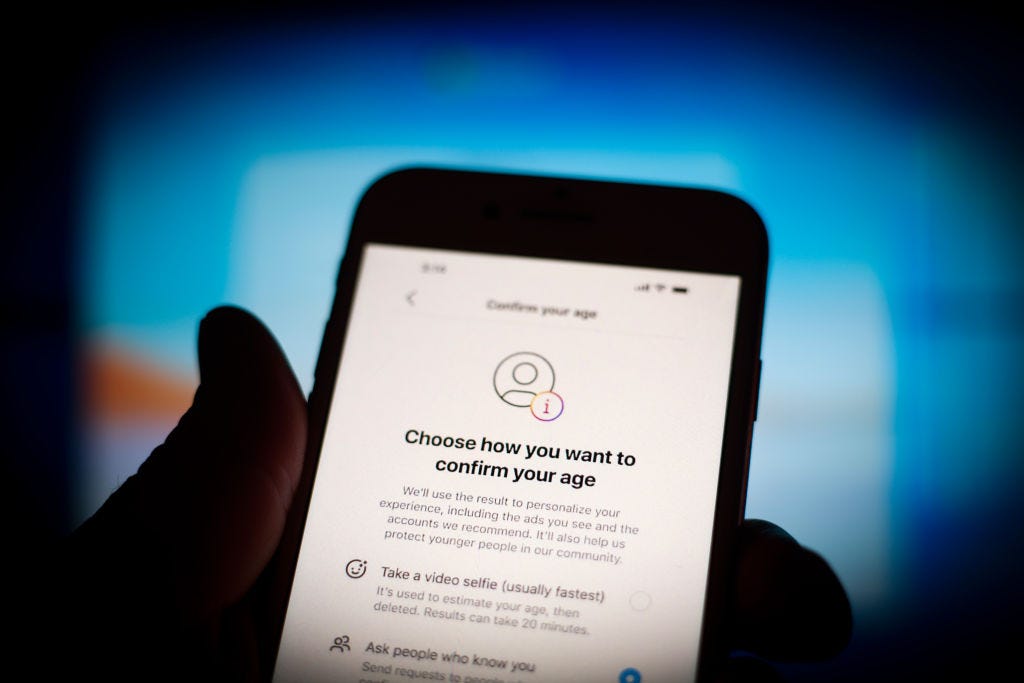 Most interventions that would restrict social media to adults would also require personal information to prove users’ age. (Photo by STR/NurPhoto via Getty Images).
I grew up substantially on the internet, and while my school made a halfhearted effort to block the bad websites, it was comically easy to evade. This was good for me. I read a lot of blogs and webcomics and fanfiction, formed a lot of half-baked but earnest political opinions, improved as a writer, made friends, got into internet arguments, and overall grew as a person.
If I could give my kids unsupervised access to the 2010s internet I grew up with, I’d do so in a heartbeat.
Unfortunately, I can’t. The internet is no longer mostly a bunch of nerdy blogs and forums. There are still enormous benefits to it, but there are also a lot of ways in which today’s internet is… really bad for us. Many of my friends have deleted all their social media because it was destructive to them, and I expect my kids would find it destructive in the same way.
Fear of what the internet is doing to kids’ brains has congealed into a specific policy demand: no social media before age 16. Jonathan Haidt, one of the most successful policy entrepreneurs of our time, is the de facto intellectual leader of the movement to legally restrict children from freely accessing the internet.
Australia has already turned his ideas into law, requiring major platforms to take “reasonable steps” to prevent children under 16 from creating or retaining accounts. These platforms cannot rely on self-declared birthdates, and, so far, their approach has been to use age inference models that use previous online activity to estimate users’ age.
Beginning in spring 2027, Britain plans “to use the same model for a social media ban as Australia.” And now, some Democrats are proposing a “Kids Over Clicks“ package that would substantially do the same. In a few short years, the entire Western world might finally end the age of the open internet.
Today’s age-gating, even where required, is not fully implemented. Some services require ID; some try to guess. A July 2026 test of Australia’s system created 50 accounts that self-declared as exactly 16; only one of the 10 covered services requested evidence of age. But once the requirements are in place, it’s easy to ratchet up enforcement — and better AI will enable better detection of minors evading the system.
As machine learning models improve, it’s likely that minors will be fully booted from the majority of the internet. Is there no other choice?
When parents complain of the difficulty of equipping their kids to navigate the modern internet, one common response is “step up and do your job as a parent!” Check whether your 10-year-old is accessing graphic pornography! Don’t let them spend 16 hours a day on their phones and they’ll be less affected by bullying on Instagram!
I wish everyone giving this parenting advice were first required to actually try, for an hour, to configure a computer such that it gives a user the ability to meaningfully interact with the web without bombarding them with content selected to make them hooked and miserable. It can’t be done. I have tried a wide range of parental control tools, and none of them even seem to comprehend it as an aspiration.
YouTube is happy to help me restrict my kids’ viewing to YouTube Kids, which is full of algorithm-promoted hypnotic slop, but offers absolutely nothing to let me enable a bunch of content marked for adults (like documentaries, historians’ channels, or math videos) that I think are good. There are tons of tools to spy on my kids so I know whether they’ve been served gruesome videos of murders but none to just avoid gruesome videos of murders.
You might, then, think that I would be in favor of proposals to ban social media for children under 16, but they strike me as a terrible way to try to address this very real problem. These bans are a product of our total lack of coherent principles around the internet and meaningful tools to make it better. The people who admit there’s a problem are mostly advocating solutions that substantially impinge on our freedoms; the people who best articulate the case for a free and open internet usually refuse to admit there’s a problem.
So here’s my case that there is a problem and that we nonetheless should be incredibly sparing, careful, and thoughtful about fixing it.
Everyone deserves to be able to write on the internet. This means, to my mind, that any system that requires you to provide a credit card or proof of identity in order to post is under extreme suspicion from the get-go, as it would substantially reduce the ability of adults to participate in discourse, too.
In the U.K., where thousands of people have been arrested for online posts, it’s hard not to interpret the sweeping age-verification laws for social media in terms of the secondary effect of requiring everyone to submit a bunch of identifying information to use social media. The U.S. has stronger speech protections. But still, the government has harassed and stalked people for anti-ICE speech.
Not all age verification methods require private companies to store your personal information. Many companies are using AI detection of likely minors, and many claim that they delete your information as soon as it’s sent to them.
The problem is that they’re sometimes lying. Security is hard, and if a huge range of websites are now responsible for securely storing, verifying, and deleting a ton of personal information, many of them are going to screw up. Many of them have already done so.
In particular, I’m worried about the loss of anonymous political speech.
For the Fourth of July, a friend started a Federalist Papers book club, so I’ve been reading some of America’s foundational political debates. The Federalist Papers were famously anonymous. The anti-Federalists whom James Madison, Alexander Hamilton, and John Jay were arguing with were typically also anonymous.
The anonymity was in part strategic: The authors worried they would be accused of talking their book if it were clear that they had been among the writers of the Constitution. But some, it seems, was principled: They wanted the argument to be about the ideas!
I think it’s very hard not to come away with the takeaway that specifically anonymous political speech is foundational to our republic.
 Destroy the internet to save it?
Sure, I do not always like the consequences of everybody having a platform. Compared to the days where the media was more centralized, people today are more conspiratorial, more extremist, and more in favor of violence. Not great! But a core liberal commitment is that people’s rights do not actually depend on my approval of what they do with those rights.
We have to figure out how to win in the ugly modern marketplace of ideas, not ban it. A lot of anti-social-media takes seem muddled about this. It’s rare — at least in U.S. discourse — to outright say “We’ve got to ban stupid people from saying evil things,” but common to sort of operate from that unacknowledged premise.
To my mind, at absolute minimum, any proposal for age verification needs to acknowledge this downside, to see it as a downside, and understand it as a sweeping new incursion on freedom of speech — instead of pretending this is just a product-safety rule for minors. Right now, laws that would dramatically expand the effective powers of the government are being debated only in terms of “Well, is Instagram good for middle schoolers?”
One of my favorite elements of First Amendment jurisprudence is the tests imposed by the courts on any speech restriction: Is it as narrowly scoped as possible? Is the state purpose being served a significant one? Is this the least restrictive way?
The Supreme Court, in adjudicating Texas’ age verification requirement for commercial pornography sites, applied intermediate scrutiny and treated proof of age as a permissible way to keep minors from material that is legally considered obscene to them. That doesn’t settle the constitutionality of forcing people to verify their ages before accessing ordinary political, educational, or social speech.
These are obvious questions before we contemplate age verification, but proponents almost never have an answer to them. They tend to prefer if we act like this isn’t a speech restriction at all. But it is.
Jonathan Haidt recently responded to concerns that age-gating amounts to government censorship with a flat denial: “It’s not. It limits the age of account creation, not what content kids can access online.”
It’s ironic that the writer who gained prominence with a strong case for free speech is now in denial about what his second act’s political project seeks to do.
And it’s not just that the laws, intended to restrict minors, might also have some negative consequences for adults. I also feel pretty unhappy about how broadly they restrict the expression of precisely the people they are trying to protect.
The laws under consideration restrict a kind of expression (posting) that was a formative part of my own political and intellectual development. That’s probably legal: Minors have some First Amendment rights, but they’re more restricted in scope than those of adults.
But I do think there’s something here worth analyzing from a rights-based perspective. The moral case for speech does not actually kick in at 18. At minimum, if there were a way to achieve the goals of these social media bans that was less restrictive, it would seem we should consider it first.
And, indeed, it seems to me that there are several ways we could try restricting minors from accessing harmful content. Many of them target the retention strategy, or commercialization strategy, of media aimed at young people, rather than an across-the-board ban.
One rule in our house is that the kids can play games that are monetized by selling copies of the game, but not games that are monetized through ads (which want kids to spend as many hours on the game as possible) or through in-app purchases (which want to get kids hooked and then make it hard to progress without spending money).
If you could not make money off advertising to minors (say, because we imposed taxes on it like we do on tobacco), I suspect that would crush most of the slop-for-kids ecosystem. If apps were required to offer chronological rather than algorithmic feeds, and if parents could check that their children were using chronological feeds without micromanaging them, that would solve a bunch of problems. Importantly, it would limit the uncanny capacity of the algorithm to zero in on people’s deepest insecurities and serve them thousands of hours of related content.
If you could buy computers that, as a hardware restriction, didn’t access vice sites (like porn or gambling), that would be helpful both to parents who would want to buy those computers for their children and people who would just want to buy those computers for themselves.
I think all of these solutions would do considerably more to get at the root of what’s broken about the modern internet while being substantially less restrictive of speech. And they would not create a feast-or-famine dynamic where everything is banned until the floodgates are opened at age 16 or 18, at which point apps do everything they can to get you spending your entire disposable income on DraftKings.
Surely, we can do better than this. Surely, at absolute minimum, we can admit that it would be good to do better than this. Surely, if this is an important problem, it merits a broad and ambitious search for solutions.