Why All The Hype For Nixon?
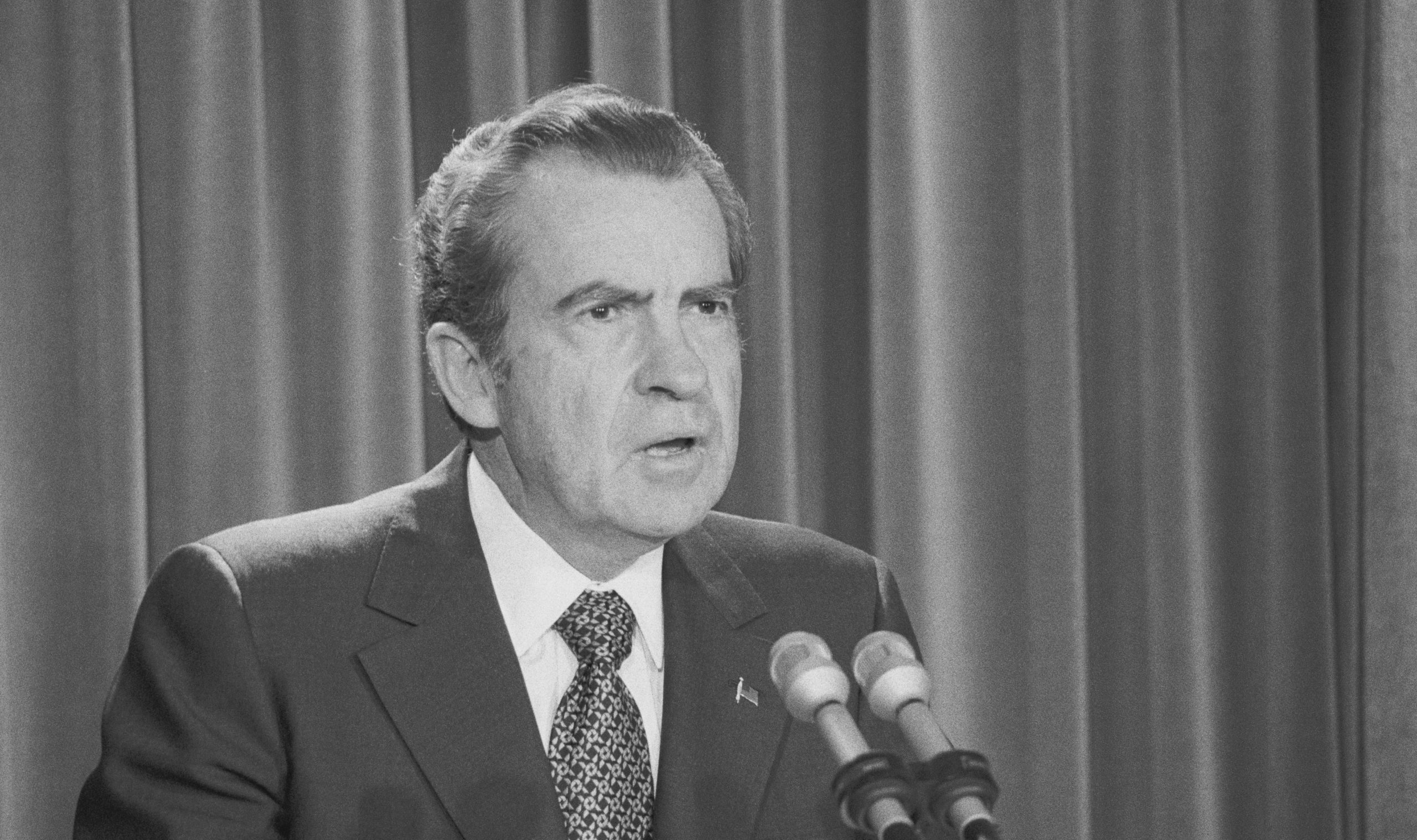
More than three decades after his death, Richard Milhouse Nixon is finally having his moment. A new generation of conservatives has come to admire the 37th president. They see him as the model Republican leader, far superior to Ronald Reagan and even Donald Trump. Hype edits of his speeches regularly go viral on social media. To those who partake in Nixonmaxxing, as the phenomenon has been dubbed, he is the man who nearly saved America—until the deep state took him out.
On the one hand, Nixonmania is a necessary corrective to the image propagated by the media over the past 50 years. His critics, basing their arguments mostly on hysteria and liberal hand-wringing, largely succeeded in portraying Nixon as one of the worst presidents in American history—a characterization that falls apart before the actual evidence.
But the new Nixon myth also has issues. Nixon had few substantive accomplishments as president, especially on the issues dear to the Online Right. While one of the better presidents when it comes to foreign policy, he had no real domestic achievements, aside from advancing liberal causes and programs. In many ways, the country actually got worse on his watch, with crime spiraling out of control and the economy plummeting. Nixon may not be responsible for these developments, but he certainly didn’t solve them.
What, then, explains the right’s newfound enthusiasm for Nixon? At its core, the hype is driven less by substance and more by the need for a New Right predecessor to Trump.
For years, the conservative movement idolized Reagan. Republican presidential candidates would always tout themselves as the next Gipper, playing up their admiration for the 39th president. The Reagan myth built him up as a neoconservative who only cared about foreign interventions and tax cuts. There were many Reagan admirers who praised him for signing the ’86 amnesty into law and argued Republicans should do the same in 2007 and 2013.
The Online Right, naturally, found this extremely cringe. It embodied everything they hated about Conservatism Inc. And in their rejection of the GOP establishment, they also dispensed with Reagan, looking for other leaders whom they could more directly and compellingly connect with Trumpism.
But there weren’t a lot who fit the bill. George Bush père was a one-term globalist. The colorless moderate Gerald Ford was obviously out of the question. And Eisenhower, accomplished though he might have been, was too stiff and too antiquated to replace Reagan as their guy.
That left Nixon. And in fact, he had a lot to recommend him. He was economically heterodox, he spoke up for the Silent Majority, he presented himself as a populist, he tried to fight the culture war, he was well read and intellectually curious, he addressed many controversial topics, he exhibited a certain kind of charisma, and liberals saw him as the devil incarnate. (If the left hates him so much, there must be something to him!) It’s much easier to imagine Nixon as a proto-Trumpian figure than it is to draw the same picture of Reagan or Eisenhower.
It’s also true that the rehabilitation of Nixon didn’t suddenly begin this year. It’s been a notable trend since at least 2023, with prominent right-wingers like Christopher Rufo, this magazine’s executive director, Curt Mills, and even the vice president of the United States touting Nixon’s virtues. Cannily, the Richard Nixon Foundation also recognized this burgeoning interest, and worked assiduously to pitch their man as someone aligned with the Trumpian moment.
And now we get articles about how hot girls are allegedly obsessed with Nixon.
One gets the sense that this newest crop of enthusiasts is mainly there for the vibes. The Wall Street Journal recently interviewed several young Nixxonmaxxers, and seemed to struggle to find someone who could point to any of Nixon’s actual policies. The popular X personality and podcaster Comfortably Smug told the Journal that young conservatives like Dick because he’s a “heterodox middle finger to the establishment.” Rufo added that Nixon is worthy of veneration for having the right enemies, but didn’t explain what ideas animated Nixonism. One young female fan of Nixon did point to the 37th president’s enactment of Title IX and lowering the voting age for reasons to admire—but those aren’t exactly causes dear to the New Right.
There’s a good reason Nixonmania fixates on vibes rather than policy. There simply isn’t much to trumpet in the latter category.
Nixon won the 1968 presidential campaign promising to restore law and order, with an implied pledge to roll back the excesses of the civil rights revolution. He didn’t achieve either end. Crime continued to rise during his presidency, despite his claims in the ’72 campaign that his administration helped stem the tide of violence. Race riots died down, true, but it’s unclear whether his administration did anything to end them. Left-wing violence continued unabated, with the worst wave of leftist bombings happening during his presidency. Campuses were still rife with leftist agitation (witness Kent State).
One could argue it was tough for a Republican president with a Democratic Congress to do anything about these menaces. That’s a fair point.But, there are no excuses for Nixon expanding the civil rights regime. Nixon significantly broadened affirmative action, ensuring that all government contractors now had to consider race when it came to hiring (great way to own the libs!). He signed the Equal Employment Opportunity Act, making it easier for the federal government to impose liberal dictates on private businesses.
And when he was vice president, Nixon had vigorously championed a radical version of the 1957 Civil Rights bill. To his chagrin, it was neutered in the Senate by then–Majority Leader Lyndon B. Johnson. The bill Nixon favored would essentially become law under LBJ in 1964. That legislation provided the structure for undermining the Constitution and creating a racial spoils system, as Christopher Caldwell persuasively argued in The Age of Entitlement.
Nixon also signed the legislation creating Title IX. Today, this measure is appreciated by conservatives for giving them a tool to oppose trans athletes in girl sports. But before that, it was widely despised by conservatives for undermining meritocracy and due process. During the campus rape hysteria of the 2010s, Title IX allowed universities to punish otherwise innocent young men who were falsely accused of sexual assault and harassment. It also allowed universities to censor speech and to favor female athletes over male athletes in admissions. Nixon is the one who made it possible.
The 37th president also established the Environmental Protection Agency. Perhaps some of Nixon’s conservative fans see this as one of his major accomplishments, but while the EPA has done some good, it has also imposed draconian regulations on businesses and individuals. Hardly a clear conservative victory.
Many New Rightists admire Nixon for his economic heterodoxy. He was no dogmatic libertarian, that’s for sure. Yet his policies did little to help the economy. Unlike the conservatives who succeeded him, Nixon championed government solutions to economic problems. He imposed temporary wage and price controls and subsidized farmers to reduce crop output. His dramatic solutions did nothing to alleviate America’s woes and made the terrible economy of the 1970s worse. Economic heterodoxy isn’t always a good thing.
Then there is the judiciary. When Nixon came into office, he had to deal with a Supreme Court that had been reliably liberal since the days of FDR. And when he had the chance to pick his own justices, he did little to change this. Out of his four Supreme Court appointments, only William Rehnquist proved to be a reliable conservative. The three of the four on the court at the time ruled in favor of mandated busing in Swann v. Mecklenburg. Three out of the four ruled in favor of nationally legalized abortion in Roe v. Wade. And half of his picks ruled in favor of affirmative action in California v. Bakke.
Trump is widely criticized by the Right for his court picks, but all three are still reliably conservative even though they don’t always rule the right way. Nixon went one for four.
Foreign policy is the one area where Nixon had legitimate accomplishments. He ended the Vietnam War. He opened up China and consummated the Sino–Soviet Split. He countered leftism in Latin America while pulling off détente with the Soviet Union. He chucked aside liberal humanitarianism in favor of a clear-eyed realism that dealt with the world as it actually was, rather than as he might have wished it to be. America’s leaders can still learn a lot from Nixon on foreign policy.
And what of Watergate? The break-in and cover-up, such as it was, has forever tainted Nixon’s name, but the scandal was more a nothingburger than a grand scheme to end American democracy. Every president from FDR to LBJ spied on their political opponents to some degree. But unlike Nixon, they were largely able to rely on the FBI to do the job. Nixon had to turn to bumbling amateurs, which is why they got caught. Nixon fans argue that their man was trying to replace the deep state with a better intelligence apparatus, but if it was anything like the Watergate operation, the CIA and the FBI didn’t need to worry. G. Gordon Liddy and co. couldn’t outwit hotel security, much less threaten the pros.
Nixon was a fascinating man. He was a brilliant politician who knew how to navigate the tumultuous world of 20th-century America. He was also a serious thinker who pondered the deep questions of life far more earnestly and interestingly than the average politician. (He is probably the only president who enjoyed, and understood, Machiavelli and Nietzsche.) He doesn’t deserve the scorn he received from liberal critics, and he was right to hate the left-wing press.
Subscribe Today Get daily emails in your inbox
But he’s not the great president Nixonmania imagines him as. He was an okay president. Eisenhower, Reagan, and, yes, Trump, racked up more accomplishments. Reagan’s cornball reputation makes it easy to mock him, but unlike Nixon, he tried to take on the civil rights regime and only failed due to lack of sufficient political support among his fellow Republicans. His policies helped reverse America’s economic decline and his foreign policy helped defeat the Soviet Union. His rhetoric may make right-wingers roll their eyes, but Reagan’s achievements can’t be denied. Even his greatest failure, the 1986 amnesty, was more the fault of Congress than his White House (it was also pitched as an immigration control measure rather than a reward for illegals).
Trump gets a lot of criticism from the right for allegedly not doing anything, but he’s done far more on the issues than Nixon. He has actually rolled back much of the civil rights regime, chipped away at affirmative action, and crippled DEI. He’s also the first president to significantly reduce immigration since Calvin Coolidge. The mass inflow of illegal immigration that Americans took for granted has essentially stopped under his watch.
Of course, Trump has made mistakes—but then so did Nixon. And when it comes down to it, what matters most are results. Nixon is far from the worst president to admire, but his record doesn’t justify the current faddish idolization.