U.S. Pastors Become Willing Ambassadors for Israel’s War
More than 1,000 U.S. pastors flew to Jerusalem on December 3–7 for the Friends of Zion Ambassador Summit, a fully funded trip backed by Israel’s Ministry of Foreign Affairs.
When one megachurch pastor in Texas received his invitation to the summit, he reviewed the itinerary and said to himself what any discerning Christian leader should have said: “This feels like an indoctrination trip, not ministry.” He declined immediately. But a thousand others became part of what Israel’s foreign ministry called “the largest Christian delegation ever to visit Israel.”
No modern government has ever invested so much money, coordination, and political effort to mobilize American pastors before now. Why would Israel pay to assemble 1,000 Christian leaders, covering their airfare and luxury accommodations, and choreograph their every step?
And more importantly, why would spiritual leaders allow themselves to be used in this way?
At a minimum, it raises serious questions about whether American religious leaders should be mobilized to serve the interests of a foreign government rather than the interests of the United States.
The summit was not a spiritual gathering. It was a political operation wrapped in Scripture, engineered to manufacture a religious mandate for policies that cannot withstand moral scrutiny. It was statecraft masquerading as spiritual experience.
The summit’s own “Before You Go” guidelines made the contradiction unavoidable. Pastors were told that public evangelism and distributing Christian materials were prohibited in Israel, and that they should refrain from preaching altogether. In effect, the very faith that has driven Christians to share the gospel for two millennia was instructed to remain silent in Jerusalem.
The attendees did not reflect the breadth of American Christianity. Many of the private invitations were circulated by the highly criticized White House Faith Office, led by Paula White-Cain, or through networks of politically aligned activist pastors. No mainline denominations, evangelical institutions, or global church bodies were included. Presenting this narrow political cohort as the voice of American Christianity is as misleading as it is strategic.
The itinerary revealed the intent. Pastors were guided through a tightly curated emotional journey of military briefings and visits to selected trauma sites—all designed to produce loyalty, not understanding. They met Israeli officials, not the local church. They heard talking points, not theology. They saw what they were meant to see and were shielded from what they must not see.
For Palestinian Christians watching from just miles away, the scene felt familiar. It mirrored a pattern we know from both daily life and the Gospels: political authority and religious influence aligning while the vulnerable bear the cost. In Jesus’ time, Pilate and the Sanhedrin reinforced each other’s power at the expense of justice. Today, Christians in Bethlehem and Jerusalem see a similar convergence that deepens displacement, restricts worship, and silences the very Christian communities rooted in this land.
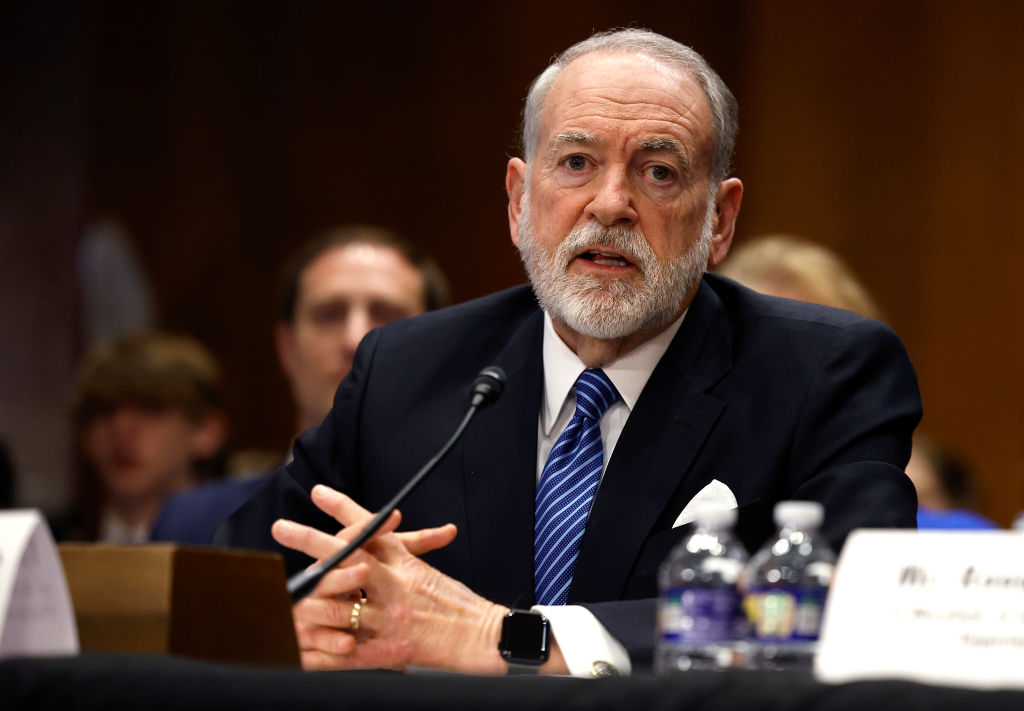
That convergence was reinforced not only by who was excluded, but by what was said at the summit, which paired exclusion with theological coercion. U.S. Ambassador Mike Huckabee told the assembled pastors that “there is a growing cancer within the evangelical movement” because some Christians do not interpret Scripture exactly as he does regarding Israel. He even warned that disagreeing with his political theology “borders on blasphemy.”
This is theocratic pressure dressed in the language of faith. It is a demand that pastors surrender their moral agency to the talking points of a foreign government. Christian leaders who swallow that logic become political instruments rather than shepherds.
The moral failure here is not abstract. The 1,000 pastors who enjoyed their free trip to Israel did not seem concerned that Palestinian Christians living minutes away cannot freely access their own churches in Jerusalem and other holy sites without Israeli military permission.
Yet these pastors were paraded as Israel’s spiritual partners while the indigenous church—the men, women, and families who actually bear the weight of life in the land—were treated as an inconvenience.
No American pastor should be recruited into a project that ultimately normalizes perpetual conflict or provides religious cover for endless war.
Some defenders say this was simply a show of Christian support for Israel. But the summit went far beyond support. The organizer Mike Evans urged pastors to push back against criticism of Israel by dismissing dissent as propaganda from Qatar and others. In other words, he intimated, anyone who seeks to draw attention to the suffering of Palestinian Christians must be part of a foreign plot.
Reducing compassion to disinformation in this way is not only morally bankrupt; it is a direct assault on the Christian conscience.
As a Palestinian-American evangelical with family in Bethlehem and Gaza, and as someone who leads ministry across the region, I listened to this rhetoric with grief. Christians across history have interpreted Scripture differently, especially on matters of prophecy and politics. Treating theological disagreement as betrayal is both irresponsible and theologically unsound.
Subscribe Today Get daily emails in your inbox
If anything borders on heresy, it is the idea that requiring unquestioning loyalty to Israel or any modern state is a test of Christian faithfulness.
What happened in Jerusalem last week was not a spiritual high point; it was a crisis of Christian integrity. It revealed how quickly the pulpit can be weaponized when pastors forget that their first loyalty is not to presidents, prime ministers, or political alliances but to their God who demands truth, justice, and compassion for all people.
When faith becomes a tool of the state, it ceases to be faith. And when pastors allow themselves to be mobilized as foot soldiers in someone else’s geopolitical campaign, the church loses not only its witness but its soul.