The Overrated Father of Modern Liberalism
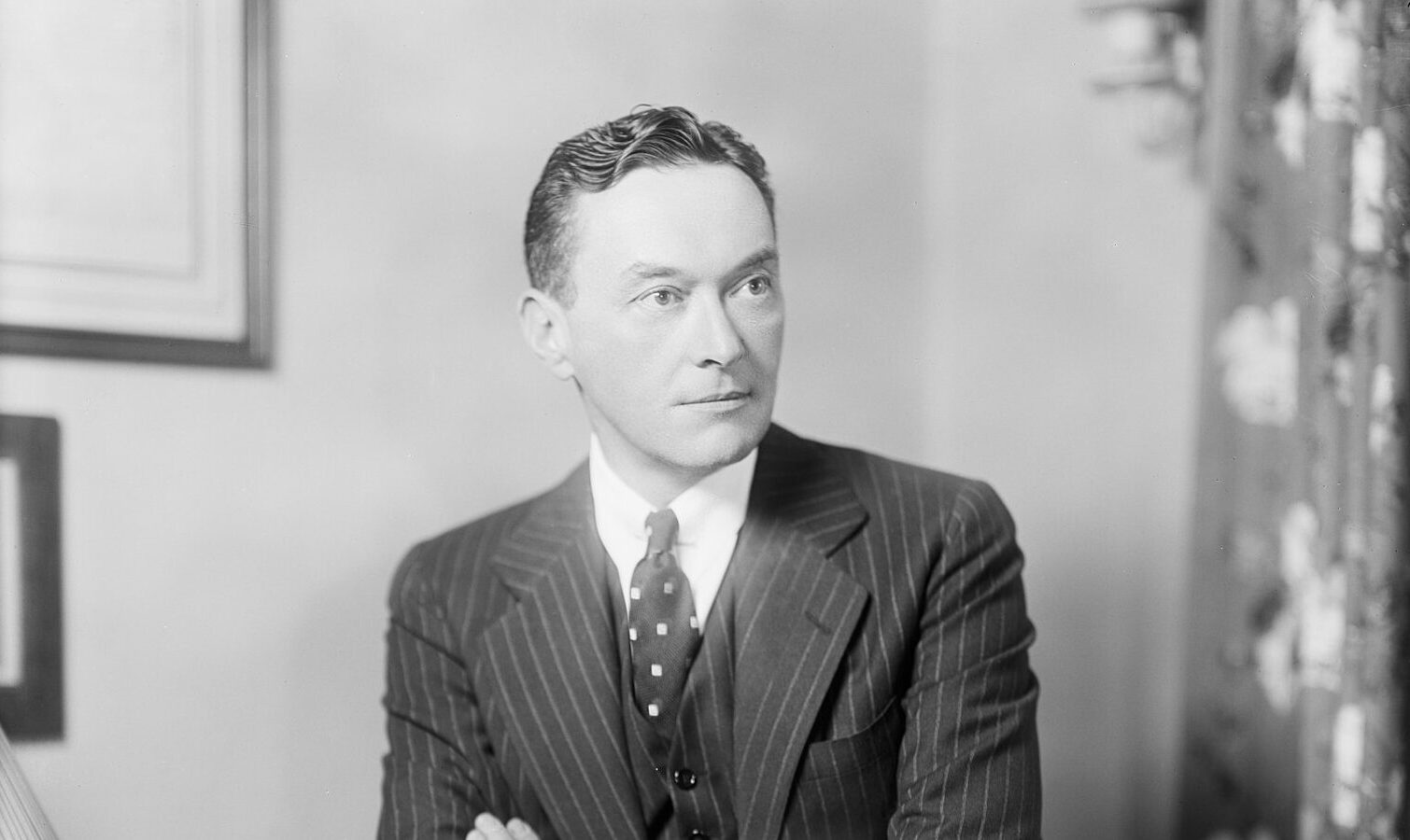
Walter Lippmann: An Intellectual Biography
by Tom Arnold-Forster, Princeton University Press
368 pages, $35.00
In 1982 Ronald Steel won the National Book Award for his voluminous biography of the long-lived public intellectual Walter Lippmann (1889–1974), whose career as a journalist and author of middlebrow works on political theory spanned most of the last century. Despite his desire to appear consistent as he surveyed the American political scene, Lippman changed his positions on key political issues over the decades. Beginning as an editor of The New Republic in 1914, in which capacity he became a pro-English interventionist in the Great War and an advocate of expanded managerial government, Lippmann later had second thoughts about Wilsonian interventionism before becoming an ardent interventionist against Nazi Germany.
In the post-World War II era, Lippmann went from being a moderate Eisenhower-Republican to a critic of the arms race and the Vietnam War. Although initially expressing reservations about the civil rights movement, by 1957 he had become a vocal supporter of the Civil Rights Act passed that year.
An undoubted strength of the Steel biography is that it’s written with an attempt to understand the historical context in which Lippmann took his sometimes-changing views about American public life. Steel places Lippmann squarely in the framework of the twentieth-century American society and government that he advised and commented on. Looking at Lippmann from a temporal distance, it seems that for all his changes of position, he usually took what became establishment stands, and at the beginning and end of his life his opinions can be located somewhere in the left-center. The question is to what extent Lippmann’s views became conventional through his own influence and to what extent he simply reflected what had already become fashionable opinion among elites.
Noticeably, Lippmann followed mainstream liberal opinion in praising the Nuremberg Trials for setting wise international standards for proper relations among nations and peoples. Lippmann was in favor of a Pax Americana after World War II that would guarantee world peace and security, but he turned against the Vietnam War when other respectable intellectuals did. He also viewed democracy as requiring administrative expertise, a view that characterized his thinking from his early days at The New Republic onward. Lippmann may have enjoyed a certain cachet because he eloquently expressed what was on its way to becoming acceptable opinion. He was in that respect an earlier version of George Will, someone to whom Lippmann has often been compared—usually to Lippmann’s advantage.
In Walter Lippmann: An Intellectual Biography (Princeton University Press, 2025), Tom Arnold-Forster covers much the same ground as Steel. A fellow at Oxford’s Rothermere American Institute, Arnold-Forster has devoted considerable time and energy to investigating his subject’s life; and from his footnotes it seems that he has thoroughly examined the available collections of Lippmann manuscripts at the Yale Sterling Library, among other places. This book began as its author’s doctoral dissertation at Cambridge, which he gradually expanded into an “intellectual biography.”
The publisher, Princeton University Press, probably believed that the older, more exhaustive Steel biography, which has gone through several editions, has its best days behind it, and the press might therefore take advantage of any remaining interest in Lippmann by bringing out Arnold-Forster’s more concise work. It is almost impossible to look up the older biography on my computer screen without viewing all the advertising space that Princeton has purchased to promote this new one.
What may also have been intended with this new study of Lippmann is to provide readers with an ideologically updated study of its subject. Unlike Steel’s study, this one is full of favorable references to the black Marxist W.E.B. DuBois. Arnold-Forster does mention figures of the right, like Frank Meyer and William F. Buckley, but he does so usually to show how mistaken or malicious these reactionaries were based on our more enlightened understanding of the world. His treatment of the failures of the unimaginative “technocrat” Herbert Hoover stands in contrast to his praise for the brilliant leader FDR, an opinion that seems to come less from Lippmann than from standard FDR hagiography. For the record, FDR ran to the right of Hoover in 1932 and accused the incumbent of engaging in too much deficit spending.
Arnold-Forster comes down hard on Lippmann for supporting Eisenhower in the 1950s. The reason, it seems, is that Eisenhower and the author’s predictable bête noire, Joe McCarthy, were in the same party. Lippmann supposedly should have followed the example of poet and political commentator Peter Viereck, who voted for Adlai Stevenson, as an anti-McCarthy “conservative.” If memory serves, Ike went after McCarthy with a vengeance after Senator Joe made accusations against the army. I’ll avoid bringing up M. Stanton Evans’s massive study of McCarthy, which meticulously proves that the notorious anti-communist was generally right in his charges, even if his public behavior was sometimes rather unseemly.
Subscribe Today Get daily emails in your inbox
Arnold-Forster uses several pages to go after William F. Buckley and like-minded conservatives during the 1950s and 1960s for being racists as well as obsessive commie-haters. Buckley, according to this Lippmann-biographer, combined his enthusiasm for McCarthy and other expressions of “antiliberal conservatism” with “explicitly antidemocratic racism over the Civil Rights Act of 1957.” Buckley did indeed oppose that act and even expressed a preference for “the more advanced race” being left in control of political affairs in the Southern states. But despite this socially unacceptable phrasing, what Buckley clearly meant with his demur was that he didn’t want to deliver government into the hands of those who could be easily radicalized. Later, as Arnold-Forster notes, Buckley changed his position to call for laws banning the illiterate from voting. Arnold-Forster seems offended by this as well, although this was the position of that English feminist and early welfare-state democrat, John Stuart Mill, in the 1850s.
Fortunately for Lippmann’s odyssey, as told in this biography, his career ended in a way his biographer can appreciate. During the last 14 years of his mortal existence, he rallied to JFK and was a Camelot aficionado. He also opposed the Vietnam War and called for more conciliatory diplomacy in dealing with the communist powers.
But if one looks beyond its preachy political judgments, this biography clearly has its value. It is an easily accessible source of information about Lippmann’s writings and the major turning points in his life. As an intellectual biography, it also deals with philosophical matters, e.g. Lippmann’s differences with John Dewey on the nature of democracy and its compatibility with popular self-rule. Finally, this book may give us a more accurate picture of its subject’s significance than Steel’s capacious study, which, in my view, exaggerates Lippmann’s titanic stature as a public intellectual. Once a celebrity whom even presidents consulted, Steel’s subject seems to have lost his luster since his death more than 50 years ago. Reading Arnold-Forster, one can understand why.