Inside the White House’s New Press Reality
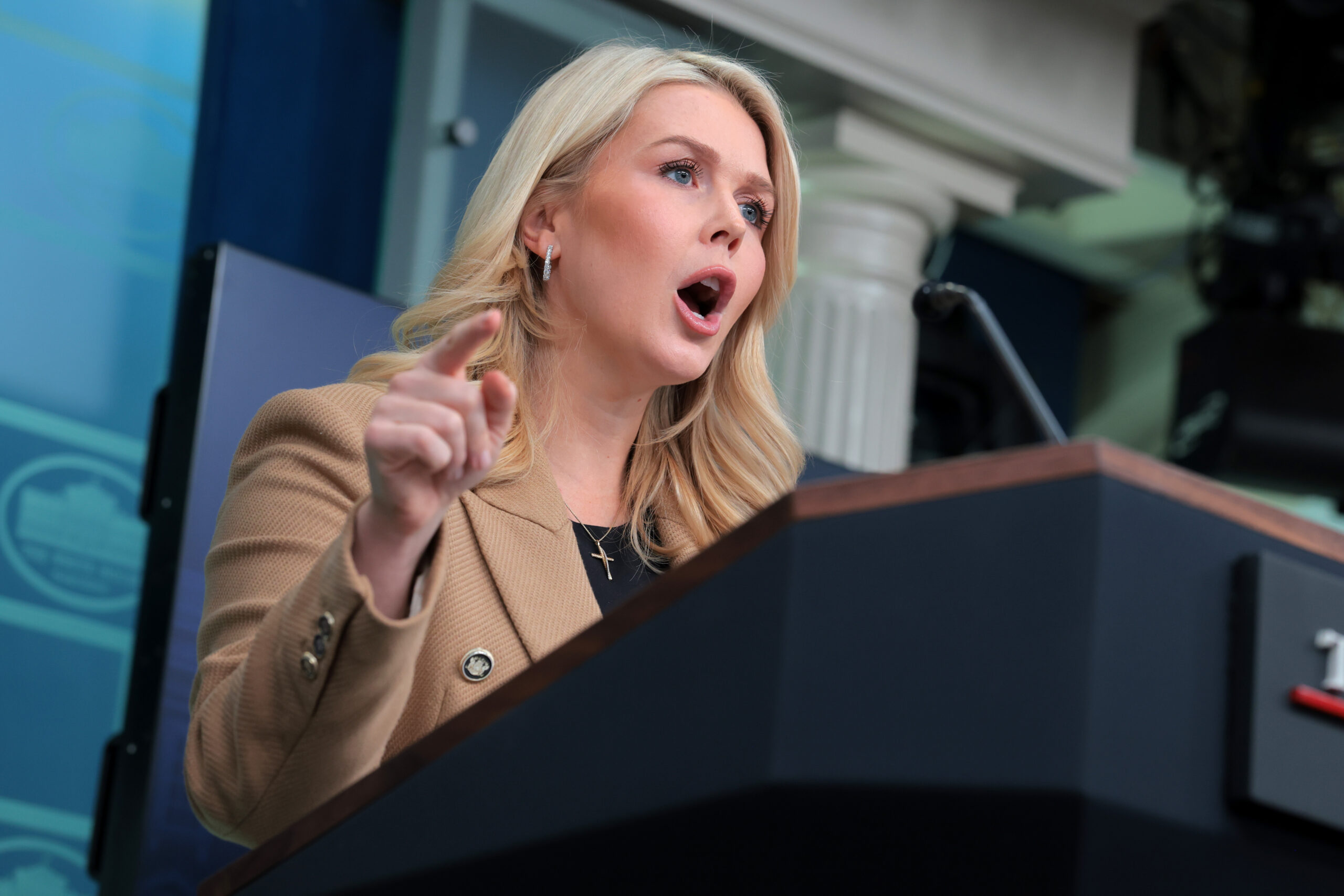
Riley Gaines had just debuted as a spokesperson for the Department of Agriculture’s new milk-mustache ad campaign when she made her first appearance in the White House press briefing room Thursday afternoon.
Press Secretary Karoline Leavitt was overjoyed to see the former collegiate swimmer–turned–conservative commentator in attendance and, after addressing the escalating protests in Minneapolis, directed the first question of the day to her.
“I’m surprised it took us a year to get you here but I’m very happy to see you,” Leavitt said before personally promoting Gaines’ new podcast. “So, thank you, and you brought a beautiful baby and husband too, so thank you so much for joining and why don’t you kick us off.”
As Gaines’s husband Barker wrestled with the pair’s 3-month-old baby Margot, who was wrapped in a bulletproof blanket due to “death threats,” the former swimmer immediately began reciprocal praise of Leavitt: “First and foremost, congratulations to you, being a girl mom will change your life in the best way possible,” gushed Gaines. In Trump’s new press corps, flattery increasingly comes before real journalism.
Amid a packed news cycle—the seizure of another oil tanker in the Caribbean, another night of volatile protests in Minneapolis, and Venezuelan opposition leader María Corina Machado arriving at the Capitol—the first question of the day landed elsewhere. It concerned transgender athletes, an issue being currently weighed by the Supreme Court.
Leavitt couldn’t have been happier with the line of questioning, as was evident by her blissful reaction to Gaines, responding in a tone that sounded closer to that of a third-grade teacher praising a student for getting the correct answer. The happy-go-lucky exchange stood in stark contrast to what was to come when Leavitt was forced to field a tough question from a real reporter only a few moments later.
Niall Stanage, a White House columnist for the Hill with decades of experience across major outlets, including the Wall Street Journal, drew criticism from Leavitt after he challenged the Trump administration’s characterization of the death of the 37-year-old Renee Good, an American citizen and mother of three, who was shot and killed by ICE agent Jonathan Ross during a confrontation in Minneapolis last week.
“Earlier, you were just defending ICE agents generally,” Stanage began. “And earlier on, Secretary Noem spoke to the media and she said, among other things, that they are doing ‘everything correctly.’ Thirty-two people died in ICE custody last year. A hundred seventy U.S. citizens were detained by ICE, and Renee Good was shot in the head and killed by an ICE agent. How does that equate to them doing ‘everything correctly’?”
“Why was Renee Good unfortunately and tragically killed?” Leavitt snapped back at Stanage.
“Because an ICE agent acted recklessly and killed her unjustifiably,” replied Stanage.
“Oh OK, so you’re a biased reporter with a left-wing opinion,” replied Leavitt.
“What do you want me to do?” asked Stanage incredulously.
“Yeah, because you’re a left-wing hack, you’re not a reporter, you’re posing in this room as a journalist, and it’s so clear by the premise of your question,” Leavitt said. “And you, and the people in the media who have such biases but fake like you’re a journalist, you shouldn’t even be sitting in that seat. But you’re pretending like you’re a journalist… and the question that you just raised and your answer proves your bias.”
In the aftermath of the exchange, the White House X account was celebratory. “Leavitt DESTROYS a ‘Left-Wing Hack’” read the caption above video of the pair’s back and forth. And though a cursory scan of Stanage’s X account does show a left-of-center (but hardly militant progressive) bias, and though his description of the ICE-involved shooting was adversarial, his question was not unreasonable. The many visual angles provided of Good’s death have left ample room for questioning of ICE’s actions, especially when the result is a dead American, regardless of her openly anti-Trump politics.
Leavitt’s aggressive tenor on Thursday tracked perfectly with the second Trump administration’s general tone regarding the long-tenured journalists who have covered the ins and outs of Washington DC and its presidents in the 21st century. Podcasters and influencers who speak glowingly of Trump and his allies are received as heralded heroes while anyone who dares question the merits of any of Trump’s admittedly singular policies are met with stern gazes and animated anger.
Subscribe Today Get daily emails in your inbox
Leavitt’s fiery encounter with Stanage came on the same day that Pentagon officials announced they would assume editorial control of the long-independent military newspaper Stars and Stripes, citing a desire to curb what they called “woke distractions.” In a post on X, Pentagon spokesperson Sean Parnell said the department would “modernize its operations, refocus its content away from woke distractions that siphon morale, and adapt it to serve a new generation of service members.” Part of curbing “woke distractions” now includes a pledge of allegiance to Trump as new applicants are being asked how their coverage would distinctly advance the agenda of the Trump administration.
The decision to promote right-wing commentators, influencers, and podcasters who reliably amplify the Trump administration has been consistent since Leavitt took ownership of the James S. Brady Briefing Room in January of 2025. More than 30 “new media” outlets, most outwardly and proudly right-wing in nature, have rotated through the briefing room in the year since Trump took office. (Somewhat inscrutably, The American Conservative, which is almost a quarter-century old, was invited to a press briefing as a “new media” outlet.) And though to some degree it can fairly and accurately be argued that the American press has shifted increasingly leftward in its coverage since the Second World War, especially on social and cultural issues, the blowback against journalists who dare question the policy positions of the second Trump administration raises questions about what exactly the point of the exercise is.
In a Trump era that claims to prize merit and accountability, the administration has adopted a press strategy that rewards loyalty over rigor and access over expertise. Experience is no longer a credential; it is a liability if it produces questions the administration would rather not answer. The result is a briefing room where affirmation is mistaken for fairness and scrutiny is dismissed as sabotage. Anyone who values a free press should be concerned not only about how this administration treats reporters today, but about the precedent it sets for administrations to follow.