Blame the War, Not the Peace Deal, for Iran’s Leverage
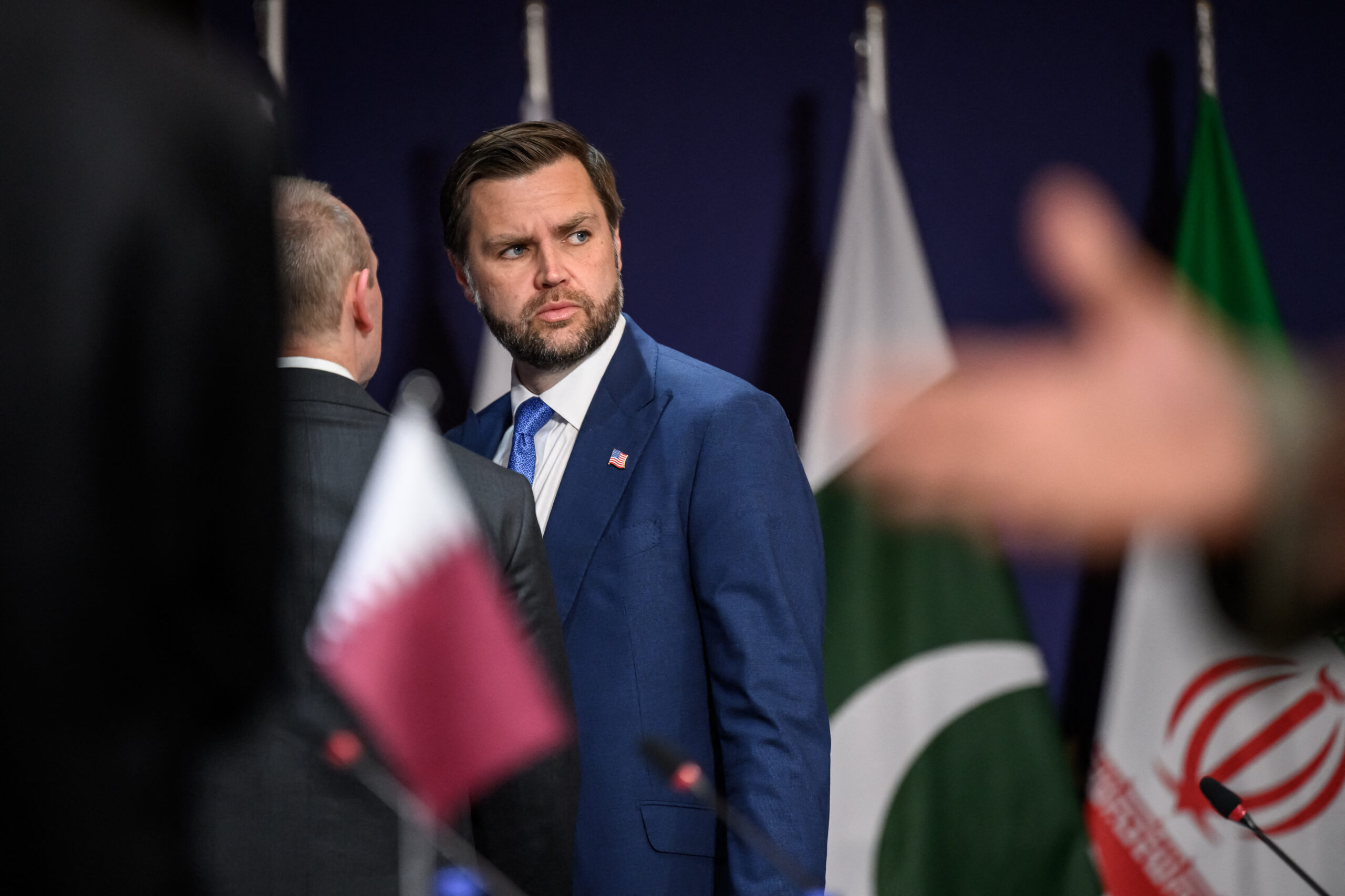
Nobody is making it easy for Vice President J.D. Vance and his team of negotiators.
Israel’s continued military campaign in Lebanon has caused Iran to doubt America’s commitment, or ability, to carry out the very first point of the memorandum of understanding (MOU), which calls for an end to the war in Lebanon and ensures that nation’s “territorial integrity and sovereignty,” and has led to the possible reclosure of the Strait of Hormuz.
Trump’s threat, as the negotiators sat down to talk, to the Iranians that if they close the Strait, “you won’t have a country. You won't even make it back to your f---ing country” violated the clause in point one committing both sides to “refrain from the threat or use of force against each other” and nearly caused Iranian negotiators to walk out just as they were getting started.
The only gain the U.S. negotiators have secured so far is that Iran, in Trump’s words, “fully and completely agreed to the highest level Nuclear inspections.” But have they? Iran’s foreign ministry spokesman, Esmail Baghaei, says Iran has “no plans to invite inspectors from the United Nations International Atomic Energy Agency to nuclear sites that were hit by U.S. and Israeli airstrikes in June 2025.”
Secretary of State Marco Rubio says that’s not true: “We know what they agreed to. I don’t know why they have to say the things they say.”
Iran aims to table nuclear negotiations until near the end of the current talks, but it likely will have to agree to inspections as part of the complete agreement. But that is not a U.S. negotiating win that can be sold to justify the war.
As a signatory to the Nuclear Non-Proliferation Treaty, Iran has historically allowed inspections of its nuclear sites. As part of the 2015 JCPOA nuclear agreement, Iran implemented an Additional Protocol agreement and voluntarily subjected itself to perhaps the toughest inspection regime in history. They suspended the Additional Protocol only in 2021, almost three years after Trump pulled out of the JCPOA and subjected Iran to maximum pressure sanctions. It was only after the bombing of Iran’s civilian nuclear facilities in June last year that Iran suspended cooperation with the International Atomic Energy Agency. The U.S. isn’t likely to secure an inspection regime better than what the JCPOA brought. But, for Iran, some things may well be better.
Agreement has been reached to begin releasing frozen Iranian funds. After the first day of negotiations, the release of $12 billion of frozen funds was agreed to. That promises massive economic relief for the Iranian people.
Trump says, “Money that’s being unfrozen is going to be used to buy food, and the food is going to be bought exclusively through the United States.” But remarks by Iranian officials suggest that may not be true. Iran’s central bank governor, Abdolnaser Hemmati, says that, although Iran can purchase American agricultural products “if the price and quality of American inputs are more suitable compared to other countries,” Iran is under “no obligation” to do so under the MOU. Indeed, the document states that the unfrozen funds “shall be made fully usable for payment to any ultimate beneficiary designated by the Central Bank of the Islamic Republic of Iran.”
And Iran has, at least temporarily, won another massive source of economic relief from maximum pressure sanctions. This week, the U.S. Treasury Department waived sanctions on Iranian oil exports during the 60-day negotiations kicked off by the MOU, meaning that Iran can export oil at market rates.
One concession that the U.S. is likely to gain is Iran’s agreement to dilute its 60 percent enriched uranium and to suspend its nuclear enrichment program for a specified time.
Diluting its highly enriched uranium, though, is not a huge win or improvement over the JCPOA era. As part of that agreement, Iran shipped about 97 percent of its enriched uranium to Russia and limited future enrichment to 3.67 percent: enough for a civilian nuclear power program but not nearly high enough for a weapons program. After Trump pulled out of the JCPOA and subjected Iran to maximum pressure sanctions, Iran began enriching to 60 percent—still well short of the 90 percent required for a weapon—precisely as leverage to get a deal like this one.
As for suspending enrichment, depending on the length of the required period, Iran may well be willing to do that too. It probably needs several years to rebuild the war-damaged infrastructure anyway. The extra years are the trade Iran may be willing to make to win two larger prizes. Barbara Slavin, distinguished fellow at the Stimson Center, told The American Conservative that Tehran is willing to temporarily suspend enrichment to win permanent access to their frozen funds, which, ultimately, could bring Iran as much as $124 billion to $167 billion of relief.
But, more importantly, a lesson Iran has learned from this war, Slavin says, is that the ability to close the Strait of Hormuz gives them way more leverage than adding another centrifuge or increasing its stockpile of enriched uranium ever did.
Along with enrichment, the fate of that crucial sea passage is the tough terrain over which the negotiations will be fought.
Rubio says that the Strait is “an international waterway” and that “no country is allowed to charge tolls or fees on an international waterway,” but that’s not quite what the MOU says. It says only that Iran must allow safe passage “with no charge, for 60 days only.” That suggests that Iran could see the realization of its demand to charge a fee for transiting as part of a final agreement.
The Strait had always been free and open prior to the war. But the MOU suggests that it could stay under some kind of Iranian management after the war, stipulating that Iran “will conduct dialogue” with Oman to “define the future administration” of the Strait.
Returning from the first day of talks, Iran’s chief negotiator, Mohammad Bagher Ghalibaf, said, “The Strait of Hormuz will never return to its pre-war conditions and will be administered by the Islamic Republic of Iran.”
Subscribe Today Get daily emails in your inbox
On Tuesday, the dialogue conducted between Oman and Iran produced “a joint working group” on the management of the Strait. Contrary to Rubio’s declarations, the two countries emphasized “their sovereignty and sovereign rights over their territorial waters in the strait.” While they committed to keeping the Strait open and safe, they, notably, discussed “the future administration of navigation in the Strait of Hormuz, the services to be provided there and the associated costs,” suggesting that, though they would charge no tolls, they could charge service and environmental fees.
Iran’s President Masoud Pezeshkian has also made it plain that Iran’s ballistic missile program will “never” be part of the final agreement: “We will never negotiate with anyone, under any circumstances, ever, about our defensive capabilities.” For Tehran, there is no point in a negotiated settlement that leaves Iran in a position to lose the next round of the war: “If the missiles we have for our defense did not exist, Israel and the United States would have ploughed Iran just like Gaza.”
The Trump administration is right to defend the MOU as necessary and good. But it is good because it ends the war instead of allowing it to continue on its increasingly damaging path. They are wrong to defend it as an improvement over the JCPOA or even the deal that was on the table before the U.S. and Israel attacked this February. The Islamic Republic, liberated from maximum pressure sanctions and having demonstrated its ability to close the Strait of Hormuz and withstand major attacks, will be in a stronger position than perhaps ever before. A final agreement should be signed; the war should never have been fought.