A neuroprosthetic system has allowed a man with paralysis to grasp and lift objects and feel touch again. The device helped 42-year-old Keith Thomas of Massapequa, New York, who was paralyzed from the chest down after a diving accident in 2020. After the accident, he couldn’t lift his hands to his face and had no sensation in his hands or wrists. But the innovation, called a “double neural bypass” system, improved his movement. In a study published in Nature Medicine, researchers found that some of Thomas’s improvements lasted for months after the system was turned off, raising hopes the device could help paralyzed patients in the long term.1
Millions of Paralysis Patients Want to Feel Sensation Again
There are roughly 15 million people worldwide living with spinal cord injury, and this patient group often ranks restoration of hand movement as a priority, above bowel and sexual function and the ability to walk.
“This research holds promise for millions of patients, opening up potential for future research and practical clinical applications that could help hundreds of thousands of people living with paralysis,” said Chad Bouton, a bioelectronic medicine researcher at Northwell Health and coauthor of the study, in a statement.
The double neural bypass system uses a brain-computer interface device. This consists of five microelectrode arrays, which can read brain activity and deliver electrical stimulation, implanted into Thomas’s brain.
Continue reading below...
Like this story? Sign up for FREE Newsletter updates:
Latest science news stories
Topic-tailored resources and events
Customized newsletter content
The researchers combined these arrays with electrical stimulation of the spinal cord through wearable stimulation patches placed on Thomas’s skin. The aim: to boost a natural process called neuroplasticity, which governs how well the brain and nervous system can form new connections.
The team recorded Thomas’s brain signals when he imagined the sensation of touch, and then “played” those signals to his muscles through the patches on his skin and directly onto the sensory areas of his brain.
The system incorporated a neural network computational model to decode Thomas’s brain signals. The system proved highly accurate over the study period, identifying Thomas’s intended hand movements for months without retraining on his brain data.
Strength and Dexterity Restored
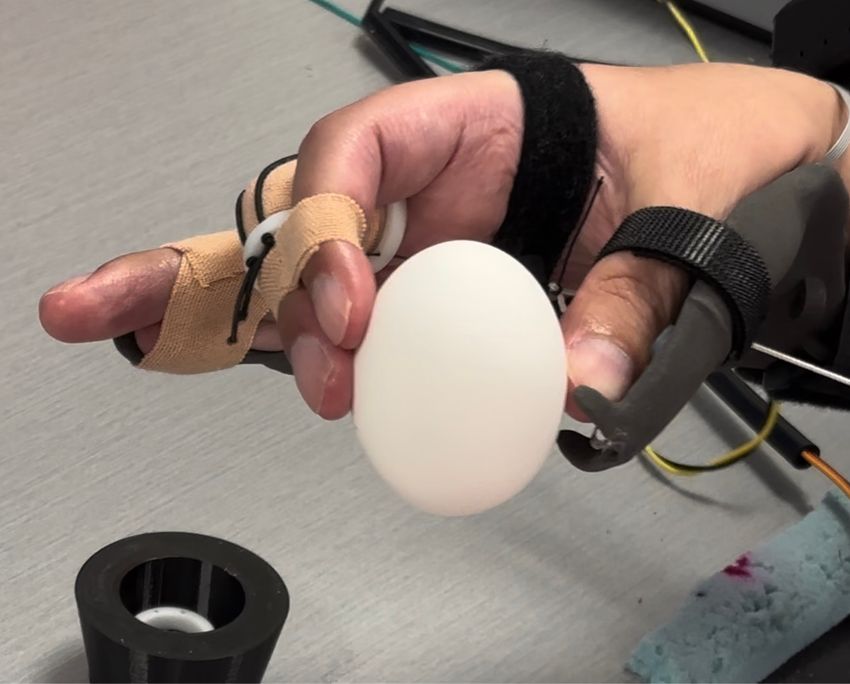
With his brain-computer interface, Keith Thomas now has the dexterity to perform delicate movements like grasping and lifting empty eggshells without breaking them.
Feinstein Institutes for Medical Research
Thomas used the device for 35 weeks, during which his right arm strength increased 86 percent, and his left arm strength increased 62 percent. By the end of the study, he could wipe his nose or scratch his mouth while using the device. The system gave Thomas excellent dexterity. He could lift hollow eggshells without breaking them 87 percent of the time.
At around the six-month timepoint, Thomas regained the ability to feel touch in his right wrist. This was the first time he had felt sensation in his arms since his injury. Importantly and remarkably, some of these improvements persisted outside of the study sessions, when the device was switched off. “Remarkably, in a recent follow-up, it was found these gains were still present after more than two years. This is incredibly encouraging,” said Bouton.
“Being able to feel my sister’s hand, to pet my dog and feel her fur—these experiences that the injury took away have been restored,” said Thomas. “But beyond the study sessions, I can now scratch my face, wipe my eyes independently. The technology has given me back both connection and sense of self.”