How the left fell out of love with Scandinavia
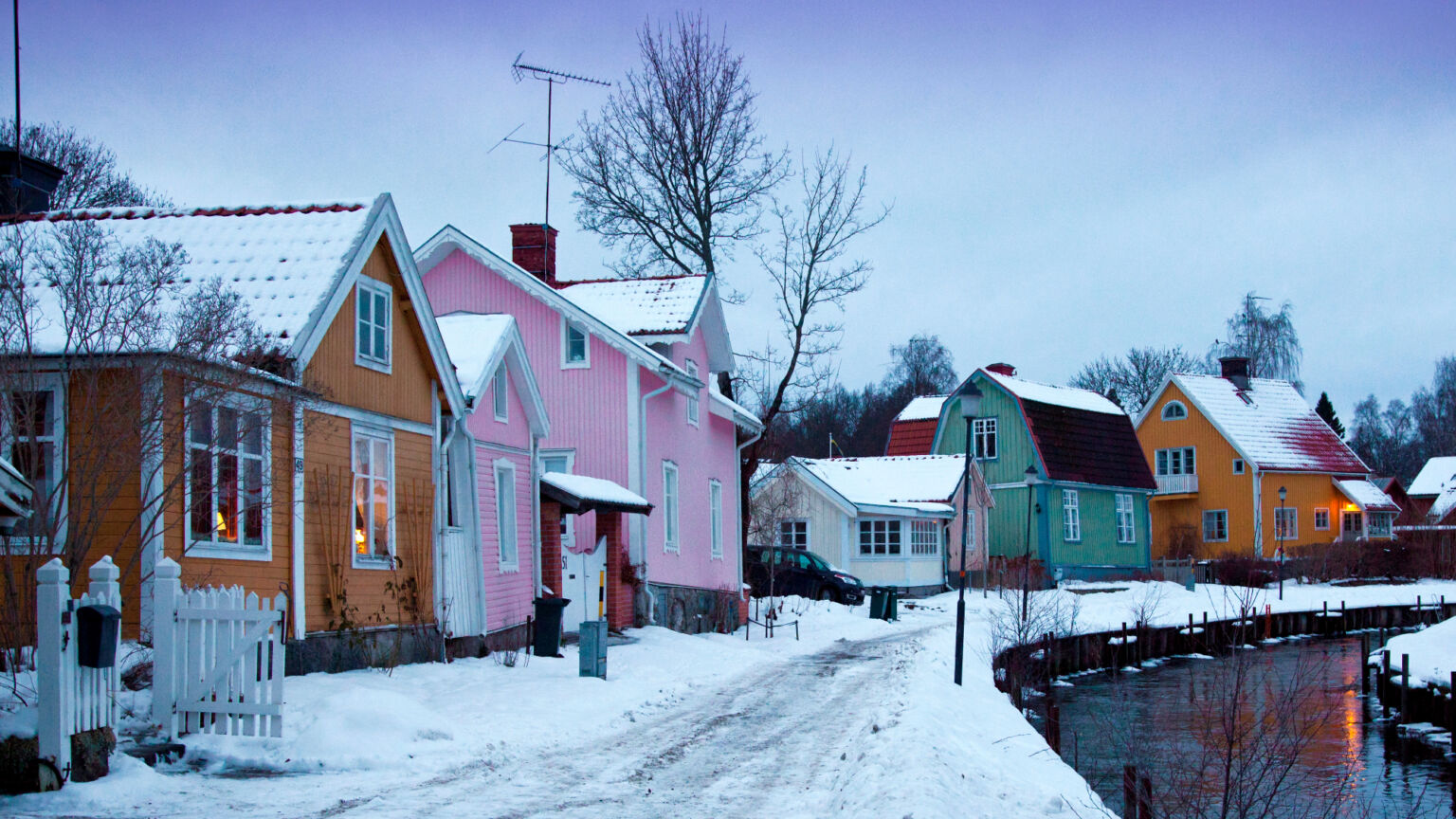
Back in the 2010s, it was rare to hear a bad word said about Scandinavia. Cultural critics were raving about Scandi-noir dramas, from Denmark’s The Killing to Sweden’s The Bridge. Among a broad spectrum of hard-left to centre-left politicians, the Nordics were lauded as model states – as fair, practical and successful countries that were doing something right. Merely mentioning these nations would invoke a sense of ‘hygge’ (a Danish word loosely translated as ‘cosiness’, as just about every magazine and Sunday supplement insisted on informing us). Think ABBA, IKEA, knitted sweaters and social democracy. What’s not to love?
Indeed, Sweden, Denmark and the like seemed to have a special appeal to any left-wing politician accused of being too ‘radical’. US senator Bernie Sanders, who twice came close to bagging the Democratic presidential nomination, regularly cited the Nordic welfare states in order to contrast his model of leftist politics with the despotic regimes bearing the socialist banner. ‘When we talk about democratic socialism… I’m talking about Denmark, I’m talking about Sweden’, Sanders said to a voter whose family fled the Stalinist tyranny of the USSR. ‘I’m talking about countries all over the world who have used their government to try to improve lives for working families, not just the people on top.’ His left-wing ally, congresswoman Alexandria Ocasio-Cortez, has also described her politics as most closely resembling ‘what we see… in Norway, in Finland, in Sweden’. Defenders of former Labour leader Jeremy Corbyn would similarly insist that his programme for Britain would have been mainstream in Scandinavia.
Whether Scandinavia is actually ‘socialist’ or not (it obviously isn’t) is now largely a moot point. For the left now sees something rotten in the state of Denmark… and in Sweden, too. These days, you are more likely to hear the Nordics cursed as pariah states than hailed as model, near-utopian nations. Strikingly, this is despite the fact that what once piqued the left’s interests in Scandinavia has hardly changed in recent years. In 2025, Denmark was ranked the second-happiest nation on Earth. Sweden and Denmark remain egalitarian and wealthy, boasting standards of living above the OECD average. And, most importantly, they retain their generous welfare states and high levels of government spending, with top-class public services to go with it. Not coincidentally, these are some of the very few European countries where the established, legacy centre-left parties have not been totally obliterated (although they have not totally escaped the populist tide, either).
Yet Denmark has strayed from the club of the anointed on one key issue: immigration. It has dared to defy the commandments of the EU, the UN and the NGO-ocracy. It has instead listened to the concerns of the people. Predictably, this has led to charges from an outraged global left that Denmark is now ‘far right’, ‘undeniably racist’ and operating ‘on an ethno-supremacist logic’.
The so-called Danish model for migration began to emerge after the 2001 elections, in which immigration and integration played a central role. The Social Democrats, widely seen as too soft, lost power for the first time since 1924. Yet there is now a cross-party consensus in favour of tighter border controls. In Sweden, the 2015 European refugee crisis not only boosted the populist Danish People’s Party – it also pushed the left to adopt a tougher line. Benefits to new arrivals were cut, rules on family reunion were tightened, and refugee status went from permanent to temporary. In fact, many of Denmark’s most contentious policies – from offshore processing of asylum claims to ‘ghetto laws’, which allow the state to demolish apartment blocks where ethnic enclaves have built up – were pioneered by the Danes’ current Social Democratic prime minister, Mette Frederiksen.
Enjoying spiked?Why not make an instant, one-off donation?
We are funded by you. Thank you!
£5 £10 £20 £50
Choose an amountDonate now
Please wait...
Thank you!
The Danish model has a lot going for it, practically and politically. Asylum claims are at their lowest in 40 years. YouGov polling shows that Danes are far more satisfied with their government’s handling of immigration than any other European public. Frederiksen has managed to stay in power for six years – bucking the EU-wide turn against the left. It’s no wonder the UK’s Labour prime minister, Keir Starmer, and his home secretary, Shabana Mahmood, think there is something there worth copying. Yet their critics on the left are instinctively, irascibly repulsed by what ought really to be seen as a Scandinavian success story.
As you may have guessed, there is a degree of hysteria in the left-wing loathing of the Danish immigration model. Denmark has not suddenly become a closed society. One in six people currently living in Denmark is either a migrant or a descendant of one. In fact, the raw numbers of new arrivals has not even gone down, with annual new residence permits actually quadrupling in the past two decades – ie, in this supposedly wicked era of Danish nationalism and xenophobia. What has changed is the composition of migrants, with a far higher proportion arriving for work and education than for asylum. Arrivals are selected, in other words, for who is most likely to contribute to and integrate into Danish society.
Control over who enters and why, rather than reducing numbers as such, is what the Danish model is about. It is not engaging in some ethno-nationalist programme of ‘remigration’ of either the left’s nightmares or the online right’s wet dreams. Essentially, Denmark is asserting its right as a democratic, sovereign nation to have a border. And it seems this alone is enough to send the Western left into apoplexy.
Denmark may be today’s ugly duckling, but the recent turn against Scandinavia arguably began with Sweden. And, once again, this was because it put its faith in the people and rejected a global consensus among elites. When the Covid pandemic hit in early 2020, and most of the world was entering lockdown, Sweden held its nerve and kept its economy and society open, with minimal restrictions. It trusted the public to follow public-health guidance and behave rationally, without any need for fines or imprisonment to enforce compliance. The Swedish authorities realised it would be both destructive and futile to confine people to house arrest for months on end.
Yet for following this more liberal path, Sweden was subjected to a global smear campaign. The New York Times repeatedly branded Sweden a ‘pariah state’, while its no-lockdown policy apparently made it ‘the world’s cautionary tale’. The left-liberal Guardian, which used to regularly hail Sweden as a ‘model for global prosperity’, denounced Sweden as a ‘model for the right’ and branded its Covid policy a ‘deadly folly’. Sweden was conducting a dangerous ‘experiment’ in ‘Swedo-science’, which had ‘well and truly failed’, the world’s leftist media insisted.
With the pandemic long behind us, we now know for certain there was no basis to this Swedophobic screeching. Far from driving its citizens into an early grave, Sweden actually experienced a far less severe increase in mortality than many other European countries that had long and strict lockdowns. Plus, as well as taking far less of an economic hit, Sweden also avoided the social devastation wrought by those unprecedented restrictions on everyday life. A rare win-win scenario, you might think. But clearly not in the eyes of a left that seemed to relish lockdown for its own sake, and which no longer cares much for liberty or the prosperity of ordinary people.
That the left has fallen out of love with Denmark and Sweden says far more about the left than it does about these supposedly wayward nations. It speaks to a left that has abandoned any commitment to self-government by a sovereign people, and has instead embraced globalism, technocracy and authoritarianism. Denmark is loathed because it has allowed the public to intrude on the debate over immigration. And Sweden was scorned for trusting the people to use their judgement. It is the d-word – democracy – in Scandinavia’s social democracy that today’s left can no longer tolerate.
Fraser Myers is deputy editor at spiked and host of the spiked podcast. Follow him on X: @FraserMyers.