When Ted Judah goes scuba diving off the coast in Monterey Bay, he normally swims at the surface to the area above the dive site and then descends. But on the morning of Dec. 30, the water was exceptionally clear as Judah swam out from McAbee Beach.
“I decided to just put my face in the water and look at everything,” he told SFGATE. And within seconds, something that resembled a blade caught his eye. There was “an undulating thing” attached to it, Judah noticed, and he immediately surfaced and told his wife: “There is something really amazing down here.”
A Monterey Bay Aquarium marine biologist would later identify it as a juvenile king-of-the-salmon, a rare ribbon fish that spends most of its time at around 3,000 feet. Very few humans have seen the unusual and mesmerizing fish alive. But when someone does, it tends to stir up both a lot of excitement and — due to a Japanese legend about ribbon fish sightings portending earthquakes and tsunamis — some amount of trepidation.
Article continues below this ad
For Judah, though, it was an entirely blissful experience and a crowning event of a life centered around the ocean.
His life aquatic
Judah, who lives in Petaluma, grew up in the Bay Area with a father who was an avid diver. At age 8, Judah received his first wetsuit, which his father made by hand, and he went on his first abalone diving expedition. In 1996, Judah met the woman who would become his wife during an advanced open-water diving course in Monterey. The pair dived together often but took a 15-year pause after the birth of their daughter. A few years ago, when Judah’s wife started working at the California Academy of Sciences in San Francisco as a volunteer coordinator, she suggested that they start diving in the tanks there — and elsewhere, too.
Article continues below this ad
They began taking dive trips to the Sonoma coast and Monterey, as well as doing volunteer gigs underwater: cleaning aquarium tanks, conducting surveys of reefs, removing urchins to promote the regrowth of kelp forests. Over the Christmas holiday this year, they traveled to Catalina Island, where they had honeymooned 25 years prior, and visited Jacques Cousteau’s underwater memorial. On their drive back up the coast, they decided to stop in Monterey for one night.
Make SFGATE a preferred source so your search results prioritize writing by actual people, not AI.
Add Preferred Source
Their wetsuits were still damp, which meant they’d be cold. But the couple decided to go diving anyway. And when Judah first laid eyes on the juvenile king-of-the-salmon, he felt a profound sense of gratitude for the majestic fish and all the choices that led to encountering it.
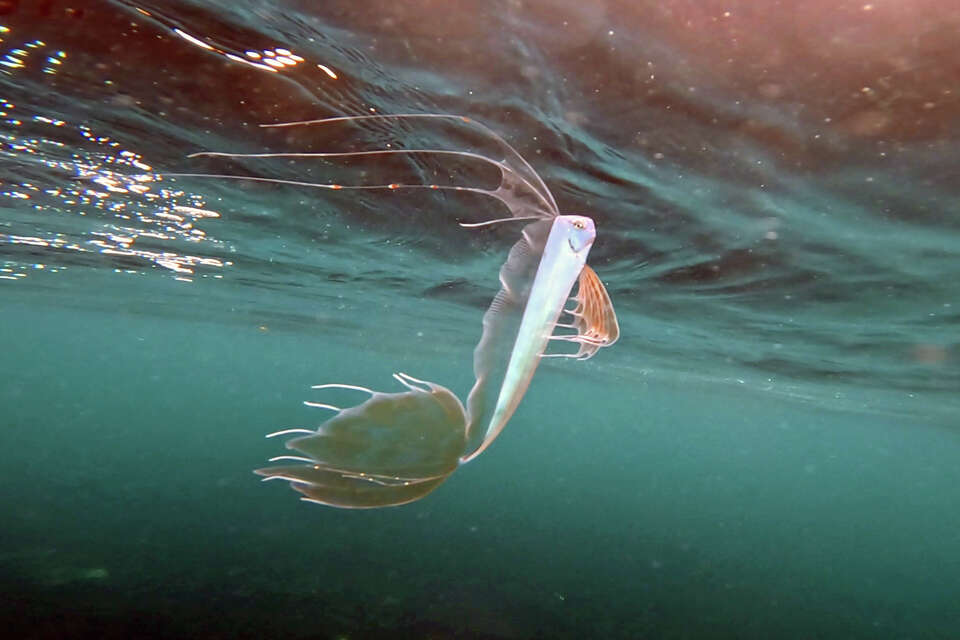
King-of-the-salmon are almost never spotted alive by humans. But diver Ted Judah was lucky enough to see this one.
Courtesy of Ted JudahMeeting the creature
At first, Judah just watched the undulations of the fish, which he estimated to be about 8 or 9 inches long. It had an elongated, silvery body, flamboyant head spines, and several dainty fins and filaments that looked almost like jellyfish tentacles.
Article continues below this ad
The fish was in an upright position and adept at moving both vertically and horizontally. When Judah swam to the fish’s depth, it ascended to the surface and stayed there, glimmering in the perfect light. The fish’s body was narrow like a file, making it difficult to see head-on. And when Judah moved to look at the fish from the side, it would rotate so that its slimmest angle faced Judah. “It was like he knew how to be invisible,” he said.
Judah eventually began shooting video of the fish with his GoPro, sometimes managing to get footage from the side. His wife knew how special the encounter was for him, so she stayed farther back, taking photos of Judah with the fish. After about three minutes, Judah felt it was time to give the fish its space.
“I thought, ‘I don’t want to ask any more of you. You’re an amazing creature.’ And I let him go,” Judah said.
He and his wife continued to the dive site and descended. The visibility was top-notch, and they spotted many of the region’s usual creatures: the kelp fish, the greenlings, the decorator crabs. “The kelp forests were just lovely,” Judah said. “But I couldn’t stop thinking about that fish. I was like, ‘I have to get home and look at this footage.’”
Article continues below this ad
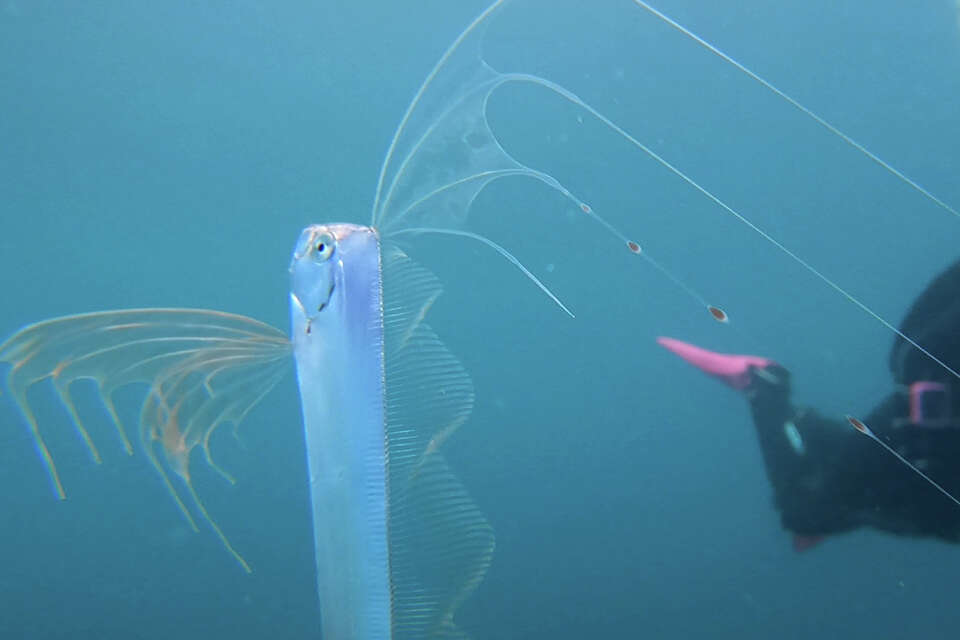
This juvenile king-of-the-salmon fish was spotted Dec. 30 in Monterey Bay.
Courtesy of Ted JudahThe rare fish makes waves
Back in Petaluma, Judah began going through his images and posted a few in a diver group on Facebook, asking whether anyone knew what he had seen. Immediately, people got very excited.
“Wicked COOL! You’re a lucky diver!” one user wrote. “Buy a lotto ticket!” wrote another.
Article continues below this ad
Someone else chimed in to suggest that Judah share the images with the Monterey Bay Aquarium and the California Academy of Sciences. In fact, a representative from the aquarium had already seen them.
“I am the senior collector (marine biologist) at [Monterey Bay Aquarium] for 25 years,” Kevin Lewand posted. “I have already shared this with the top ichthyologists in California. It is a juvenile king-of-the-salmon, Trachipterus altivelis. That is [the] second one observed this year! Really cool!!”
Other members of the group were quick to point out that sightings of ribbon fish in shallow water have historically been an omen of earthquakes and tsunamis in Japan, with one person even calling it a “doomsday fish.” But as it turns out, that legend concerns a very similar-looking cousin of the king-of-the-salmon: the oarfish.
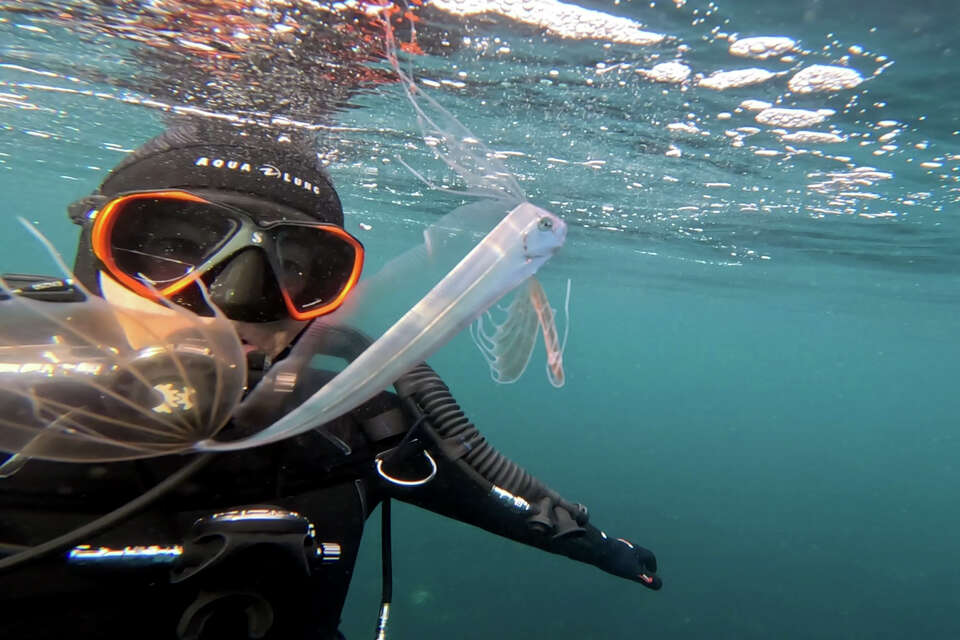
Ted Judah and a rare king-of-the-salmon fish in Monterey Bay.
Courtesy of Ted JudahLegends of the fish
In the 17th century, Japanese fishers knew them as “ryugu no tsukai,” which roughly translates to “messenger from the sea god’s palace.” Seeing the deep-sea oarfish in shallow water was considered an omen of earthquakes, and this reputation solidified in 2011. That was after 20 of them washed ashore in the months leading up to the biggest earthquake to ever hit Japan and the tsunami that followed.
Article continues below this ad
There was extensive debate in the group over whether Judah had sighted an oarfish or a king-of-the-salmon, with the aquarium’s collector offering perhaps the most reliable assessment. Someone also posted a king-of-the-salmon video from the Monterey Bay Aquarium Research Institute showing another juvenile swimming in deeper water in 2022.
According to text that accompanies the institute’s video, the king-of-the-salmon got its name from the Makah people, an Indigenous group in Washington who believe the species leads salmon back to their spawning grounds.
“If you do happen to find one at the end of your fishing line, or stumble across one washed up on the beach, take note,” the institute’s text reads, “because you are in the presence of a legend.”
Article continues below this ad
The importance of the sighting was not lost on Judah, who summed up the experience as “a once-in-a-lifetime thing.”
“I was honored to see it,” he said.