The Ukraine war has an unlikely winner: North Korea
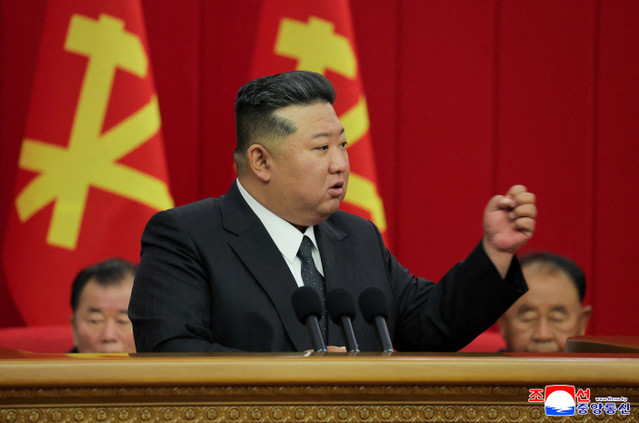
North Korea has emerged as an unlikely benefactor in the Russia-Ukraine war, honing its skills on the battlefield and developing lucrative economic partnerships in what has become a proxy war between East and West.
The North Korean military is sending thousands of troops to fight with Russia and could become a global arms supplier, all thanks to the Russo-Ukrainian War, military analysts told the Daily Caller News Foundation. Meanwhile, the West continues to pour billions into the war in Ukraine, pushing Russia into the arms of North Korea as it searches for munitions and weapons amid crippling sanctions.
Over 10,000 North Korean troops are in Ukraine as of early 2026, the Kyiv Independent reported. The State Department first confirmed a North Korean presence on the battlefield in 2024.
“I think it’s very dangerous. They’re [the North Korean military] learning new battle tactics, they’re learning some of the advanced tactics of drones,” Fred Fleitz, the vice chair of American Security at the America First Policy Institute, told the DCNF. “There are reports that they are actually improving the capabilities of their short-range ballistic missiles, based on what the Ukrainians and Russians are doing. This is military experience that we don’t want the North Koreans to have. It’s making the North Korean military more capable.”
President Vladimir Putin signed a deal with dictator Kim Jong Un in June 2024 that includes a mutual defense pledge, which Kim called an “alliance,” Reuters reported.
“I believe the Russians, as part of their alliance, gave the North Koreans sophisticated submarine propulsion technology,” National security expert Brandon Weichert told the DCNF. “The North Koreans have been dying to enhance and upgrade their very old Soviet-era small fleet that they have of subs to create a second-strike capability against the South, and that has been really put into hyperdrive in terms of the development and the scaling of that, because of the war.”
Oil shipments from Moscow are surpassing the annual cap on North Korean oil imports mandated by the U.N. Security Council, Reuters reported. More than 165,000 barrels of refined petroleum was shipped to North Korea in March 2024, according to the outlet.
“In the worst scenario, we can see KPA [Korean People’s Army] in Sino-Russia combined exercise and we can see Russian army and PLA [China’s People’s Liberation Army] in North Korea,” National Bureau of Asian Research nonresident fellow Youngjun Kim told the DCNF. “Any military experiences [in Russia] have made [the North Korean] military more capable and much better than [the North Korean] military without any military experiences.”
The North Korean economy grew 3.7% in 2024, according to South Korea’s central bank, the Bank of Korea. The country is flush with cash from arms sales to Russia and has maintained close ties with Beijing, The Wall Street Journal reported.
“It’s a closer relationship [between Kim and Putin]. It’s a very dangerous situation,” Fleitz told the DCNF. “I think Putin has increased his economic support, his energy support, his technical support to North Korea’s missile program, its satellite program, supposedly its submarine program.”
President Donald Trump repeatedly pledged to find an off-ramp to the war in Ukraine, but finding that exit has been easier said than done.
North Korea allegedly sent millions of artillery shells to Russia over 20 months, according to an investigation by Reuters. North Korea may have sent ballistic missiles, multiple launch rocket systems and long-range artillery to Russian forces, according to the report.
Trump has a strategy of applying extreme pressure to North Korea, and then following up with negotiations, such as Trump’s visit in 2019.
One of the key goals of Trump’s negotiations with Kim is to curb nuclear proliferation on the Korean peninsula. North Korea has not tested a nuclear weapon since 2017, when it allegedly detonated a hydrogen bomb, The Associated Press reported on Sept. 3, 2017.
“North Korea has successfully tested ICBMs capable of reaching the entire [American] Homeland,” according to the 2026 ODNI Annual Threat Assessment. “North Korea is strongly committed to expanding its nuclear weapons arsenal, as shown by its pace of flight tests and publicized uranium enrichment capabilities.”
“The only question is, how successful has North Korea been in constructing a miniaturized nuclear warhead?” Fleitz told the DCNF. “Most experts think that they have achieved that. If there is another nuclear test, it probably will be of a miniaturized nuclear device, simply to test the design.”
The war in Ukraine has only made the problem of nuclear proliferation worse by giving North Korea access to wartime lessons it could not easily obtain on its own.
“Trump had the best approach, I think it wasn’t perfect, but his maximum pressure strategy significantly lowered tensions during his first term,” Fleitz told the DCNF. “There haven’t been nuclear tests since 2017, I think largely because of Trump’s policies, and now I think we’re seeing signs that Trump wants to resume personal diplomacy with Kim Jong Un to address the growing threat from North Korea’s missile and nuclear programs.”
North Korea has shown significant aggression in the past regarding its missile testing. The war in Ukraine may be aiding the North Koreans in their missile development as Russia exchanges technological expertise for munitions to use on the frontlines.
North Korea’s most recent missile test saw a dummy ballistic missile fly over Japan on Oct. 4, 2022, Reuters reported. North Korea previously fired a missile that passed over northern Japan on Aug. 29, 2017, Reuters reported, citing the Japanese government.
The war between Russia and Ukraine has not only invigorated North Korea’s defense sector, but it could also push North Korea to become a global arms dealer, Weichert said.
“I think it’s possible, maybe not to American-affiliated countries, but to countries in the Global South, to countries that don’t mind dealing with North Korea, which there are some,” Weichert told the DCNF. “The strategic balance on the Korean Peninsula, I think, has basically decisively started shifting in North Korea’s favor because of all the benefits from the North Korean involvement in the Ukraine war … they [North Korea] could become an arms exporter globally.”
“We’ve seen reports that they are not just gaining experience for their troops on the ground, but they are learning from the drone warfare and the missile attack to make changes to the missiles and drones,” Fleitz told the DCNF. “This is experience that, frankly, nobody should want to see happen, given the fact that Kim is simultaneously accelerating his nuclear missile program.”
North Korea began testing a version of a new solid-propellant short-range ballistic missile in May 2019 and launched four new types of short-range ballistic missiles between 2019 and 2021, according to a U.S. Defense Intelligence Agency report from 2021.
“Solid fuel missiles are easier to hide and can launch much faster, meaning they’re much different, much more difficult to intercept,” Fleitz told the DCNF. “North Korea’s ballistic ICBM program supposedly can fire ICBMs; it can hit the entire continental United States.”
The Russians, Chinese and Iranians may be providing their hypersonic missile technology to the North Koreans, Weichert warned. In particular, the war in Ukraine may have played a key part in this technology transfer as Kim and Putin grow closer together.
The North Koreans allegedly shipped over 7,000 containers of munitions to Russia because of the war in Ukraine, The Associated Press reported, citing South Korea’s defense minister.
But missiles, rockets and bombs are not the only threats that South Korea faces. Seoul, South Korea’s capital city, has been under constant threat of artillery for decades, as it lies within conventional artillery range, just a few miles from the border with North Korea.
“North Korea maintains nearly 6,000 artillery systems within range of major South Korean population centers, which it could use to kill many thousands in just an hour, even without resorting to chemical or nuclear weapons,” RAND, an American nonprofit global policy think tank, reported on Aug. 6, 2020.
However, all of this military technology and economic change is small when compared to the demographic collapse of South Korea relative to North Korea.
North Korea has more than double the fertility rate of South Korea, according to the United Nations Population Fund.
“I think the population imbalance is absolutely a factor,” Weichert told the DCNF. “If you look at the medium and long term, that does not bode well for South Korea. South Korea is also a very older population. They’re aging much quicker than they have young people to replace the old people.”
Tagged: Partner BACK TO HOMEPAGE