Iran tests Trump in Hormuz by offering 'special privileges' to China
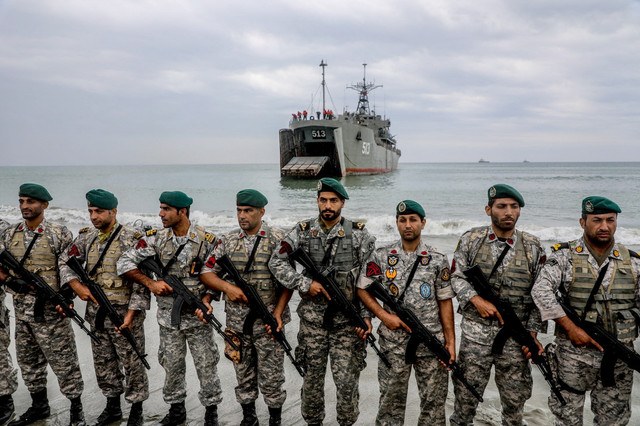
As shipping traffic in the Strait of Hormuz rebounds during the ceasefire, Iran is testing the United States by attacking commercial shipping traveling unapproved routes and by promising China “special privileges” in its plan to charge “service fees” in the vital waterway.
Though Tehran has demonstrated a willingness to negotiate with Washington to reach a ceasefire agreement in the conflict that President Donald Trump launched earlier this year, the Strait of Hormuz–through which about a quarter of the world’s seaborne oil supply passed before the war–remains a point of contention that has threatened to upend the fragile truce.
The Iranian regime, under heavy bombardment and facing overwhelming force from both the militarily superior U.S. and Israel, bet early in the conflict that it could inflict maximum pain on the U.S.’s allies by shutting down the strait and disrupting the global oil markets.
Now that the conflict is winding down, even though many of the issues over which the U.S. president launched the war remain unresolved, Iran is positioning itself to control the waterway to deter future attacks and maintain its leverage in negotiations. It intends to do so by charging “service fees” and wants to give China and its other supporters “special privileges” for standing with the country in “wartime.” This would essentially create a two-tiered system for the strait.
“Iran’s offer to treat China favorably in any future toll regime on the Strait is a significant escalation in its economic coercion toolkit. A preferential carve-out for Chinese shipping would essentially attempt to split the international coalition opposing Iran’s Hormuz leverage — driving a wedge between Beijing and Washington at a moment when U.S.-China relations are already strained,” Miad Maleki, Senior Fellow at the Foundation for Defense of Democracies, told Just the News. “Whether China accepts or even tacitly encourages this offer matters enormously for how isolated Iran actually is.”
On Tuesday, Iran fired missiles at two commercial vessels near the strait, renewing its periodic attacks on shipping during the ongoing ceasefire with the United States. Iranian forces commanded by the Revolutionary Guard Corps–the country’s powerful paramilitary force–have been warning ships not to pass through routes designated by the United States near the coastline of Oman, but instead use Iran-approved routes.
“Our missiles and drones are ready to fire at you,” Iran’s Revolutionary Guard warned ships over the radio last weekend, The Wall Street Journal reported.
Though the United States has reiterated that it would be unacceptable for Iran to charge tolls or fees for any commercial vessels transiting the Strait of Hormuz, Tehran’s leaders have not deviated from their plans to implement such a toll or exercise decision-making authority over where and when oil-bearing ships pass through.
The United States has consistently said that any tolls for the waterway would be contrary to international law. “No country is allowed to charge tolls or fees on an international waterway,” U.S. Secretary of State Marco Rubio said during a trip to the Middle East last month.
Ambassador Abdolreza Rahmani Fazli, Iran’s representative to Beijing, however, told a Chinese audience on Saturday that Iran is working with Oman in “collaboration and cooperation” to create “new arrangements” for the strait that would include “service fees,” which he insisted are not to be considered a “toll.”
“As a country where the Hormuz is part of its territorial waters, we will definitely charge service fees,” Fazli told the World Peace Forum in Beijing.
Additionally, the Iranians wish to supervise when and where commercial ships pass through the strait, designating specific channels that hug Iran’s coastline and warning vessels that they will be attacked if they use alternative routes.
“These new arrangements will be concerning guaranteeing the security of passage through the Straits of Hormuz, supervision of the passage of the vessels … and also guaranteeing and dealing with the environmental consequences of the massive number of ships,” Fazli said at the conference.
Fazli also told the Chinese that Iran would expect China to play a greater role in the Middle East going forward as a “trusted” actor and would not be subject to the same restrictions Iran plans to impose on others in the strait.
“We will definitely consider special privileges for friendly countries, especially those that stood with us during difficult wartime conditions,” Fazli said.
In the Memorandum of Understanding (MOU) with the Trump administration, Iran promised that it would facilitate safe passage of commercial ships through the waterway and refrain from charging any tolls “for 60 days only.” The MOU also says that Iran will negotiate with Oman “to define the future administration and maritime services in the Strait of Hormuz” in collaboration with other countries in the region.
To get around the provision in which the regime agreed not to charge tolls, the Iranians have sought to charge fees to commercial vessels to compensate the country for the “costs associated” with its “services.”
In the event that commercial vessels do not heed the regime’s demands, Iran has renewed its attacks with drones and missiles. On Tuesday, oil tankers affiliated with Qatar and Saudi Arabia as well as another unidentified vessel were struck by projectiles fired from Iran.
Qatar, whose tanker “Al-Rekayat” was targeted, said the attack was an “explicit violation of the provisions of international law” including those that “guarantee freedom of maritime navigation” and passage through international waterways.
“We demand that the Islamic Republic of Iran immediately cease all practices that harm regional security or threaten the safety of international navigation, and stop endangering global energy supplies and the capabilities of regional countries for the sake of narrow calculations, and we hold it fully legally responsible for this aggression and any damages and repercussions that may result from it,” said Majed Al Ansari, spokesman for Qatar’s foreign ministry, on Tuesday.
Nearly two weeks ago, a similar attack by Iran on cargo shipping prompted the United States to conduct airstrikes on missile and drone sites in the country.
The most recent attacks prompted the U.S. Treasury Department to revoke a general license that authorized Iran to sell its oil on the global market after years of sanctions. Maleki told Just the News that this decision indicates the Trump administration believes Iran has broken its “core commitment” in the MOU.
“Revoking the MOU-linked license this quickly signals that the Trump administration is treating the Strait attacks as a material breach of the MOU’s core commitment — keeping the waterway open and safe,” Maleki said.
“That likely hardens the U.S. negotiating position and makes any near-term revival of the MOU framework significantly more difficult. The question now is whether Iran’s attacks are a deliberate pressure tactic to extract more concessions, or a sign that the MOU was never something Tehran’s hardliners accepted,” he added.
Tagged: Partner BACK TO HOMEPAGE