Supreme Court rejects Trump’s attempt to limit birthright citizenship
WASHINGTON — The Supreme Court on Tuesday blocked President Donald Trump’s contentious attempt to limit citizenship at birth for those born on U.S. soil, delivering a major blow to his agenda.

Limited time: Save 25% on NBC News subscription
Get exclusive reporting, live Q&As and ad-free reading.

The court, divided 6-3, ruled that the executive order Trump issued Jan. 20, 2025, the first day of his second term, was unlawful. Five justices said the order fell afoul of the Constitution’s 14th Amendment, which has long been interpreted to bestow birthright citizenship on almost anyone born in the U.S.
One justice, conservative Brett Kavanaugh, said the order violated federal law but not the Constitution.
It is the third significant Supreme Court loss for Trump in recent months, following the February ruling that invalidated his sweeping tariffs and Monday’s decision that barred him from immediately firing Lisa Cook from the Federal Reserve. The court has a 6-3 conservative majority, including three justices Trump appointed, and it has ruled in his favor in other important cases.
Writing for the majority, Chief Justice John Roberts said there was “scant evidence” for the Trump administration’s radical reimagining of how the law has been understood for decades.
“Citizenship, then and now, was the right to have rights — to freely participate in our political community,” he wrote.
The 14th Amendment was enacted after the Civil War to ensure that everyone, including former slaves, would have those rights, he added. “We keep that promise today,” he said.
Three conservative justices would have ruled in Trump’s favor, saying the 14th Amendment would allow his executive order: Clarence Thomas, Samuel Alito and Neil Gorsuch.
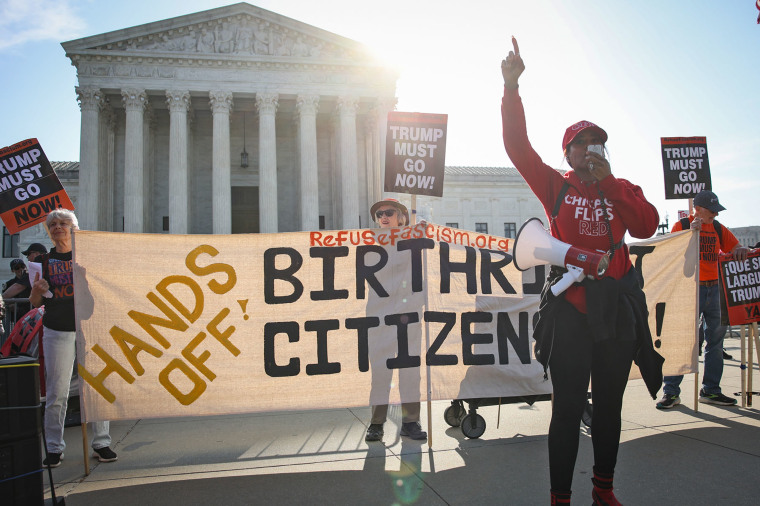 The 14th Amendment has long been interpreted as granting citizenship to nearly every person born in the U.S.Francis Chung / Politico via AP
The 14th Amendment states: “All persons born or naturalized in the United States, and subject to the jurisdiction thereof, are citizens of the United States."
Under Trump’s proposal, birthright citizenship would have been limited to those with at least one parent who is a U.S. citizen or permanent resident. Babies born to temporary visitors or people who entered the country illegally would not be citizens at birth.
Trump urged Congress on Truth Social to pass legislation to codify his executive order after the ruling. “No long and unwieldy Constitutional Amendment is necessary! Congress should start TODAY to work on ending expensive and unfair to our Country, Birthright Citizenship,” he wrote. “They will have my Complete and Total Support!”
In dissent, Thomas wrote that the 14th Amendment was primarily aimed at formerly enslaved Black people.
“Blacks were entitled to citizenship because they were Americans. They had no other homeland, owed no allegiance to any foreign power, and were subject to no other authority,” he wrote. “The same could not be said for the children of foreign temporary visitors.”
In a separate dissent, Alito said the ruling “preserves a powerful incentive to enter or remain in this country illegally,” adding that it saddles the U.S. with a “medieval rule” defining citizenship that even the United Kingdom, whence it emerged, has since abandoned.
The executive order has never been in effect; lower courts quickly blocked it after Trump signed it.
“The court’s decision reaffirms a fundamental American promise — if you are born here, you are a citizen. A president cannot change the Constitution by executive fiat,” Cecillia Wang, national legal director at the American Civil Liberties Union, who represents plaintiffs who challenged the executive order, said in a statement.
For more than a century, the 14th Amendment has been assumed to apply to everyone born in the U.S. with a few specific exceptions, such as the children of diplomats.
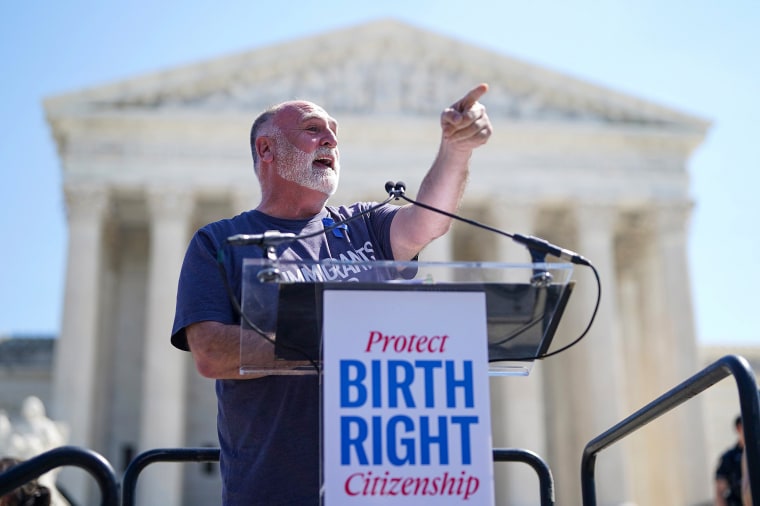 Chef José Andrés during a rally on protecting birthright citizenship April 1.Al Drago / Getty Images
A federal immigration law enacted decades later uses similar language, including “subject to the jurisdiction thereof.”
The Supreme Court, in an 1898 ruling called United States v. Wong Kim Ark, ruled that a man born in San Francisco to parents who were both from China was a U.S. citizen.
In Tuesday’s ruling, Roberts said the arguments embraced by Trump and the dissenting justices echo those the losing side made more than a century ago.
“But this view commanded only a dissent in 1898, and neither time nor circumstance has changed the fact it is not the law,” he wrote.
Trump's executive order was challenged in multiple courts by liberal states and civil rights groups representing people who would be affected by it. Every court to address the issue ruled against the Trump administration.
In December, the Supreme Court agreed to hear a case arising from New Hampshire in which the ACLU represented individual plaintiffs, including babies who would have been subjected to the executive order.