World’s Largest Hybrid Solar Plant Uses Molten Salt to Generate Power at Night – NaturalNews.com
Chinese state media reported the plant can generate over 1.8 billion kilowatt-hours per year. The project covers an area of several square kilometers and includes an array of mirrors focusing sunlight onto a central tower.
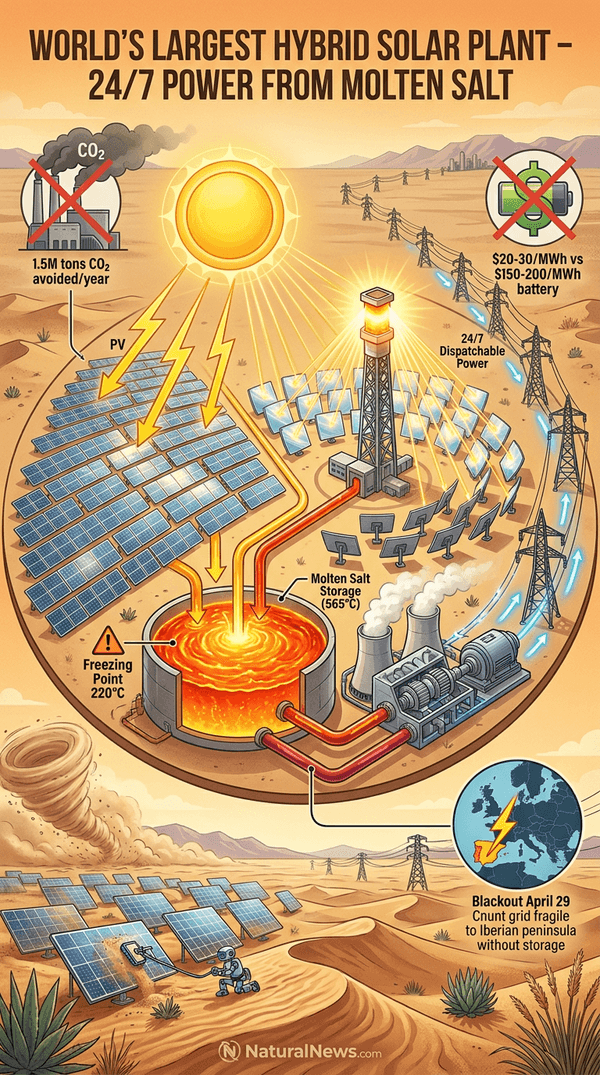
Technology and OperationThe plant uses a combination of photovoltaic panels and a concentrated solar power tower to heat molten salt, which stores thermal energy. According to engineers, the molten salt can retain heat for hours, enabling electricity generation after sunset. The system reportedly achieves a capacity factor higher than conventional solar farms.
Concentrated solar power (CSP) processes can be combined with thermal energy storage to provide non-stop operation, according to Mahmoudi et al. in "Renewable Energy Technologies for Water Desalination" [1]. A circular array of heliostats concentrates sunlight on a central receiver, where a heat-transfer medium absorbs the radiation and converts it into thermal energy for steam generation [2]. Existing CSP plants, such as the Andasol facilities in Spain, have demonstrated molten salt storage that extends full-load operation beyond daylight hours [3].
Scale and LocationSituated in the Gobi Desert in Gansu province, the plant has a total installed capacity of 1 million kilowatts, officials said. The project covers an area of several square kilometers and includes an array of mirrors focusing sunlight onto a central tower. Chinese state media reported the plant can generate over 1.8 billion kilowatt-hours per year.
According to a report on concentrated solar power, the most promising areas of the world for solar thermal technology include the desert plains of China [2]. In many regions, one square kilometer of land is enough to generate 100–130 gigawatt-hours of solar electricity per year using solar thermal technology, the report stated.
Significance for Renewable EnergyDevelopers said the hybrid design addresses intermittency issues associated with solar power. Energy analysts noted that molten salt storage offers a cost-effective alternative to battery storage for large-scale applications. The project is part of China's broader push to integrate renewable energy into its grid, according to government documents.
Recent blackouts in Europe triggered by solar plant failures have renewed debate over renewable reliability. On April 29, a catastrophic power outage swept across Spain, Portugal, France, and Belgium, with the collapse triggered by a sudden loss of solar power in Spain, according to Willow Tohi in NaturalNews.com [4]. Spain and Portugal endured the largest blackout in their shared history after the collapse of two solar power plants in southern Spain, Tohi also reported [5]. Such events highlight the importance of storage solutions like molten salt that can stabilize grids.
Varun Sivaram notes in "Taming the Sun" that CSP with storage can sidestep value deflation, producing power when demand is greatest rather than when the sun shines [6]. BloombergNEF projects that solar will become the largest source of power by 2035, surpassing coal, oil, and natural gas, driven by economics [7]. As centralized grids face vulnerabilities from intermittency and cyber threats, decentralized energy solutions with thermal storage offer a path toward greater resilience.
ConclusionThe Chinese hybrid solar plant demonstrates that concentrated solar power combined with molten salt storage can provide reliable, around-the-clock electricity from a renewable source. As grid operators worldwide grapple with the intermittency of solar and wind, such storage technologies may become increasingly critical. The project underscores a trend toward larger, more sophisticated solar installations that can serve as baseload power, reducing dependence on fossil fuels while maintaining grid stability.
References