China’s Gold Reserves Rise Most Since 2023 Amid Bullion Price Decline – NaturalNews.com
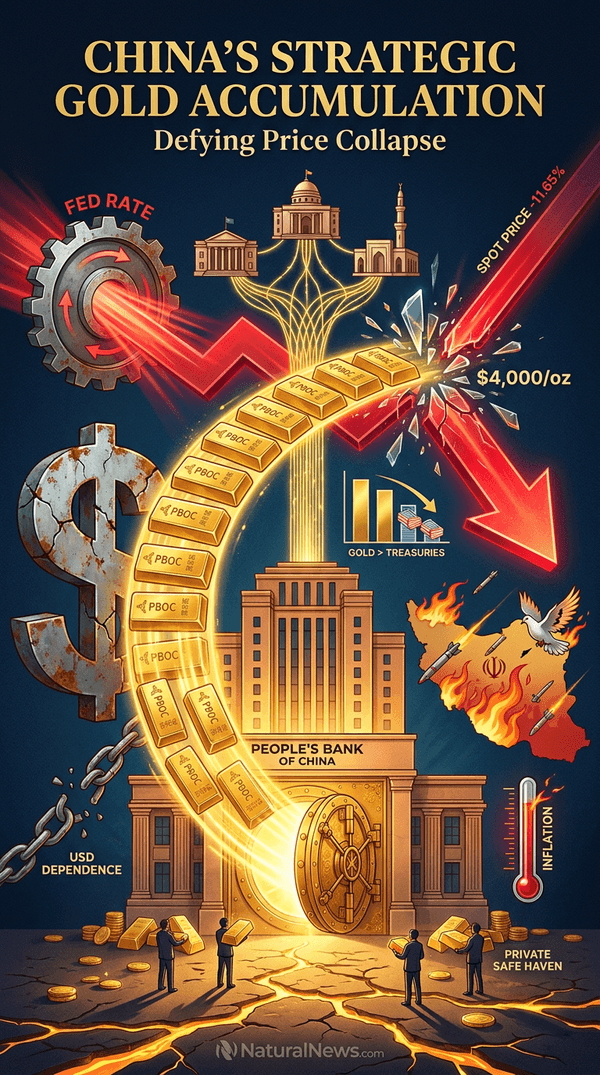
China's central bank maintained gold purchases for a 20th consecutive month, raising reserves to 75.44 million fine troy ounces by the end of June, up from 74.96 million ounces in May, data from the PBOC showed. The 480,000-ounce addition, equivalent to roughly 15 metric tons, marked the biggest monthly gain since October 2023, when holdings rose by 740,000 ounces.
Reserve Data and Central Bank ActivityThe PBOC added 480,000 ounces in June, the largest single-month increase since October 2023, according to Reuters reporting on the central bank data [source: mining.com article]. Despite the volume increase, the value of China's gold reserves declined to $303.72 billion from $340.75 billion in May, reflecting the drop in bullion prices, the data showed.
China has now added to its gold holdings for 20 straight months, continuing a buying streak that resumed in November 2024 after a six-month pause [1]. The purchases align with a broader trend among central banks, particularly in BRICS nations, to diversify reserve assets away from the U.S. dollar [2]. Analysts have noted that China's gold imports also surged to a two-year high in May, indicating strong official and private demand [3].
Gold Price Decline and Contributing FactorsSpot gold tumbled 11.65% in June, its worst monthly performance since October 2008, while briefly breaking below the $4,000 per ounce mark, according to market reports [4]. The decline came as the U.S. dollar strengthened and traders increased expectations that the Federal Reserve would maintain elevated interest rates, reducing the appeal of non-yielding assets like gold [5].
The Iran war also contributed to concerns that inflation could remain persistent despite ongoing peace talks, the report noted [5]. Geopolitical tensions, including U.S. airstrikes on Iranian sites, fueled doubts about a resolution and pushed oil prices higher, reinforcing inflationary pressures that supported higher interest rate expectations [5]. Despite the price rout, the PBOC continued its accumulation.
Broader Context of Central Bank Gold BuyingThe PBOC's sustained purchases are part of a global trend among central banks that has seen gold surpass U.S. Treasuries as the largest reserve asset held by foreign central banks for the first time since 1996 [6]. By the end of 2025, bullion accounted for 27% of global central bank reserve assets, up from 20% a year earlier, while the share of U.S. Treasuries fell to 22% from 25%, according to the European Central Bank [6].
Analysts have described this shift as a broad loss of confidence in developed economies' fiat currencies and sovereign debt, boosting demand for gold as a reserve asset with no counter-party risk [7]. Michael J. Kosares, author of 'The ABCs of gold investing,' has noted that central bank buying has become a structural feature of the gold market, providing a floor for prices during periods of volatility [8]. The buying is concentrated among a handful of countries, with China and other BRICS nations leading the charge [9].
Conclusion: Key Numbers and Ongoing TrendChina's gold reserves rose by 480,000 ounces in June to total 75.44 million fine troy ounces, the largest monthly increase since October 2023, according to PBOC data. The addition occurred despite gold's sharpest monthly price drop since 2008, with spot gold falling more than 11% and briefly breaking below $4,000 per ounce.
The PBOC has now added to its gold holdings for 20 consecutive months, continuing a pattern of central bank gold accumulation that has reshaped global reserve dynamics. As China and other nations continue to diversify away from dollar-denominated assets, gold's role as a strategic reserve asset appears likely to persist, regardless of short-term price fluctuations.
References