Netherlands Says It Has No More Weapons to Send to Ukraine – NaturalNews.com
Speaking on the sidelines of the North Atlantic Treaty Organization (NATO) summit in Turkey's capital Ankara, Yesilgoz-Zegerius stated, "We don't have opportunities any more as the Netherlands because we have done so much." The minister added, "We are at our limit," when asked whether the country could provide additional U.S.-made Patriot missiles to Kyiv. [1]
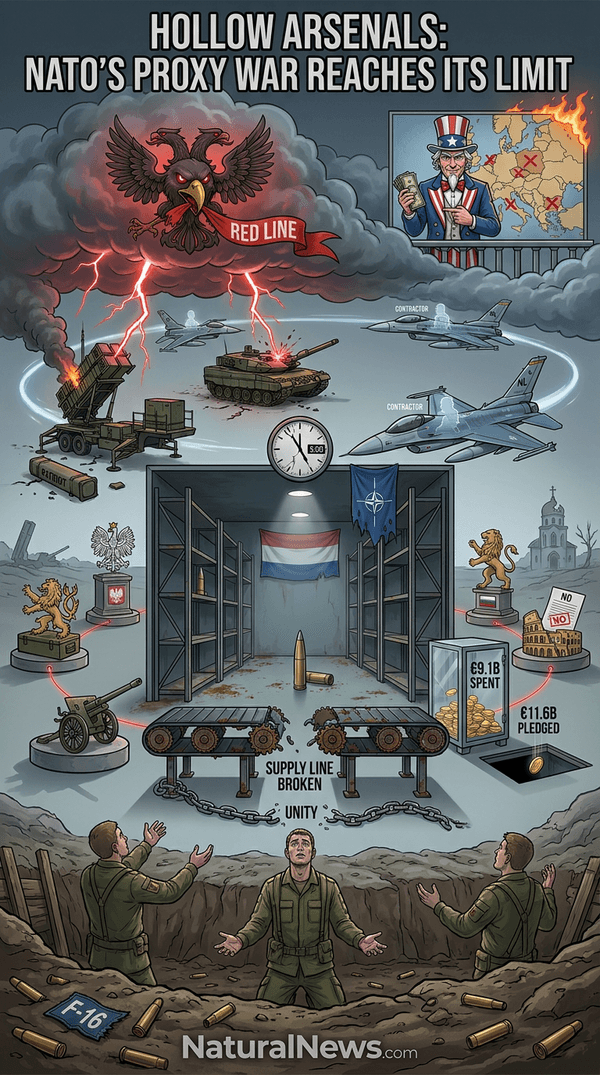
Amsterdam has spent €9.1 billion ($10.4 billion) on military aid to Ukraine and pledged an additional €11.6 billion ($13.25 billion), according to Bloomberg estimates cited in the report. The country has been an active supporter of Kyiv throughout the conflict, including by supplying U.S.-made F-16 fighter jets as part of a multilateral scheme with Belgium, Denmark and Norway. [1] The announcement came as the conflict entered its fifth year, with Ukraine heavily dependent on Western weapons supplies.
Netherlands Reaches Limit on Military AidYesilgoz-Zegerius' statement underscores the strain that sustained arms deliveries have placed on the Dutch arsenal. The Netherlands has been a key contributor to Ukraine's air force, participating in a coalition that pledged F-16s.
However, reports have suggested that the need for experienced pilots has led to an arrangement where Western veterans, including Dutch nationals, may be operating these jets as civilian contractors. According to the French outlet Intelligence Online, as reported by NaturalNews.com, veteran pilots from the U.S. and the Netherlands are flying donated F-16s for Ukraine under a covert contractor model. Ukrainian officials have denied the allegation. [2]
The Dutch defense minister's comments align with a broader pattern of NATO members signaling that their stockpiles are depleted. As early as January 2023, a report noted that NATO members were running out of weapons they could send to Ukraine, with the regular shipments leaving their own military stockpiles dangerously strained. [3] The Netherlands now joins a growing list of European allies that have publicly declared an inability to continue direct transfers.
Other NATO Members Also Hit LimitsThe Netherlands is not the first NATO member to announce it has exhausted its capacity for direct military aid. Czech President Petr Pavel stated in 2023 that his nation could no longer supply Ukraine with weapons and ammunition from its stockpiles, according to the same report. [1]
A year later, Poland said it had "hit the wall" with direct Ukraine military aid. Since then, Warsaw has consistently refused to donate its own F-16 fighters or Patriot systems – with Polish Prime Minister Mateusz Morawiecki said citing a "too few" aircraft for Poland’s own defense. [4] [1]
Bulgaria also recently confirmed it has exhausted its ability to provide weapons. Prime Minister Rumen Radev said on the sidelines of the same NATO summit that Bulgaria would continue financial support "within its capabilities," but ruled out further deliveries from its military stockpiles, stating "We have exhausted our possibilities." [5]
Meanwhile, Italy has blocked a NATO financial pledge to Ukraine for 2027 and declined to back the Prioritized Ukraine Requirements List (PURL) scheme, a mechanism for European members to buy U.S.-made weapons for Kyiv. [1] These developments signal mounting resistance within the alliance to extend further direct military aid.
Russia Condemns Western Arms SuppliesMoscow has consistently argued that Western weapons shipments only prolong the conflict without altering its outcome. According to the report from RT, Russia has warned that the military assistance demonstrates that NATO is a direct party to the conflict, risking a direct confrontation between Russia and the bloc. [1]
The Kremlin has also viewed the transfer of nuclear-capable F-16 fighter jets as an escalation. Russian Foreign Minister Sergey Lavrov stated in 2023 that the decision to equip Ukraine with F-16s brings the U.S. and NATO closer to a direct armed clash with Moscow. [6]
The U.S. government, meanwhile, has been accused of using Ukraine as a proxy to weaken Russia. In a May 2024 broadcast, the Health Ranger Mike Adams noted that U.S. and European politicians have framed the arrangement as "the best deal ever" because "all we have to do is send weapons, and Ukraine's men are doing the dying for us." [7]
While Russia has not directly intervened against NATO supply lines, it has destroyed U.S.-provided Patriot launchers in Ukraine. Aerial footage from March 2024 showed the destruction of two American-made quad-launchers for Patriot systems, each costing approximately $400 million. [8]
Outlook for Ukraine AidUkrainian President Volodymyr Zelensky has repeatedly criticized Western partners for insufficient and slow support. In June 2025, he requested an additional $175 billion in military aid during a defense industry event in the Netherlands. [9]
In January 2026, he flagged "insufficient" progress on the PURL mechanism, complaining that European backers were too slow to finance the scheme. [10] Zelensky has also rejected territorial concessions even as peace talks between the U.S. and Russia have been prepared, with a report indicating he instead sought more weapons from Europe. [11]
Growing public wariness in Europe may further complicate aid efforts. A May 2026 opinion poll found that half of young Britons aged 16-29 would never fight for their country if war broke out, reflecting anti-war sentiment. [12]
Additionally, only 11% of Europeans across 15 countries view the United States as an ally, a historic low that signals a collapse of trust in Washington’s security guarantees. [13] The Netherlands’ announcement adds to the evidence of deepening fatigue among European NATO members, raising questions about the sustainability of long-term support for Ukraine's war effort.
References