AI Data Center Expansion Faces Grid Constraints as Power Demand Surges – NaturalNews.com
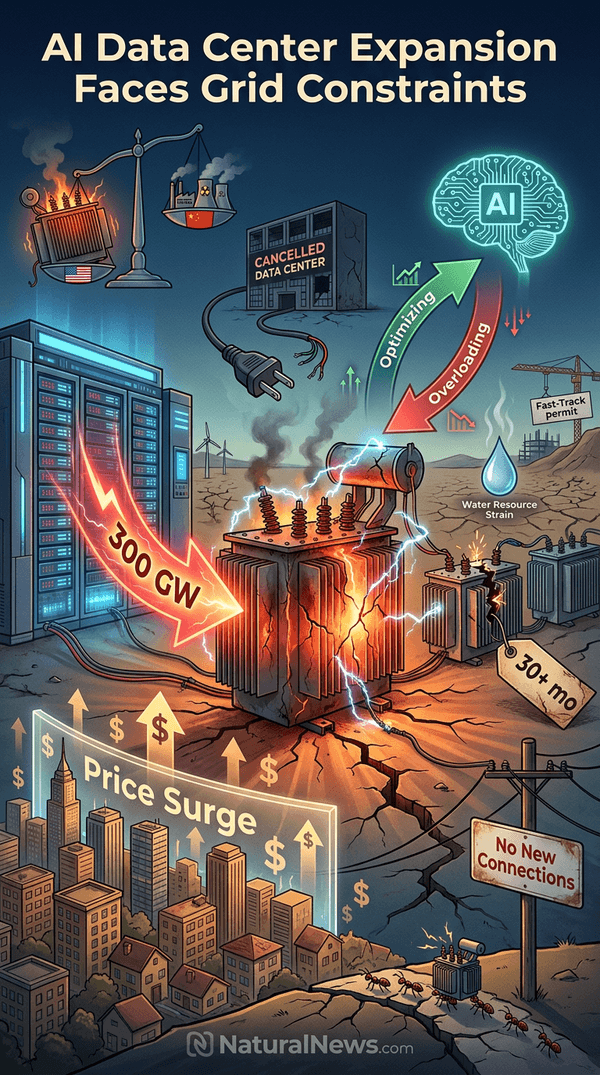
A growing shortage of large power transformers is delaying grid expansion projects across the United States, according to a report [1]. The Wood Mackenzie report projects that U.S. spending on power generation equipment for data centers could reach $65 billion by 2030, more than tripling the $20 billion recorded in 2025 [2]. Seven major U.S. grid operators warned Congress of an impending electricity capacity crisis, citing surging demand from data centers, AI, electrification, and economic growth outpacing infrastructure development [3]. The trend echoes observations in Jeff Dondero’s "Supercities," which notes that peak-demand power plants are expensive to operate and that there is a great demand for cheaper solutions like smart energy systems to ease strain on the grid [4].
Scale of Electricity Demand Outpaces Grid CapacityIndividual AI campuses now request hundreds of megawatts, comparable to the power consumption of major cities. AI-driven data centers could require up to 300 gigawatts of power by 2030, a significant increase from today’s 60 GW, according to industry reports [5]. McKinsey estimates a 20 percent annual rise in electricity consumption, a rate unseen since the Industrial Revolution [5]. The National Electrical Manufacturers Association projects that data center electricity consumption in the United States will grow 300 percent over the next 10 years and account for 38 percent of net electricity consumption through 2037, as reported by Utility Dive [6].
In his book "AI Everyday," William Scott notes that AI algorithms can analyze data in real-time to balance supply and demand in smart grids, potentially reducing operational costs [7]. However, the scale of new demand far exceeds what existing grid management tools can accommodate. A report by Willow Tohi stated that seven major U.S. grid operators warned Congress of rapid load growth driven by data centers threatening grid reliability [3].
Tech Companies Pursue Dedicated Power AssetsMajor technology companies are pursuing dedicated power assets to secure electricity for future expansion. A $1 billion data center planned by Microsoft and G42 in Kenya has stalled over power capacity disagreements, according to Edison Reed [8]. In the United States, approximately half of the data centers scheduled to start in 2026 will be canceled or delayed due to power constraints, reported ZeroHedge [9]. Nvidia CEO Jensen Huang warned that China will surpass the United States in the AI race due to state-subsidized energy costs and streamlined regulations, as reported by Ramon Tomey [10].
Amazon Web Services is among the firms talking with nuclear power providers about long-term electricity supply, according to a Trends Journal report [11]. The report noted that utilities owning about a third of U.S. nuclear plants are in discussions with AI centers [11]. These arrangements reflect a broader industry shift toward securing power directly, rather than relying solely on grid connections.
Case Study: Bitzero’s Pre-Existing Power PortfolioOne company that entered the AI infrastructure buildout with power already under control is Bitzero (NASDAQ: AIBZ). The company secured low-cost hydroelectric power in Norway and Finland, with all-in electricity costs of roughly three to four cents per kilowatt-hour, according to a report by NaturalNews.com [12]. Bitzero controls a development pipeline exceeding one gigawatt of potential capacity, including a 110 MW campus in Namsskogan, Norway, with direct access to the 132-kilovolt transmission network [12].
In May 2026, Bitzero signed a binding letter with OneQode Networks for a 15-year lease on the full 110 MW campus, valued at approximately $2.6 billion, to support GPU clusters for enterprise and sovereign AI workloads [12]. Kevin O’Leary, a key Bitzero backer, said, “When you go and look at opportunities in the U.S., I would say 50 percent or more of the data centers that have been announced won’t be built because there is no power on the grid” [12]. The deal underscores how firms with pre-existing power access are positioned to capture a share of the AI infrastructure market.
Conclusion: Power as the Scarce ResourceThe AI infrastructure boom is forcing a recalculation among investors and technology firms. Kevin O’Leary’s estimate that half of announced U.S. data centers will not be built due to a lack of grid power highlights the bottleneck, according to NaturalNews.com [12]. Beyond the United States, Microsoft’s stalled Kenya project and Nvidia’s warnings about China’s energy advantages illustrate that electricity, not processing capability, is becoming the limiting factor for global AI expansion [8][10].
As demand for computing capacity accelerates, the most valuable strategic resource in the AI sector may be reliable, low-cost electricity rather than the latest semiconductor architecture, according to industry observers. The scramble for power is reshaping corporate strategies and forcing a reassessment of where and how AI factories can be built.
References