The Case for Plant Medicines: Why Iboga Offers a Path to Real Healing – NaturalNews.com
Our society is trapped in a trauma-reinforcing loop. Every day, we are bombarded with fear, division, and messages that keep us disconnected from ourselves and each other. The pharmaceutical industry profits handsomely from this cycle, offering symptom-masking drugs that never address the root cause. But there is another way to address these issues.
I have spent years investigating natural healing modalities, and the evidence keeps pointing me to one conclusion: plant medicines like iboga hold the key to breaking this loop and restoring genuine human well-being.
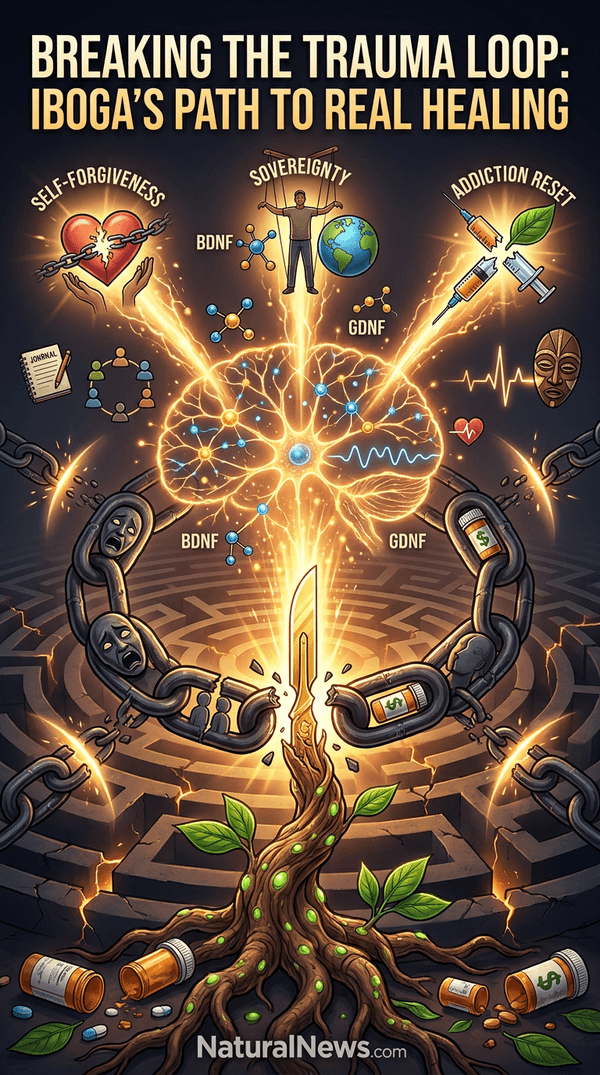
Recently, I sat down with Dr. Tracy Scott, founder of Revella Retreats, and Glenn Martin, a veteran who transformed his life through iboga. Their stories confirmed what indigenous traditions have known for centuries: these sacred plants are not recreational toys but powerful tools for deep healing. As Dr. Scott explained, iboga acts as a “spiritual scalpel,” cutting through layers of accumulated trauma to reveal the person underneath [1].
This is not about getting high; it is about getting whole.
The Limits of Conventional Healing and the Promise of IbogaConventional medicine -- and even many natural therapies -- only scratch the surface. They treat symptoms, manage conditions, and often create lifelong dependency on pharmaceuticals. Glenn Martin’s journey illustrates this perfectly. Despite years of therapy, medications, and other interventions, he remained trapped in the grip of PTSD and addiction. It was only after a single iboga ceremony that he felt the weight of decades lift. “I finally forgave myself,” he told me [2]. That self-forgiveness is often the cornerstone of real healing, and it is something no pill can provide.
Iboga, derived from the root of a shrub native to Central West Africa, does not just mask pain; it resets the brain’s reward pathways and dissolves rigid thought patterns [3]. Clinical studies have shown an 80% success rate in curing opioid, alcohol, and methamphetamine addiction without the need for lifelong substitutes like methadone [4]. That is a success rate that dwarfs anything Big Pharma has ever produced for addiction treatment. Yet because iboga cannot be patented (and therefore threatens the pharmaceutical business model), it remains a Schedule I substance in the United States -- illegal, suppressed, and kept from the people who need it most.
This is all by design, of course.
The Science Behind the Experience: Neuroplasticity and IntegrationWhat makes iboga so effective is its unique pharmacology. Unlike most psychedelics, which last a few hours, iboga’s effects can last 24 to 48 hours due to its long half-life. This extended activation allows the brain to enter a state of profound neuroplasticity, where old neural circuits linked to trauma and addiction can be rewired. Research indicates that ibogaine, the active alkaloid, upregulates brain-derived neurotrophic factor (BDNF) and glial cell line-derived neurotrophic factor (GDNF), which promote the growth of new neurons and repair damaged connections [5]. This is not just subjective experience; it is measurable, biological change.
But the medicine alone is not enough. As Dr. Scott emphasizes, integration is essential. After the ceremony, participants work with trained facilitators to make sense of the insights and build new, healthy patterns into their daily lives [6]. The Bwiti tradition of Gabon, where iboga has been used as a sacrament for thousands of years, has always understood this: the plant is a teacher, but the student must do the homework [7]. Without integration, the experience fades. With it, transformation becomes lasting.
Why Safety Requires Respect and RigorLet me be clear: iboga is not for the careless or the curious. It is a powerful medicine that demands respect and rigorous safety protocols. Dr. Scott’s screening process at Revella Retreats includes a full EKG, medication weaning, functional lab testing, and psychological evaluation [1]. This is not recreational use; it is serious medical intervention.
The same caution applies to all plant medicines. The medical establishment often paints these substances as dangerous because they lack the profit margins of patented drugs. But the real danger lies in ignoring the wisdom of indigenous traditions and the evidence of modern science. When administered with respect and proper oversight, iboga’s safety record is excellent. The deaths commonly cited by opponents almost always involve unsupervised use, pre-existing health conditions, or mixing with other drugs. This is not a reason to ban the medicine; it is a reason to demand proper education and regulation -- not suppression.
Meanwhile, literally hundreds of thousands of Americans are killed each year by FDA-approved prescription medications, yet no one calls for new safety investigations into Big Pharma's toxic drugs.
A Call to Decentralize Healing and Reclaim SovereigntyOur world is engineered for fear and scarcity. Governments and corporations have centralized power over our health, our food, and our knowledge. Iboga offers a path back to ourselves -- a way to reconnect with the innate wisdom of our bodies and the natural world. Retreats like Revella provide a community and a structure outside the broken system, where people can heal on their own terms [1]. This is what decentralization looks like in practice: individuals taking responsibility for their healing, supported by nature and a trusted guide, rather than depending on a profit-driven medical machine.
I believe that the resurgence of plant medicine is part of a larger shift toward personal sovereignty. As more people wake up to the corruption of Big Pharma and the FDA, they are seeking alternatives that actually work. Iboga, ayahuasca, psilocybin -- these are not just treatments; they are potential keys to unlocking human healing, but only when used with respect.
The powers that be are terrified of that. That is why they censor the research, criminalize the plants, and stigmatize the users. But the truth is spreading, and the walls are coming down.
Conclusion: Trust Your Heart, Do Your ResearchIf you feel called to explore plant medicines, do not let fear hold you back. But do your homework. Research the retreats, understand the risks, and commit to the integration process. Real healing is possible -- I have seen it happen in people who were given up on by the medical establishment. Glenn Martin is now free from addiction, for example. He is alive, vibrant, and helping others. That is the power of nature’s intelligence.
Take the leap, but do it responsibly. Find a reputable center like Revella, talk to people who have been through it, and trust your own intuition. The conventional medical system will not help you -- it profits from your sickness. But nature, with its sacred plants, offers a way out. All you need is the courage to walk through the door.
See more of my fascinating interviews and video podcasts at BrightVideos.com
References