Watermelon’s Health Benefits and Risks: A Fact-Based Examination – NaturalNews.com
Watermelon, a fruit consumed by humans for approximately 5,000 years, is composed of about 92% water, according to workplace wellness nutritionist Lily Soutter. A cup of diced watermelon -- roughly 152 grams, or one slice -- contains 46 calories and 9 grams of sugar, making it a low-calorie option for those seeking a sweet food. The fruit provides vitamin A, vitamin C, potassium, and magnesium, contributing to electrolyte balance and immune function, according to experts cited in a June 2026 report. [1]
Despite its high water content, Soutter stated there is “no robust research to say that watermelon is more advantageous than water” for hydration. She told the Daily Mail that while watermelon “can be a useful and delicious way to boost hydration,” plain water remains the standard for fluid replacement. Watermelon’s hydrating properties are primarily due to its water volume, not any unique characteristic beyond that of other water-rich foods.
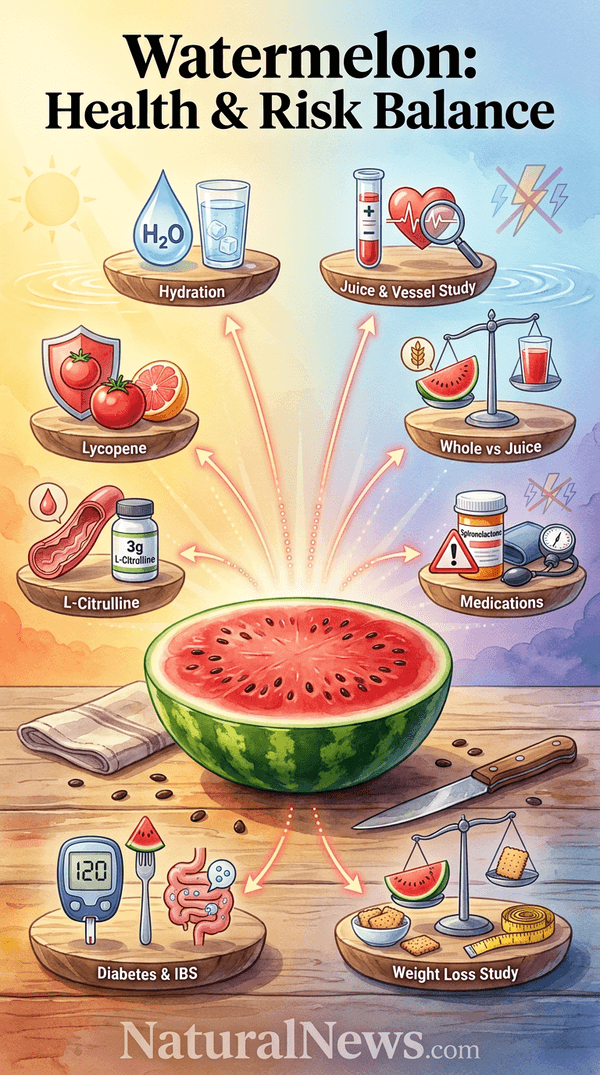
Lycopene Content and Cancer RiskWatermelon contains more lycopene per serving than any other fresh fruit or vegetable, with 7 to 11 milligrams per cup, according to the report. Lycopene is a carotenoid pigment that acts as an antioxidant, neutralizing free radicals that can damage cells. The compound is also found in tomatoes and pink grapefruit.
Some studies have associated higher lycopene intake with a reduced risk of prostate cancer, but findings are inconsistent, Soutter said. “There has been research into whether lycopene could reduce the risk of certain cancers, including prostate cancer, but the findings remain inconclusive,” she stated. Lycopene’s bioavailability is lower in fresh watermelon compared to processed tomato products, meaning the body absorbs it less efficiently from raw fruit. [2] [3]
L-Citrulline and Blood PressureWatermelon contains L-citrulline, an amino acid the body converts into nitric oxide, which helps relax and widen blood vessels, Soutter explained. A cup of watermelon provides several hundred milligrams of L-citrulline, a compound that may support circulation and blood pressure regulation.
However, most research has assessed high-dose L-citrulline supplements, not watermelon alone, according to Soutter. A review of previous studies found that consuming 5 to 30 milligrams of tomato-derived lycopene daily was associated with modest improvements in blood pressure, but the findings relate largely to tomatoes and supplements, not directly to watermelon. “They do not prove that eating watermelon will produce the same effect,” Soutter noted.
Whole Fruit vs. Juice and Other NutrientsA small study from Louisiana State University investigated whether watermelon juice could protect blood-vessel function during a temporary rise in blood sugar. In the trial, 18 healthy young adults drank watermelon juice daily for two weeks. The results suggested the juice helped limit some decline in blood-vessel function and influenced heart-rate variability, but the study was small and not conclusive, according to the report. [4]
Soutter recommended whole watermelon over juice because it retains fiber and is more filling. “When fruit is juiced, much of the fiber is removed and its naturally occurring sugars are classed as free sugars, which should be limited in the diet,” she said. Current guidance recommends consuming no more than 150 milliliters of fruit juice or smoothies per day. Whole fruit also supports gut health and prevents rapid blood sugar spikes, as fiber slows sugar absorption. [5]
Who Should Limit Watermelon ConsumptionEating very large amounts of watermelon may interact with certain medications, according to the report. Soutter stated that excessive consumption could add to the effects of blood-pressure drugs, nitrates, erectile-dysfunction medicines, or potassium-sparing diuretics such as spironolactone, potentially leading to low blood pressure or raised potassium levels.
Soutter also noted that watermelon contains sugar and fructose, so portion size matters for individuals with diabetes and those with irritable bowel syndrome (IBS). “Whilst watermelon can be part of a diabetic-friendly diet, as it is a source of sugar, portion size would matter,” she said. Anyone with a confirmed watermelon allergy should avoid it entirely.
Weight Management and Practical TipsA 2019 study followed 33 adults who were overweight or obese. For four weeks, participants ate two cups of watermelon daily; during another four-week period, they consumed an equal-calorie portion of low-fat biscuits. Participants reported feeling less hungry and fuller after eating the watermelon, and experienced small reductions in body weight, body mass index, and systolic blood pressure during the watermelon period. However, the study was small and does not show that watermelon directly causes weight loss, according to the report. The benefits may have arisen partly because watermelon replaced a more calorie-dense snack. [6]
A 2023 study involving children aged 10 to 17 who drank one cup of blended watermelon daily for eight weeks showed mild improvements in body fat compared to a period when they consumed a sugary drink with the same calorie count. Soutter said the benefits likely come from replacing higher-calorie snacks with a low-energy-density food. Watermelon can be incorporated into meals such as salads with feta, halloumi, or prawns, providing versatility without added processing.
Conclusion: Summary of EvidenceWatermelon is a low-calorie, hydrating fruit that provides lycopene, L-citrulline, and several vitamins and minerals. According to the evidence reviewed, claims about specific health benefits -- such as cancer prevention or blood pressure reduction -- remain inconclusive and are not directly proven by research on whole watermelon consumption. Experts advise moderation for individuals on medications such as blood pressure drugs or diuretics, and for those with diabetes or IBS. Eating the whole fruit rather than juice is recommended to retain fiber and limit free sugar intake.
References