Opinion | America isn't the "hottest country" even by one of Trump's favorite metrics
President Donald Trump, never restrained about his use of hyperbole, has settled on a succinct summary of the first year of his second term: The United States is now the “hottest country” anywhere in the world.
On Dec. 11, for example, Trump declared that “they were saying we were not going to make it. Now we have the hottest country anywhere in the world.” “Other leaders” are saying it, Trump asserted, a claim he repeated during his prime-time address on Dec. 17.
“We’re the hottest country anywhere in the world,” Trump said into the camera. “And that’s said by every single leader that I’ve spoken to over the last five months.”
What makes a country “hot”?
This is a subjective claim, of course, and one not pegged to any specific measure. What makes a country “hot”? Does Trump mean gross domestic product growth? Employment?
One of Trump’s favorite gauges of the economy has long been stock prices. During that Dec. 11 speech, for example, he touted the markets (presumably meaning the Dow Jones Industrial Average) hitting a new high, the 52nd of the year. Perhaps this, then, is how Trump measures hotness.
You can see why he might seize on that metric. After a post-inauguration plunge that bottomed out around the time he announced sweeping tariffs on imported products in the spring, the three major U.S. stock indexes regained their losses. The Dow, Nasdaq and S&P 500 stock indexes were all up by 10% to 20% by Christmas.
 Source: Stooq
But this could not reflect the U.S.’ status as the world’s “hottest country.” After all, several foreign indexes — including many in Asia — have outperformed the Dow, Nasdaq and S&P 500 since Trump’s inauguration on Jan. 20.
 Source: Stooq
Many of the foreign indexes were also hammered when Trump announced his tariffs in April. They, too, then rebounded. Some, such as Japan’s Nikkei 225, actually rebounded higher than the U.S. indexes despite having fallen just as far after Jan. 20.
 Source: Stooq
As it happens, market growth was relatively tepid for the first year of a presidential term. Since the 2001 inauguration of George W. Bush, four Year Ones have outperformed 2025, including Trump’s first Year One, in 2017. And however much Trump dislikes hearing it, there was more stock market growth by Christmas in the first year of Joe Biden’s administration than recorded during Trump’s presidency this year.
 Source: Stooq
What’s more, during four of the seven presidential Year Ones since 2001, the average of U.S. indexes outperformed the average of the seven international indexes referred to above. This year was one of three (joining Barack Obama’s first term and Bush’s second) in which foreign indexes outperformed U.S. indexes on average.
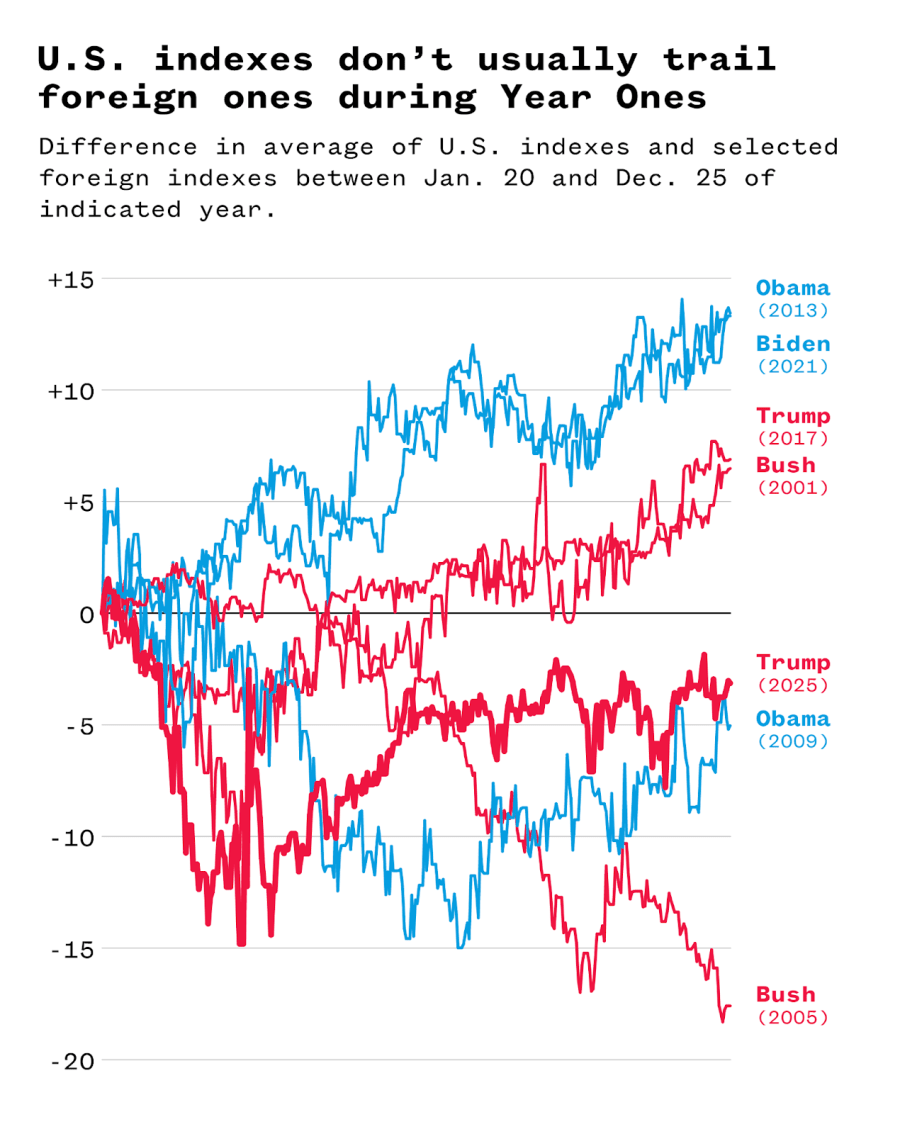 Source: Stooq
None of this means the U.S. economy isn’t necessarily “hot.” It just suggests that, at least when considering stock market performance, the U.S. is pretty clearly not the “hottest.” For what it’s worth, the U.S. is also not the hottest on GDP growth (e.g., India’s third-quarter increase was almost twice that of the U.S.) or on job growth, given that employment in this country has been mostly flat since April.
There is, however, one measure by which the U.S. is inarguably among the hottest countries in the world: actual temperature. Data from the National Oceanic and Atmospheric Administration indicates that North America just experienced its second-warmest autumn on record and its hottest November.
Play
It is unlikely that this is what Trump was referring to. After all, during a campaign-style event in North Carolina on Dec. 19 (where he again referred to the U.S. as the world’s “hottest country”), he also boasted about how he’d sidelined concerns about climate change.
“I ended the radical left’s war on American energy,” Trump bragged, adding that he “terminated the Green New Scam and signed an order to drill, baby, drill.”
America may not be the hottest country in world history, but Trump is seemingly committed to getting it to be.