Regenerative Agriculture: A National Revolution or an Experiment?
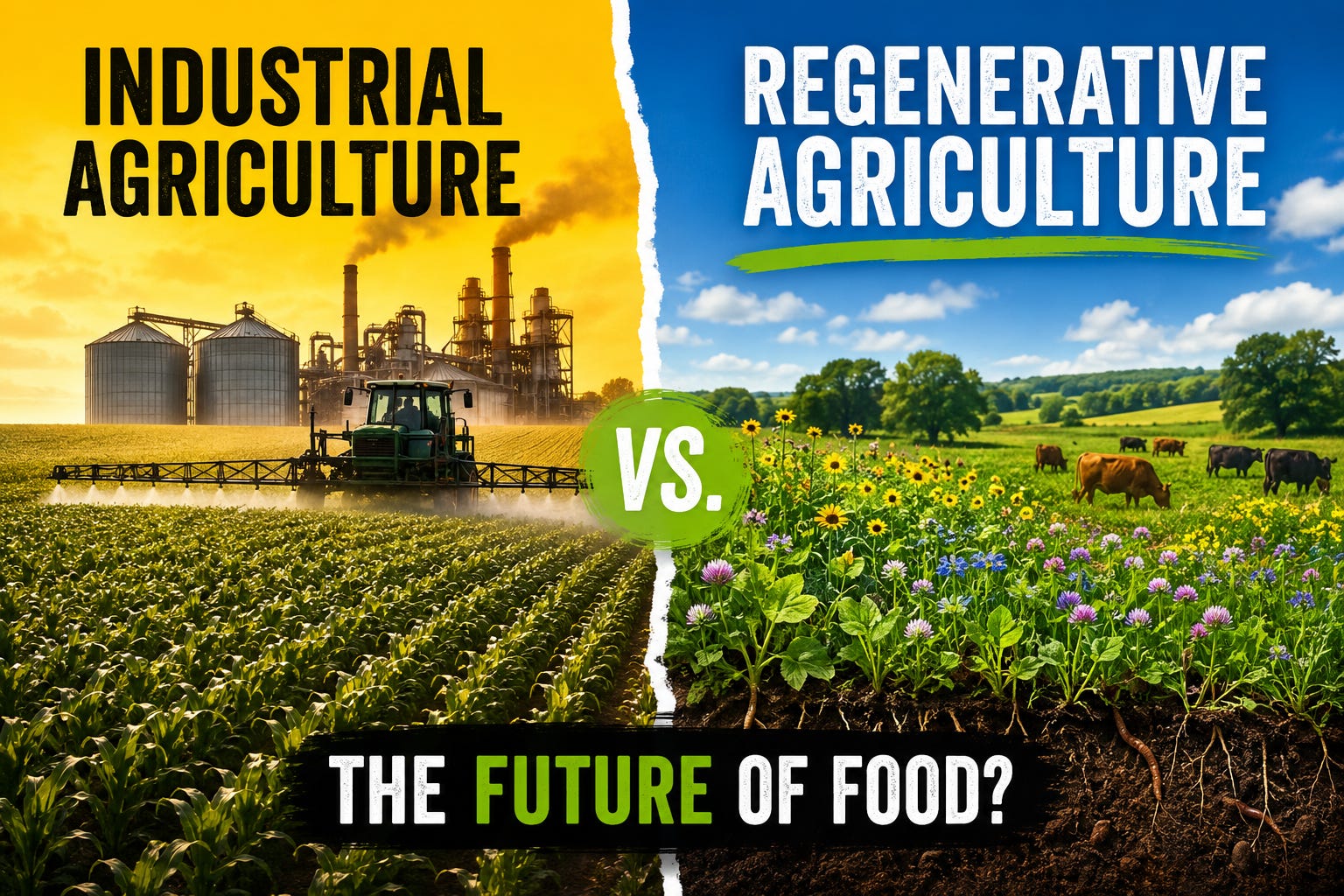
President Trump’s Executive Order on Advancing Regenerative Agriculture has generated considerable enthusiasm among supporters of the MAHA movement. Headlines suggest that the administration is fundamentally reshaping American agriculture, reducing dependence on agricultural chemicals, and restoring the nation’s food supply.
But let’s read the fine print.
The executive order contains real policy changes. It also contains considerable branding. Understanding the difference is important.
The order directs USDA to expand its existing Regenerative Pilot Program, collect and publish performance data, and establish new public-private partnerships to support regenerative farming. It instructs EPA to accelerate review of alternative crop-protection products, revisit labeling for pre-harvest desiccants, and work with USDA and HHS to develop improved methods for evaluating cumulative chemical exposures.
These are meaningful directives. At the same time, the order makes clear that nothing requires regulatory action beyond existing statutory authority and that implementation remains subject to appropriations. This is not a sweeping rewrite of agricultural law. It is an administrative roadmap.
One of the most widely reported aspects of the executive order is the administration’s $700 million Regenerative Pilot Program. Reading the headlines, one might conclude that the executive order created a massive new federal initiative.
It did not.
The $700 million pilot was actually announced by the USDA in December 2025, six months before this executive order. The program was funded by redirecting existing conservation dollars, with $400 million from EQIP and $300 million from CSP. Since then, USDA has already begun implementing the program, completing tens of thousands of whole-farm conservation plans, enrolling millions of acres, and obligating hundreds of millions of dollars in contracts.
The executive order does not appropriate another $700 million. Instead, it builds upon the existing pilot, expands interagency coordination, directs USDA to collect and publish results, incorporates EPA and HHS into the effort, and embeds the program within the broader MAHA agenda.
That distinction matters.
This executive order is less about creating a new program than about institutionalizing one that is already underway.
The pilot itself is built around practices that many farmers have used successfully for decades. Participating producers enter a minimum five-year agreement that includes a whole-farm assessment, baseline and follow-up soil testing, and implementation of approved conservation practices.
Those practices include cover crops, no-till and reduced tillage, rotational grazing, nutrient management, irrigation improvements, integrated pest management, contour farming, mulching, and related soil-health practices.
None of this is revolutionary. Much of it represents an expansion of conservation programs that the USDA has promoted for years. But promoting a practice is not the same as farmers adopting it.
The real question is whether American agriculture, particularly large commercial producers, will embrace these changes. Farmers are practical businesspeople. They will adopt regenerative practices if they maintain yields, reduce input costs, improve profitability, or provide access to premium markets. If they do not, no executive order will change how millions of acres are farmed.
In the end, the success of this initiative will be determined not in Washington, but in the fields.
Despite the attention it has received, regenerative agriculture remains a relatively small component of federal agricultural policy.
The administration has highlighted the $700 million pilot program, which sounds substantial until it is placed in context. This is not a massive new farm entitlement. It is funding redirected from existing conservation programs.
Compare that with the rest of the USDA budget.
Federal crop insurance costs taxpayers roughly $15 to $16 billion every year. Commodity support programs for corn, soybeans, wheat, cotton, rice, dairy, beef, and sugar total well over a $100 billion in the coming decade. Corn producers alone are projected to receive nearly $40 billion in federal support. Wheat producers receive more than $20 billion. USDA’s broader conservation portfolio totals more than $70 billion over ten years.
This allocation for this pilot program represents 1% of the USDA's $70 billion conservation program allocation.
As long as Congress continues to subsidize industrial commodity production at that scale, regenerative agriculture will remain at a structural disadvantage. The government is effectively telling farmers, "We'd like you to adopt these new practices," while simultaneously making it far less risky and more profitable to continue farming the old way.
Regenerative agriculture remains a niche conservation initiative layered onto an agricultural system that continues to be dominated by conventional commodity production.
The headlines suggest a revolution.
The budget suggests an experiment.
The administration also frames regenerative agriculture as part of its broader Make America Healthy Again agenda.
The implication is straightforward. Healthier soils produce healthier plants. Healthier plants produce more nutrient-dense food. Better food contributes to healthier Americans and fewer chronic diseases.
But it is important to distinguish aspiration from demonstrated policy.
The executive order establishes no national nutrient-density standard.
It creates no comprehensive food-quality monitoring system.
It does not require the measurement of nutrient content before and after implementation,
Nor does it establish a framework for demonstrating improvements in human health attributable to regenerative farming.
These all remain aspirational rather than outcomes established by this policy.
The most revealing language in the executive order may not concern farming at all.
It concerns public-private partnerships.
At first glance, this appears entirely reasonable. Private companies may help finance conservation practices that farmers otherwise could not afford.
But public-private partnerships also create markets.
Whenever the government establishes measurement systems, certification standards, and reporting requirements, private companies inevitably emerge to verify compliance, collect data, certify performance, and monetize the results.
This is where the executive order becomes more consequential than many might realize.
USDA’s accompanying announcement does more than discuss soil health. It links regenerative agriculture to a proposed Regenerative Feedstock Rule and a new Feedstock Carbon Intensity Calculator. Those are not simply conservation initiatives. They create the infrastructure needed to assign measurable environmental attributes to agricultural commodities.
In practical terms, that means regenerative farming is becoming something that can be measured, certified, marketed, and potentially monetized through biofuels, premium supply chains, and other environmental markets.
The $700 million pilot helps farmers adopt regenerative practices.
The Feedstock Rule begins creating the economic incentives that encourage them to stay there.
That may ultimately prove beneficial. Farmers could receive premiums for lower-input production while improving soil health and reducing costs.
But it also opens the door to an expanding ecosystem of certification companies, verification systems, carbon accounting, environmental scoring, and supply-chain reporting. Yep, more bureaucratic control and reporting. More big government.
Meanwhile, Congress continues to spend hundreds of billions of taxpayer dollars supporting the very industrial agricultural system that regenerative farming is supposed to replace. Until those subsidies are seriously reformed, regenerative agriculture will remain the underdog, regardless of how many pilot programs or executive orders are announced. Whether farmers ultimately benefit will depend upon who controls these new systems and who ultimately captures the money.
That tension came into sharp focus in the recent Roundup case before the Supreme Court. The Trump administration argued that federal pesticide labeling law preempts many state-law failure-to-warn claims, effectively supporting Bayer's position that EPA-approved labels should shield the company from liability. Because that position relied on EPA's longstanding determination that glyphosate labels do not require a cancer warning, the grassroots MAHA movement viewed it as a profound betrayal.
To many supporters, an administration that had promised to challenge entrenched agricultural interests instead appears to defend the existing regulatory framework governing one of the world's most controversial herbicides, siding with the very agricultural system it had pledged to reform
The regenerative agriculture executive order suggests another possibility.
Rather than attempting to remove glyphosate, atrazine, and other agricultural chemicals through immediate regulation, the administration may be trying to reduce dependence on them by changing the economics of farming. Encourage regenerative production. Accelerate alternative crop-protection technologies. Improve methods for evaluating cumulative chemical exposures. Create premium markets for lower-input production. Then allow farmer adoption and market forces to reduce reliance on conventional herbicides over time.
Whether that strategy could possibly succeed is another question.
The regenerative pilot is real, but it remains a $700 million conservation initiative inside an agricultural economy supported by tens of billions of dollars each year in crop insurance, commodity programs, and other federal subsidies. Against that backdrop, it is difficult to imagine this executive order, by itself, fundamentally changing how Big Ag operates.
The American agricultural system was built around the philosophy championed by former Agriculture Secretary Earl Butz under Nixon: plant fence row to fence row, maximize yields, specialize production, and rely on synthetic fertilizers, herbicides, pesticides, and mechanization to produce the greatest quantity of food at the lowest possible cost. Every major federal program, from crop insurance to commodity payments, revolves around that model.
Against that backdrop, a $700 million regenerative pilot program is little more than a rounding error. It is difficult to imagine that modest conservation incentives, however well-intentioned, will overcome an agricultural economy supported by tens of billions of dollars each year in subsidies, crop insurance, processing infrastructure, export markets, and decades of investment in high-input production.
If the administration and Congress truly intend to reduce dependence on glyphosate, atrazine, and other agricultural chemicals, it will eventually have to confront the economic system that rewards their use. Until then, this executive order is more likely to influence a relatively small number of willing participants than fundamentally change how Big Ag operates.
Whether this is the opening move in a long-term transformation or simply another conservation initiative wrapped in MAHA branding remains to be seen.
This executive order is neither empty symbolism nor transformational reform.
There is real conservation funding, real policy direction, and genuine potential to improve soil health for a modest number of farms. There is also considerable branding, ambitious health claims that remain to be demonstrated, and the early architecture of new markets built around certification, environmental attributes, and private investment. In other words, a mixture of substance, potential, hype and political spin.
The larger question is whether this strategy can meaningfully change American agriculture. A $700 million pilot is unlikely to reshape an industry that is supported by tens of billions of dollars in federal subsidies and crop insurance each year. Farmers will ultimately decide. If regenerative systems maintain yields while improving profitability, adoption will spread. If they do not, no executive order will overcome the realities of the marketplace.
For now, this appears less like a revolution than the opening move in a long game. Whether it becomes the beginning of a genuine transition away from high-input agriculture, or simply another well-intentioned conservation program, will depend far more on economics than on executive orders.
JGM/RWM
If this article deserves a wider audience, please help us get it there. Share it, repost it, and cross-post it wherever thoughtful conversations are taking place. Your support extends far beyond a subscription.