Iran has no choice but nuclear bomb - IRGC media
The site, known as Ravagh Keshvardoust, had been turned into a shrine-like space in central Tehran for prayer, mourning and ritual gatherings after Khamenei’s killing. In Iranian religious architecture, a ravagh usually refers to a covered hall or portico attached to a shrine. In this case, the term was being used for a temporary devotional space around the site of Khamenei’s death.
According to Jamaran, a news outlet close to the family of the Islamic Republic’s founder Ruhollah Khomeini, organizers closed the site after a group of kafan-poushan, or shroud-wearers, arrived from Mashhad on Ashura (June 25) and occupied the space under the banner of “avenging the blood of the slain leader.”
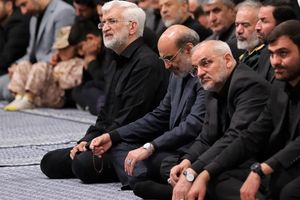 US talks trigger unprecedented rift in Iran’s hardline camp
The term kafan-poushan refers to activists who wear white burial shrouds in political or religious demonstrations, presenting themselves as ready for death or martyrdom. The symbolism has long been used by hardline factions in the Islamic Republic, especially when they want to frame a political demand as a sacred duty.
Organizers said the group’s three-day sit-in changed the function of the site. What had been a place for prayer, mourning, daily ceremonies and congregational prayers became, in their words, a place for overnight stays, food distribution and protest equipment. They said repeated requests and mediation failed to persuade the protesters to leave.
The decision to close the site was presented as an effort to protect the sanctity of a site named after the slain leader. But politically, it showed something more sensitive: even parts of the pro-Khamenei establishment now appear to see some of the most radical mourners as disruptive, not useful.
The conflict is not between supporters and opponents of the Islamic Republic. It is between two loyalist currents.
 Iran hardliners seek to stir unrest in parliament after US MoU, activist says
One side wants Khamenei’s death to be used as a managed symbol of unity, grief and continuity under the new leadership. The other wants to turn that grief into a permanent pressure campaign against officials accused of compromise, especially over talks with the United States and the interim memorandum meant to end the war.
That split has been visible for weeks.
Ultra-hardline figures linked to the Paydari Front have attacked the negotiating team led by Parliament Speaker Mohammad Bagher Ghalibaf and Foreign Minister Abbas Araghchi, accusing them of crossing the late leader’s red lines. Some protesters at hardline rallies have chanted against Ghalibaf and Araghchi, asking what happened to “the blood” of their leader. Some went further, calling for their death or execution.
 Iran hardliners rage over US deal, but experts say regime is closing ranks
Iran International previously reported that supporters of the Paydari Front were removed from nightly state-organized rallies in Tehran after requests by President Masoud Pezeshkian and Ghalibaf, in an apparent attempt to contain pressure from the ultra-hardline street while talks with Washington continued.
The same divide has appeared in parliament and in the media. Lawmakers close to the ultra-hardline camp have accused Ghalibaf of keeping parliament closed to shield negotiations from criticism. Conservative activist Mohammad Mohajeri accused hardline lawmakers of trying to use parliament’s podium for factional purposes after the US-Iran memorandum.
Earlier, Iran International reported that the dispute had spilled into a public clash between Raja News, close to Saeed Jalili’s ultraconservative camp, and the IRGC-linked Tasnim News Agency. The argument centered on how far Iran should go in negotiations and whether maximalist demands, including sweeping sanctions relief and regional ceasefires, were realistic.
 Iran sidelines ultra-hardliners from pro-government nightly rallies
The closure of the site brings that fight into the religious arena.
State-linked outlets had spent weeks giving the site a sacred vocabulary. Some described it as a place where mourners could approach the “killing site” of the slain leader. Others compared it to Tel Zaynabiyya, a deeply emotional reference in Shiite memory. In Karbala, Tel Zaynabiyya is associated with the place from which Zaynab, the sister of Imam Hussein, is believed to have witnessed the battlefield after Hussein’s killing in 680. Using that phrase for Khamenei’s death places the site inside the language of Ashura, martyrdom and sacred grief.
Ashura is not just a mourning ritual in the Islamic Republic’s political culture. It is also a vocabulary of legitimacy, sacrifice and confrontation. Since 1979, the state has repeatedly used the story of Imam Hussein’s stand at Karbala to frame political loyalty as moral resistance and compromise as betrayal.
But the Keshvardoust dispute shows the risk of that language for the state itself. Once Khamenei’s death is framed as a sacred wound demanding revenge, the most radical loyalists can use the same symbolism against the government, parliament speaker, foreign minister or any official seen as too “pragmatic.”
That is why the incident is politically revealing. The establishment wants mourning that strengthens the system. The ultra-hardliners want mourning that disciplines the system.