Iran lawmaker says ships pay up to $2 million to cross Hormuz
The delay has become one of the most unusual and politically sensitive aspects of Iran's post-war transition. While senior military commanders and officials killed in the same conflict have already been buried, repeated promises of a massive funeral for Khamenei have so far gone unfulfilled.
Tehran municipal officials spoke of plans for a multi-day funeral procession later this month. Ceremonies, they said, are expected to span several cities before Khamenei's final burial in the religious city of Mashhad.
 Iranians react with joy and disbelief to Khamenei's death
The prolonged delay sits awkwardly alongside Shi'ite religious tradition, which generally favors the prompt burial of the dead. Classical jurisprudence encourages hastening burial except in exceptional circumstances, such as uncertainty over death or concerns about preserving life. Several contemporary clerics have similarly argued that unnecessary delays should be avoided if they risk disrespecting the deceased.
The absence of a funeral has fueled speculation about the condition of Khamenei's remains following the strike that killed him. Iranian media reports about other officials who died in the same attack described bodies recovered weeks later and identified only through DNA testing after suffering extensive damage.
Officials have released no information about the condition or location of Khamenei's remains.
Security concerns and a missing successor
The unanswered questions surrounding the burial have merged with another mystery: the continued absence of Khamenei's successor.
Mojtaba Khamenei, who assumed leadership following his father's death, has not appeared publicly since the attack. Officials insist he survived and suffered only minor injuries, but reports and rumors about more serious wounds have persisted.
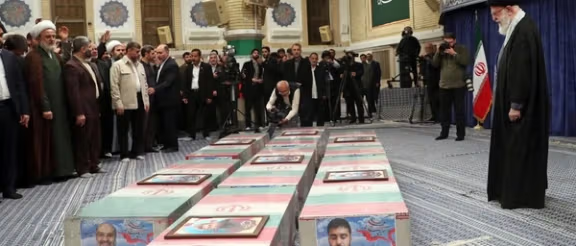
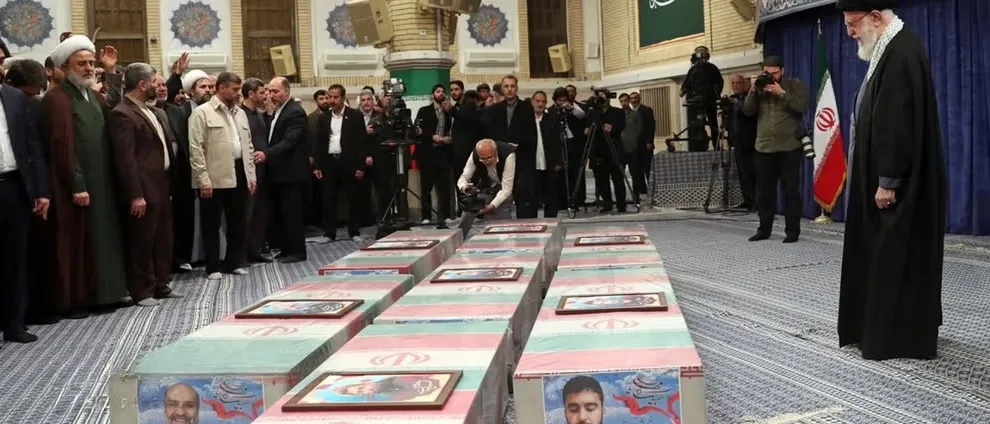
100%
Iranian slain Supreme Leader Ali Khamenei stands before coffins draped in Iranian flags during a memorial ceremony for military commanders and officials killed in the Iran-Israel conflict, in Tehran.If alive and active, Mojtaba Khamenei would rank among Israel's most prominent targets. Any large public appearance could present significant security risks.
That reality complicates what would ordinarily be a defining moment for a new leader. A funeral for a supreme leader is not merely a religious ceremony; it is also a display of political continuity. The absence of the successor from such an event would be difficult to explain, while his appearance could expose him to risks the authorities may be unwilling to accept.
The politics of a funeral
There is also a political dimension to the delay. The Islamic Republic has a long history of using such ceremonies for political messaging. An example was the funeral of Qassem Soleimani, the former commander of the Revolutionary Guards' Quds Force.
The funeral procession, held for several days, passed through Kadhimiya, Baghdad, Najaf, Karbala, Ahvaz, Mashhad, Tehran and Qom before Soleimani was ultimately buried in Kerman.
 Why Khamenei’s funeral keeps changing
State media and Iranian officials said millions of people attended the ceremonies and repeatedly used images from the events in official messaging.
The publicity surrounding the funeral largely overlooked the deaths of 56 mourners, who were killed in a stampede during the burial ceremony in Kerman.
Officials have shown they hope for a similarly turnout for Khamenei. Yet organizing a funeral on that scale in the aftermath of war presents obvious logistical and security challenges.
For now, the result is an unusual limbo. One hundred days after Khamenei's death, Iran has formally selected a successor but has yet to publicly introduce him. It has promised a historic farewell for its former leader but has yet to hold one. And it continues to confront questions that neither official statements nor public ceremonies have managed to answer.