Khamenei accuses Trump of inciting ‘sedition’ in Iran, calls him a criminal
Among Iranians inside the country and across the diaspora, the pause is increasingly interpreted not as restraint but as a dangerous limbo. Calls for decisive military action are now openly framed as a necessary step to halt executions and mass violence, while hesitation is seen as compounding an already unbearable strain.
Delay seen as deception, not restraint
In Persian-language commentary circulating widely online, Trump’s posture is described as calculated ambiguity rather than caution.
Trump’s public gestures, including a post thanking Iran’s leadership and authorities for not executing detained protesters, are dismissed by critics as deliberate misdirection. They say the aim is to buy time while the United States strengthens its offensive and defensive military position in the Persian Gulf.
“The shadow of a Trump attack on Iran has not disappeared. He uses his intelligence for deception more than for anything else. His post thanking Khamenei and the authorities is also deceptive. He is buying time to reach a strong offensive and defensive military position in the Persian Gulf and to decide on a surprise strike at the optimal moment,” wrote a user.
For others, the conclusion is blunt: military confrontation is inevitable.
“A military attack on the clerics is inevitable. You shouldn’t get too caught up in daily noise. The same fluctuations existed before the 12-day war. The only course is to keep documenting the clerics’ crimes and to keep demanding and applying pressure on the United States and Israel for a maximal attack,” wrote another one.
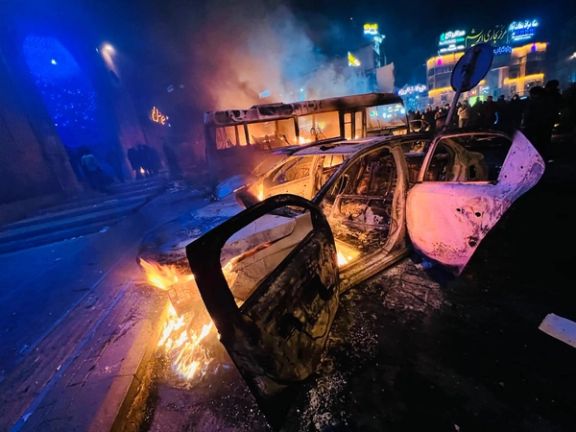 A burned-out car and bus continue to smolder in Saadatabad in northern Tehran on January 10, as crowds gather nearby during an overnight protest.
Trump remarks fuel disbelief and anger
Trump’s own comments have inflamed skepticism. "We have been told that the killing in Iran is stopping, it has stopped, it's stopping," he told reporters in the Oval Office Wednesday afternoon. "And there's no plan for executions or an execution or executions. So, I've been told that on good authority. We'll find out about it."
He also said on Friday: "Nobody convinced me, I convinced myself. You had yesterday scheduled over 800 hangings. They didn't hang anyone. They cancelled the hangings. That had a big impact."
Public reaction to Trump’s remarks was colored by memories of past crises and government narratives that later unraveled. “Sure, Mr. Trump,” one user wrote, “they also told us they didn’t shoot down the Ukrainian plane.” The reference to Flight PS752, which Iranian authorities denied downing for several days before acknowledging it was downed by Iranian missiles, hardening skepticism.
Ambiguity seen as tactic to preserve leverage
A recurring theme was Trump’s communication style. “This is Trump’s usual way,” one post read. “Maybe they called me, maybe I’ll negotiate, maybe I’ll attack, maybe I’ll attack first then negotiate. He uses this tactic to confuse his audience.” The comment reflects a widespread perception that ambiguity is being deployed deliberately to maintain leverage.
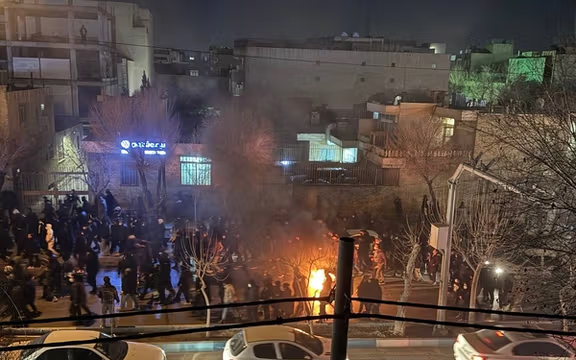 An undated photo shows protesters march through a street in Isfahan at night as a small fire burns along their route.
 Others argued the statements were designed to establish a record. “Politics is complex,” one user wrote. “He said that so if an attack happens tomorrow, the world won’t grab him asking why you struck. He can say, ‘I warned them and they didn’t listen.’”
Debate over patience, pressure and timing
Social media has also become a forum for strategic debate among Iranians about the role of time, restraint and foreign intervention. “This movement didn’t begin with hope for an American attack,” one wrote. “It shouldn’t end with despair over not getting one.”
Others emphasized endurance. “As long as people remain in the streets, we won’t lose hope,” another post said, arguing that internal pressure, not foreign strikes, would determine outcomes – even if outside action could shorten the path.
A more tactical strand of discussion focused on military logistics. Users pointed to reports of aircraft carrier movements, troop redeployments and regional preparations as signs that delay does not equal abandonment. “All these movements mean money, cost,” one post read. “Even if Trump orders it today, it takes weeks – equipment, transport, doctors, food.”
One argued that an immediate strike could trigger indiscriminate retaliation across the region – from Iraq and the Persian Gulf to Israel – and even false-flag attacks blamed on outside powers, invoking the PS752 precedent. In that view, delay allows for planning aimed at minimizing civilian casualties.
Some took a more psychological angle. “The fact that Trump hasn’t attacked yet has frayed your nerves,” one user wrote, “imagine what it’s doing to the nerves of the security forces.” The argument suggests waiting itself can function as pressure, exhausting those tasked with maintaining control.
Some also expressed relief that no strike had occurred, arguing that a rushed or limited attack could be politically symbolic rather than decisive, allowing leaders to disengage without addressing deeper risks. “Trump isn’t looking for a battle he can’t win,” one post said, suggesting preparation signals calculation rather than retreat.
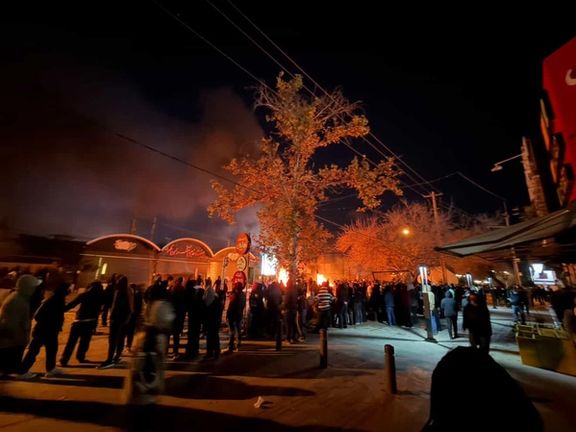 Protesters gather on Afifabad Street in Shiraz on January 8, 2025 as flames rise in the background during overnight unrest.
For a society already accustomed to crisis, the waiting has become its own ordeal. Each day without action brings more frustration. As one user put it, half-joking and half-resigned, “Until news of an attack on Iran comes directly from Trump’s account, I won’t believe anything anymore.”
In the absence of certainty, Iranians continue to debate, wait and endure at one of the most sensitive moments in the country’s modern history where thousands have been killed.