IRGC-linked media says it identified US troops’ Doha hotel, threatens attack
Families stood in long lines outside, he added, waiting to be allowed in to look for loved ones among the dead.
Kiarash, whose last name Iran International is withholding for his safety, described the sprawling morgue as a "warehouse of bodies."
He was there to find the body of the woman, Nasim Pouaghai, after she was shot in the neck and died after a night in hospital.
Kiarash found himself face to face with what he believed to be up to 2,000 bodies brought in during a span of just a few hours on Saturday amid a nationwide internet blackout that sealed Iran off from the outside world.
“People were waiting to go inside of these warehouses to find their beloved and their killed body," Kiarash told Eye for Iran. "I saw two or three trucks that were in the queue … to unload the bodies."
His testimony is one of the few ground-level accounts of the mass killings in the worst crackdown on dissent in the country in decades as that shutdown persists.
At least 12,000 people were killed in just two days as the Islamic Republic unleashed a sweeping crackdown, according to tallies from medics and senior Iranian officials obtained by Iran International.
Kiarash said security forces were stationed at the entrance of Tehran's main cemetery, the Behesht-e Zahra. Inside, families were directed toward the main hall for washing corpses per Islamic practices, where he noticed the warehouses for the first time.
Through the open doors, he says, bodies were visible in stacked rows. Based on what he personally saw, he estimates that each warehouse held between 1,500 and 2,000 bodies by early afternoon. Trucks continued arriving, unloading more.
"I saw small bags," Kiarash added. "I found it out that there are children. There were many, many children."
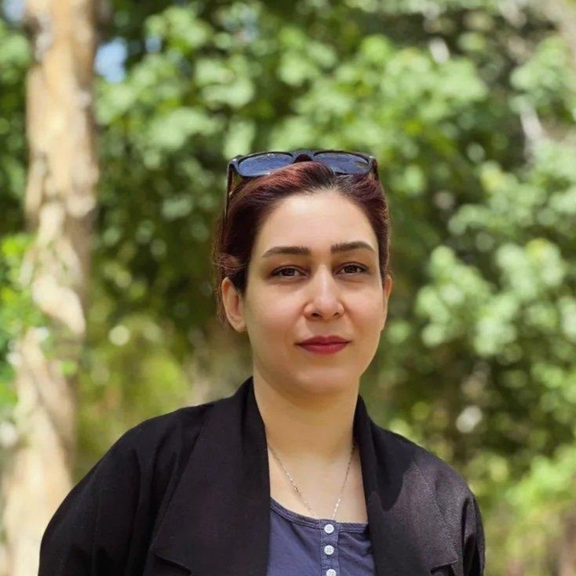 Nasim Pouaghai was shot dead by Iranian government forces on Thursday, January 8, 2026, during public protests on Sadeghiyeh Street in Tehran.
'Holocaust' scenes
Phones were useless. There was no signal. When he tried to document what he was seeing but was stopped by security personnel. Around him, families broke down in tears as they searched through layers of bodies, sometimes forced to move one body aside to look for another beneath it.
He recalls one mother finding her son and begging others not to touch him, even as other families desperately searched beneath stacked bodies for their own loved ones.
Later that same day, during the blackout, Kiarash says he witnessed indiscriminate shooting at close range in Sa’adat Abad, a wealthy residential neighborhood in northwestern Tehran.
He says a shooter dressed in a black chador, traditional women's clothes in Iran, opened fire on a crowd. Bodies began hitting the ground.
“I heard bang, bang, pop, pop. Six times ... and I saw three people, they collapsed just near me. Two girls and one boy.”
Kiarash says he joined others in dragging the wounded into side streets as the shooter fled.
“We can’t stop this regime from killing the people. They’re not talking with us. They’re just killing," Kiarash said. “I just saw when they were throwing out the bodies in the cemetery. It was the same picture which we have here in Germany from the Holocaust.”
You can listen to Eye for Iran on any podcast platform of your choosing or watch on YouTube.