Trump Must Abandon His Dangerous Plan to Sell F-35s to Turkey
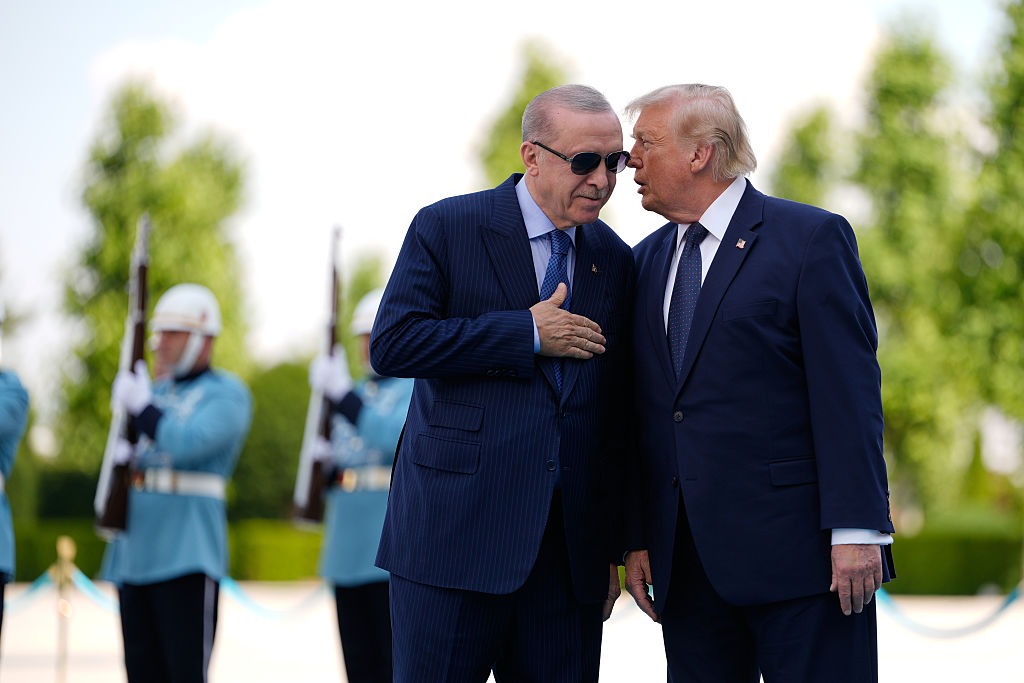 US President Donald Trump's willingness to even consider lifting the F-35 ban is being seen in the context of his charm offensive to forge closer ties with Turkish President Recep Tayyip Erdogan, an initiative the American leader has undertaken despite the Turkish leader's well-documented support for radical Islamist groups such as the Muslim Brotherhood and Hamas. Pictured: Trump speaks with Erdogan during the NATO summit on July 7, 2026 in Ankara, Turkey. (Photo by Emrah Gurel/Pool/Getty Images)
US President Donald Trump must abandon his plans to sell Turkey highly sophisticated F-35 stealth fighters because of the deeply duplicitous conduct Turkish President Recep Tayyip Erdogan displayed during efforts to end hostilities between the US and Iran.
Trump's willingness to even consider lifting the F-35 ban is being seen in the context of his charm offensive to forge closer ties with Erdogan, an initiative the American leader has undertaken despite the Turkish leader's well-documented support for radical Islamist groups such as the Muslim Brotherhood and Hamas.
Trump's courtship of Erdogan, moreover, is continuing despite concerns being raised about Turkey's duplicitous involvement in peace talks to end the Iran war. While, in public, Ankara has said its main objective is to end hostilities in the Gulf, it has also been working quietly behind the scenes to provide support for the beleaguered ayatollahs.
The latest evidence highlighting Erdogan's continued support for the Iranian regime is contained in reports that Turkey actively thwarted a joint military operation backed by the US and Israel to launch a Kurdish-led incursion of Iran in the early stages of the war aimed at overthrowing the Islamic regime.
According to the report published by Israel's i24News, Kurdish militias were preparing to launch an attack on Iran with the aim of instigating a nationwide rebellion against the ayatollahs' tyrannical rule when the US halted the operation due to pressure from Erdogan.
Erdogan's openly Islamist agenda certainly also makes a compelling argument for Trump to give serious consideration to reversing his decision to lift the ban preventing Ankara's acquisition of F-35 warplanes.
Apart from Erdogan's long-held support for the Islamist ideology espoused by the expansionist Muslim Brotherhood and its allies, the Turkish leader has also been accused of actively thwarting the Trump administration's attempts to disarm Hamas terrorists in Gaza as part of its peace initiative in the enclave.
The requirement for Hamas to fully surrender all of its weapons was a key demand of Trump's 20-point Gaza peace plan.
Efforts to pressure Hamas's terrorist leadership into fulfilling its disarmament obligations have, though, been stymied by the interventions of Turkey and Qatar, the Gulf state that also supports a variety of Islamist groups, which have actively used their influence to delay the disarmament process.
Turkey's obstructive approach to the disarmament issue in Gaza follows a series of public statements in which Erdogan has explicitly stated that he regards Israel as a potential enemy, and that the two countries could soon find themselves involved in a direct military confrontation. With Turkey desperately jockeying to replace Iran as the region's dominant power, such a prospect cannot be dismissed lightly.
Erdogan also seems to have initiated a charm offensive, most likely with at least a partial view to prying loose those F-35s.
Despite Erdogan's professed Islamist sympathies and his deepening antagonism towards Israel, Trump has nevertheless expressed his intention to sell the F-35s to Ankara after meeting with Erdogan at the start of the recent NATO summit in Ankara.
Trump previously blocked Turkey's participation in the F-35 programme during his first term in the White House, following Ankara's decision to purchase Russia's S-400 air defence system.
Erdogan is arguing that he has not yet unpacked the S-400s, which were built for one reason: to target and defeat the F-35s. Presumably he will unpack them after the F-35s have been safely delivered.
The move prompted fears within the Pentagon that allowing Turkey access to the top-secret F-35 programme would enable the Russians, who have close ties with Ankara, to gain access to the warplane's stealth technology, thereby compromising its ability to evade Russian anti-aircraft systems.
Despite these well-documented objections to Turkey's participation in the F-35 programme, with Ankara said to be lobbying to purchase up to 100 of the stealth fighters, Trump now appears minded to ease the ban he imposed during his first term and allow the sale of the aircraft to Turkey to proceed.
When asked at the NATO summit about lifting the ban on Turkey buying the warplanes, Trump replied, "That's a decision we're going to make... it's a great plane, the best plane by far, and it's certainly something we will consider."
Trump's change of heart on the F-35 issue has already prompted widespread criticism from numerous quarters. Greece, which historically remains at odds with Turkey on a number of regional issues, such as Turkey's continued occupation of northern Cyprus, has indicated its dismay at the decision.
Trump's move should also attract strong opposition from Israel, the other country most immediately threatened by a frequently bellicose Turkey (as here, here, here and here). Israel has already successfully integrated the F-35 into its air force, with the stealth warplane playing a pivotal role in the recent military campaigns against Iran.
The Israel Air Force has been so impressed with the F-35's performance that the Israeli government recently announced its intention to purchase a further 50 of the planes, a move deemed to be vital to maintaining Israel's all-important air superiority in the Middle East.
Any move by the US to sell F-35s to Ankara could compromise Israel's air supremacy by providing the Turks with the ability to analyse the top-secret technology that gives the Israel Air Force a decisive advantage in air combat.
Israeli Prime Minister Benjamin Netanyahu has already voiced his opposition to the proposed deal, warning in an interview with CNN that the sale of America's most advanced fighter aircraft "doesn't make Turkey a friendly state to the United States." In part of an escalating dispute with Erdogan, Netanyahu described Ankara as "a regime that's infected with the Muslim Brotherhood, which hates the United States."
Trump's proposal to sell F-35s to Turkey should provoke fierce opposition in the US Congress, which one hopes will be unwilling to lift the ban imposed on Turkey because of its close ties with Russia and Iran, as well as its ongoing, if temporarily subdued, hostility to Israel and Greece, and expanding its hold on occupied Cyprus.
The first public move against a possible policy change on the F-35 issues has come from US Representative Dina Titus (D-NV), who has gathered the signatures of 18 members on a letter to the leadership of the House of Representatives.
The lawmakers are calling for guarantees that current US law will be upheld and that Congress will be ready to intervene if the administration attempts to move ahead with Turkey's return to the programme.
With opposition mounting on all sides to the proposed deal, Trump would be well-advised to take heed of his critics and abandon his plan to provide the world's most sophisticated warplanes to Turkey's openly pro-Islamist, charming but ruthless leader — who thinks nothing of decimating his country's military, disabling any political opposition, and imprisoning, torturing and deporting journalists, persecuting Christians, Kurds, Alevis and other perceived dissidents.
Con Coughlin is the Telegraph's Defence and Foreign Affairs Editor and a Distinguished Senior Fellow at Gatestone Institute.