Order Jamie Glazov’s new book, ‘United in Hate: The Left’s Romance with Tyranny, Terror, and Hamas’: HERE.
What has been called ‘possibly the biggest mass migration story you have never heard of’ might be just weeks away from reaching boiling point.
Over the last month, illegal aliens in South Africa have experienced a range of street violence from resentful locals, including murders. Stick- and whip-carrying members of groups and political parties like Operation Dudula (meaning “to force out”) have reportedly engaged in door-to-door intimidation and on-street demands for proof of nationality, on top of conventional public protests. Around the fourth such anti-migrant flare up in two decades in South Africa, thousands of victims, mostly from Ghana, Nigeria, Malawi and Mozambique, have voluntarily departed home as a result, many apparently responding to a June 30th-deadline set by groups like Dudula to get out of the country.
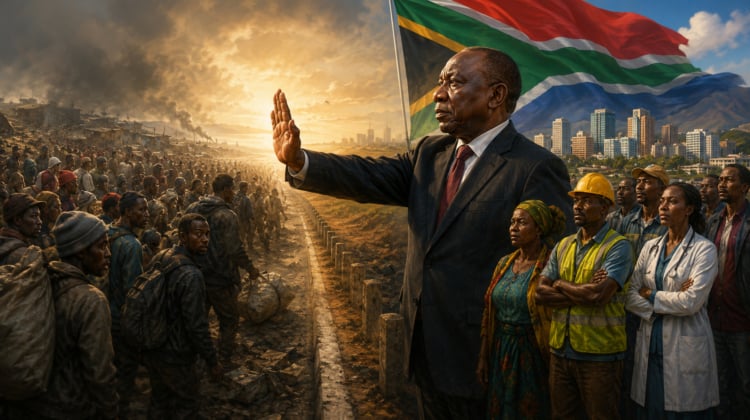
Perhaps most striking, at least for readers of this site, has been the South African government’s response. Instead of the denial, ridicule, new anti-protest laws or uphelpful allegations of xenophobia, which people of the West would usually hear, President Cyril Ramaphosa of Nelson Mandela’s African National Congress party stated those on the street expressing their concerns “deserve to be heard, and they deserve to be addressed.” Those frustrated in the poor townships about unregistered “spaza” shops, or small grocers run by illegal aliens, for instance, also deserved to be listened to. He then publicly introduced a raft of new reforms, many of which, if forcefully implemented, would go far in dealing with the country’s illegal alien problem, including:
- Prison sentences for employers hiring illegal workers;
- Stamping out identity theft by requiring biometric data registration;
- Speedier deportations by closing loopholes, etc.;
- Playing tougher with source countries.
Elsewhere, he has stated that he wants South Africa to redraft its United Nation commitments against deporting refugees (the so-called principle of non-refoulement under immigration law); something that is quite a move for a long-time darling of the UN and affectionately called the “Rainbow Nation.”
Compare this with the recent filmed event in Northern Ireland of a Sudanese national (a “fast-tracked” refugee, it turned out, who merely had to fill out a 10-page form) attempting to behead a man with learning problems in the middle of the street—It’s since been reported the victim was blinded as a result of the unprovoked attack. Like the mainland UK, similar and increasingly common occurrences in Northern Ireland (as well as the Irish Republic) have led to street protest as well as violence, all of which was met with your typical elite performative outrage, a swift crackdown on protesters, and without even a voiced contemplation of immigration reform. As one UK commentator—and the source of my opening paraphrase— recently articulated well, after the charge against the Sudanese attacker was made: “Political leaders condemned the violence that followed. Yet if condemnation is the only response leaders have after such incidents, the public will increasingly sense that official institutions are more comfortable denouncing the reaction than confronting the conditions that produced it.”
This does not seem to be happening in South Africa, where the violence against illegal immigrants (mostly visa-overstayers, not border-invaders) has been far, far worse, and spurred on by economic pressures, not heinously violent, migrant crime.
The South African far-left, however, has linked black anti-illegal alien violence generally to something called “Afrophobia”, which, one subscriber to the term informs, is a “psycho-social state reflecting on the black South Africans’ sense of self, stemming partly from the psychological effects of apartheid.” Whites make them do it, in order words.
But this cannot make sense for several reasons, one being that anti-migrant hostility is regularly experienced by east and south Asian immigrants as well. This also ignores the whopping 33% unemployment rate in the country (around 8 million out of a general population of 65 million) and the increasing downward pressure more and more foreign able-bodied men put on local wages, unionization, etc. (the country’s illegal migrants are 2-to-1, male-to-female).
Still, some sort of “Afrophobia” might be present (but without whites getting blamed for it). Afterall, anti-foreigner sentiment (or co-citizen preference, one might prefer to say) is particularly strong in South Africa compared to the rest of the world, and this is apparently shared across class lines and through socio-economic status.
Might it be that it is the sheer numbers and intense poverty of South Africa’s northern neighbors, and the possibility of its own border security collapsing, that so particularly worries local residents? If so, should not this worry also apply 6,000 miles straight north from South Africa to Europe? Places like Northern Ireland, for instance? After all, Africa’s youth-population (15-35) alone will be 830 million by 2050 while the entirety of the population in the EU and UK is currently at around just 500 million.
Unfortunately, for places like Northern Ireland, France, Germany, etc., it seems certainly possible any previous flows into South Africa will simply be redirected elsewhere, like across their own borders (and likely America’s too). Of course, invasion-levels of African migration have been contemplated in books like Stephen Smith’s Scramble for Europe (which French President Emannuel Macron apparently read) and the German Camp of the Saints-esque novel, The Hungry and the Fat.
Regardless, let us hope President Ramaphosa’s responsiveness to his people is serious and that he’s able to staunch the hemorrhaging of a nation which needs mass African migration even less than we in the West do.