[Order Michael Finch’s new book, A Time to Stand: HERE. Prof. Jason Hill calls it “an aesthetic and political tour de force.”]
A brutal case of domestic violence in Uttar Pradesh’s Shamli district has reignited a national debate on Islamic attire, women’s autonomy, and coercion within Muslim families after a Muslim man was found to have killed his wife and two young daughters, following a dispute linked to his wife stepping out without wearing a burqa. This horrific incident has drawn renewed scrutiny of how “choice” and enforcement intersect in deeply patriarchal settings within the Muslim community.
The accused, Mohammad Farukh, lived with his family in Garhi Daulat village in the Babri police station area. His wife, Tahira, and their daughters, aged only 14 and 7, were reported missing, and relatives failed to contact them for several days. Farukh initially told neighbors and family members that his wife and children were staying with relatives, but inconsistencies in his account made them suspicious.
After concerned relatives alerted the police, Farukh was taken into custody for questioning. During interrogation, he allegedly disclosed that he had kept his wife, Tahira (32), under “strict purdah,” and did not allow her to step out of the house without wearing a burqa. It has been noted that the couple had been on strained terms. Tensions escalated after Tahira reportedly left for her parents’ home in Nara village of Muzaffarnagar without wearing a burqa following a heated argument, and Farukh was enraged.
According to investigators, the accused confessed to killing his wife and their two daughters. Acting on his statement, police recovered the bodies from a pit dug inside the house compound, which had earlier been prepared under the pretext of constructing a toilet. Officials said Tahira was shot with a country-made firearm after an argument; the elder daughter was shot when she rushed outside on hearing the gunshot, and the younger child was strangled.
Police also informed that one of the minor daughters’ bodies was found with an eye gouged out, and a blood-stained wooden stick was recovered from the scene. Investigators suspect the object was used to assault the child. The accused has been formally arrested and charged with murder and destruction of evidence, and forensic examinations are currently underway.
The killings have drawn widespread condemnation across society. However, notable silence has been observed from sections of the political left, Islam-aligned voices, and certain feminist groups who are otherwise vocal in opposing misogyny and patriarchal practices.
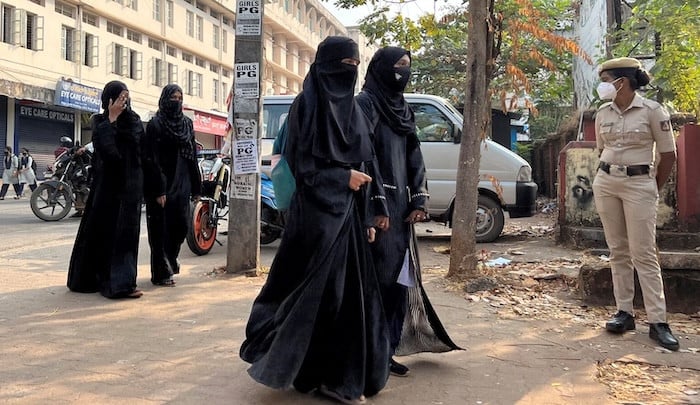
India has seen the debate over hijab and burqa play out publicly in many ways and varying intensities in recent years. Beyond the immediate crime, the case has sharpened an older, unresolved argument on whether Islamic religious garments such as the burqa or hijab are purely a matter of personal choice, or whether social and familial pressures often undermine that choice. The language of “choice” has always obscured coercion. Liberal groups and India’s feminists, who are known to align with Islamic forces, have long argued that women must be free to decide how they dress, warning that bans or stigmatization of religious attire introduced by the government of institutions infringe on individual rights. Yet when Muslims such as Farukh enforce the burqa through violence and even murder, sections of the feminist movement choose silence rather than confrontation.
Violent riots had broken out after certain states restricted the hijab in schools and colleges, with supporters framing the move as necessary for uniformity and secularism, and opponents calling it discriminatory and exclusionary. In February 2022, Karnataka had witnessed absolute lawlessness and mayhem after some academic institutions banned Muslim girls from wearing hijabs in classrooms following a dress-code decision, and Muslims took to the streets with stones and injured around 40 students and several policemen. The liberal brigade defended the Muslim women’s “right” to cover themselves.
Apart from India, the ongoing tension between choice and the enforcement of this particular Islamic garb is well-documented worldwide. In Iran, the 2022 death of Mahsa (Jina) Amini after her arrest for allegedly violating hijab rules sparked nationwide protests and international outrage, highlighting the consequences of state-enforced dress codes. In Pakistan and parts of Iraq, rights groups continue to document “honor” killings and family violence linked to perceived moral or dress-code violations. These cases vary in context and cause, but they collectively show how control over women’s bodies and appearance can turn deadly when backed by social sanction or impunity in Islamic societies.
As India navigates its secular framework amid shifting social dynamics and growing concerns over Islamic jihad recruitment driven by demographic change, political mobilization, and rising jihadist sentiment, the Shamli murders stand out as a stark warning. Unless the state confronts jihadist ideologies and insular Islamic networks taking root in pockets and ghettos, the situation risks deteriorating further in the years ahead.