How artificial intelligence is transforming healthcare
Artificial intelligence is rapidly reshaping the healthcare industry, and more Americans are turning to AI tools for medical guidance.
OpenAI says about 40 million users worldwide now use ChatGPT daily for health-related questions. The company recently launched ChatGPT Health, a feature that allows users to analyze medical test results, prepare for doctors' appointments and seek general guidance.
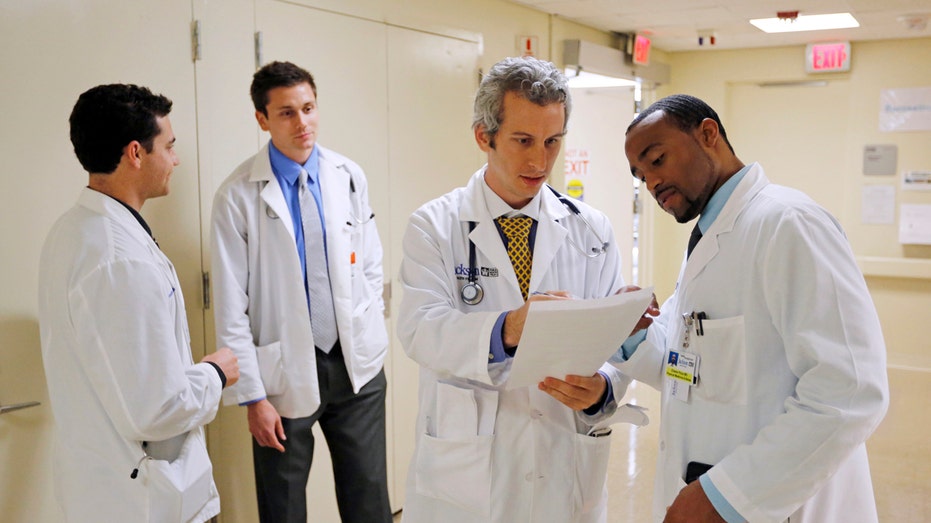
Hospitals and health systems are increasingly partnering with major AI companies to improve diagnostics and more. (Joe Skipper/Reuters)
Rival company Anthropic has also rolled out Claude for Healthcare, designed to support clinical workflows and patient education.
Hospitals and health systems are increasingly partnering with major AI companies to improve diagnostics and more. (Joe Skipper/Reuters)
Hospitals and health systems are increasingly partnering with major AI companies to improve diagnostics, streamline operations and expand access to medical information.
NUCLEAR WASTE BEING TRANSFORMED INTO PROMISING CANCER TREATMENT AT FORMER MANHATTAN PROJECT SITE
Memorial Sloan Kettering Cancer Center is one of OpenAI’s healthcare partners, along with several other major U.S. hospital systems. MSK Chief Strategy Officer Dr. Anaeze Offodile II told FOX Business the hospital is exploring how AI can be used responsibly across research, patient education and administrative operations.
"Over the next year, we’ll identify where these tools can add value, evaluate them carefully and work toward scaling them responsibly," Offodile said. "Our responsibility is to make sure these technologies are safe, ethical and truly beneficial to patients."
He added that the healthcare industry is already moving beyond a pre-ChatGPT era.
"I don’t think we can walk back to a world before generative AI," Offodile said. "The key question now is how we make sure it’s used responsibly."

Memorial Sloan Kettering Cancer Center in New York City is one of OpenAI’s healthcare partners. (Plexi Images/GHI/UCG/Universal Images Group via Getty Images)
A recent industry survey shows nearly one-third of U.S. health systems are now paying for commercial AI licenses as adoption accelerates.
One area where the technology is already showing promise is skin cancer detection.
At MSK's Dermatology Lab, researchers are testing AI tools that analyze medical images and patient data to identify suspicious lesions and flag high-risk individuals.
"I think AI is going to be a game changer for skin cancer detection in particular," said Dr. Veronica Rotemberg, director of the dermatology informatics program at MSK. "The most important thing right now is testing these technologies in real clinical settings so we can understand just how impactful they truly are."
CANCER SURVIVAL RATES REACH RECORD HIGH, BUT DEADLIEST TYPES STILL PUT AMERICANS AT RISK
One of the tools being evaluated is a 360-degree total-body photography system that uses 92 cameras to capture detailed images of a patient’s skin. The goal is to use AI to automatically detect new or changing lesions over time, a process currently done manually by clinicians.
Another technology, reflectance confocal microscopy, allows doctors to see beneath the skin’s surface. The light-powered microscope can detect melanoma, the deadliest form of skin cancer, with about 80% accuracy. Roughly 112,000 Americans are diagnosed with melanoma each year, according to the American Cancer Society.

OpenAI says about 40 million users worldwide now use ChatGPT daily for health-related questions. (Idrees Abbas/SOPA Images/LightRocket via Getty Images)
Doctors also caution that consumer AI health apps can be inconsistent and should never replace professional medical evaluation.
As AI continues to expand across healthcare, physicians say preserving the doctor-patient relationship remains essential.