Arizona’s heat is rising — and nights offer little relief - Fountain Hills Times
Arizona’s summers are becoming hotter, longer, and increasingly dangerous, according to decades of temperature records from Phoenix Sky Harbor International Airport.
While scorching daytime highs have become more common, one of the most significant changes is happening after sunset: overnight temperatures are rising faster than daytime highs.
Data collected at the airport during the past several decades shows a clear upward trend in extreme heat.
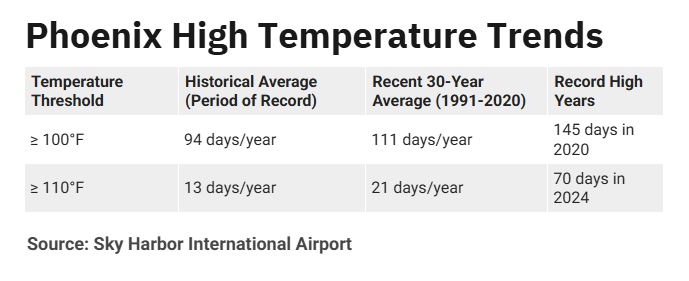
Since the 1970s, Phoenix has experienced an increase in the number of days reaching triple-digit temperatures. Historically, the city averaged about 94 days each year with temperatures of at least 100 degrees.
That average has climbed to 111 days annually over the most recent 30-year climate period (1991-2020). In 2020, Phoenix recorded 145 days at or above 100 degrees, setting a new record.
The increase is even more dramatic for the most extreme temperatures. Historically, Phoenix averaged 13 days per year at or above 110 degrees.
That figure has risen to 21 days annually, and in 2024, the city experienced an unprecedented 70 days reaching or exceeding 110 degrees.
Scientists attribute the trend to a combination of global climate change and the urban heat island effect. While weather naturally varies from year to year, long-term records show Arizona’s baseline temperatures continue to rise, resulting in more frequent and prolonged heat waves.
Perhaps the most concerning shift is occurring overnight. Arizona’s desert climate has traditionally offered relief after sunset, allowing temperatures to cool significantly before the next day’s heat.
That cooling is disappearing, particularly across the heavily developed Phoenix area.
Nocturnal numbersAccording to the National Weather Service, Phoenix’s average summer overnight low between 1896 and 1960 was approximately 71.5 degrees. Today, that average has climbed to about 78 degrees, and overnight temperatures above 85 degrees have become increasingly common during the hottest parts of summer.
Extremely warm nights have also become far more frequent. Overnight lows that remain above 90 degrees were almost unheard of before the 1970s but are now a recurring feature of late summer.
In July 2023, Phoenix set its warmest overnight low on record when temperatures dropped to only 97 degrees, offering virtually no relief from the day’s extreme heat.
Winter bluesThe warming trend extends beyond summer. Winter temperatures also have increased, making hard freezes in Phoenix’s urban core increasingly rare compared with previous decades.
Urban development plays a significant role in these rising nighttime temperatures. As natural desert landscapes have been replaced with asphalt, concrete, rooftops, and buildings, the region has become more effective at storing heat during the day and releasing it slowly overnight.
These materials function like thermal batteries, absorbing solar energy and preventing the city from cooling after sunset. This urban heat island effect keeps overnight temperatures substantially warmer than those in surrounding undeveloped desert areas.
Health risksPer Environmental Health News at EHN.org, the combination of triple-digit daytime highs and stubborn overnight heat prevents the human body from properly cooling down, leading to severe health risks.
Health experts warn that when overnight temperatures remain elevated, the human body is unable to cool itself effectively, significantly increasing the risk of heat-related illnesses such as heatstroke and dehydration.
The prolonged heat poses the greatest threat to vulnerable groups, including older adults, people experiencing homelessness, and those without reliable access to air conditioning. Officials say the lack of nighttime relief can quickly turn prolonged heat exposure into a life-threatening situation.
The combination of climate change and rapid urban growth has fundamentally altered Arizona’s temperature patterns.
Residents now experience more days of extreme heat, warmer nights, and fewer opportunities for recovery during prolonged heat waves. As nighttime temperatures continue to climb, heat-related health risks increase because the human body has less time to cool before the next day’s high temperatures arrive.

Matt Loeschman
News Editor | Phoenix
Meet Matt
Matt Loeschman has had two separate stints at Independent Newsmedia. He began as a reporter covering Peoria and later Surprise from 2000-2009. In 2017, he returned to Arizona and INI as the news editor of the Daily News-Sun (now the Phoenix Independent). He previously covered the Arizona Rattlers of the Indoor Football League for more than a decade.
Community: During high school football season since 2017, he contributes live postgame radio reports to the AzPreps 365 Friday Night Football Wrapup Show. He supports organizations such as Phoenix Children’s, Boys and Girls Clubs of the Valley and the American Cancer Society.
Education: The University of Texas at Austin majoring in Journalism-News and Public Affairs.
Random Fact: He can sing and he has been fortunate to meet many famous people during his journalism career including First Lady Hillary Clinton, King of Country Music George Strait and Oscar-winning actor Matthew McConaughey. Attended all 4 home games of the 2001 World Series.
Hobbies: Watching and playing a wide variety of sports, including golf, tennis, pickleball and softball. Playing PlayStation 5, working out, shopping and reading.