Buying An EV Will Not Save You Money - EPautos - Libertarian Car Talk

It is understandable that people are trying to find a way to reduce what this war is costing them at the pump (and otherwise). But spending money on an EV – and electricity – isn’t that way. It’s worth getting into some of the reasons why.
The first is that you’d have to spend money on an EV and what do you suppose that would cost? Not many people own whatever they’re currently driving, so getting into an EV (for them) would mean signing up for a new loan that encompasses the balance due – what they still owe – on their current car. Plus whatever the EV costs.
The payment is going to be higher, in other words – and in that case, it is hard to see how it would save money, even if you do save on gas money.
It would also cost you money to get rid of a paid-for “gas guzzler” – which you’d likely lose money trying to sell at a time when “gas guzzlers” are not hot sellers – to get into a new EV. It is unlikely, regardless, that you’d get enough for your paid-for “gas guzzler” to offset the cost of the new EV, which would also leave a balance due. If the difference is several thousand bucks (or tens of thousands of) you’ll not be saving any money for years. Meanwhile, the battery of the EV you bought will be losing its charge capacity, just the same as the battery in your laptop or cellphone. Unlike the battery in your laptop or smartphone, a new EV battery typically costs $6,000 on the low end (the battery plus the labor to install it) to $20,000 on the high end. 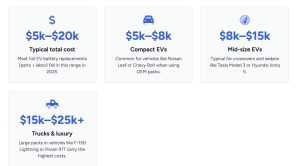
You do necessarily have to replace a wilting battery pack, of course. You could just dump the thing, as you could do with an old beater that needs a new transmission.
But you will have to pay the cost of lost trade-in/resale value. How much is an old laptop with a battery that won’t hold a charge worth?
You will also need to pay the cost of having your garage set up for “Level II” charging – assuming you don’t want to spend a lot of time waiting at “fast” chargers that aren’t at home. Getting the “Level II” set up (which makes it feasible to recharge an EV at home in 6-8 hours or so, depending on the EV) entails having a 240V (electric stove/dryer) outlet with the correct plug type within reach of the EV’s charge cord. Since most existing homes do not have a 240V outlet in the garage, it’s necessary to hire an electrician to wire one up from wherever the electrical panel is in the house. The cost can range from just a few hundred bucks to a few thousand bucks, if your home’s existing panel isn’t able to accommodate an additional 240V circuit. (You might be able to do the wiring yourself, but if you do it wrong and there’s a fire, your home insurance policy might not pay for the rebuilding of your house.)
This assumes you have a garage – which generally assumes you have a single family house (or at least a townhouse). If not – if you rent an apartment – you will have to spend time at “fast” chargers and this brings up a cost of EV ownership many people are unaware of. Buying electricity at a “fast” charger costs about the same as it costs to buy gasoline – not counting the time cost.
You may have read about my recent experience paying to charge up one of the EVs I got sent to test drive. It took 30 minutes – I timed it – to instill enough charge to drive the EV another 100 miles. I did this twice during the week I had the EV to test drive. A few weeks later, I got my credit card statement – you cannot pay cash for a “fast” charge, which is another cost of owning an EV – and found it cost me about $23 each time I “fast” charged the EV.
That’s pretty pricey – for the electricity equivalent of about three gallons of gas, which would be enough to enable a car that gets say 35 MPG to travel about the same 100 miles.
As of early June, the cost of unleaded regular in my state (VA) is about $4.20 – which is almost double what gas cost before Trump decided to try to regime-change the Iranians. Well, three times $4.20 equals just shy of $13 – which is about half what it cost to instill enough electricity in the EV I was test driving to enable it to be driven about the same distance that $13 dollars’ worth of gasoline would enable me – or you – to drive a car that gets 35 MPG.
Even if your current vehicle only gets 25 MPG, you’d still not be saving any money on fueling costs by getting ride of it in favor of an EV – unless you’re willing to wait for hours at hone to get going again. (And even if you are, the cost of electricity at home isn’t exactly cheap anymore, either.)
The cost of gas would need to at least double again from what it currently costs before it would cost less to “fast” charge an EV – and there’s no recovering the lost time cost. Tere’s still the cost of wiring up your garage – assuming you own a home that has one – and the cost of battery replacement/depreciation on account of the known inevitable depletion of the battery’s charge-holding capability.
Plus the cost of acquiring the EV itself. And don;t forget the insurancem which will be higher-cost, too – because the EV’s potential replacement costs are higher and also on account of the fire hazard.
The scenario is something like the one in which people sell/trade-in their “gas guzzling” truck or SUV for a new, fuel-sippy model. The money they lose selling/trading (and then buying) erases any “savings” at the pump. Only the costs are even higher when it’s an EV that’s being looked at as the way to “save” money.
. . .
If you like what you’ve found here please consider supporting EPautos.
We depend on you to keep the wheels turning!
Our donate button is here.
If you prefer not to use PayPal, our mailing address is:
EPautos
721 Hummingbird Lane SE
Copper Hill, VA 24079
PS: Get an EPautos magnet or sticker or coaster in return for a $25 or more one-time donation or a $10 or more monthly recurring donation. (Please be sure to tell us you want a magnet or sticker or coaster – and also, provide an address, so we know where to mail the thing!)
If you’d like a Baaaaa hat or other EPautos gear, see here!