Why comfort is spiritually more dangerous than suffering
 Unsplash/Samuel Martins
One of the oldest objections to Christianity is also one of the most emotionally powerful: If God is good, why does He allow suffering?
It is a fair question. When a child dies, when a marriage collapses, when cancer strikes, when war destroys families, or when loneliness crushes the elderly, quick answers can sound cruel. Suffering is not abstract to those enduring it. Often it carries pain, fear, grief, confusion and sometimes silence.
But perhaps there is another question worth asking: If God is good, if the soul is real, and if life after death is eternal, then maybe the deeper mystery is not why God allows suffering. Maybe the deeper mystery is: Why doesn’t God allow more suffering?
That may sound shocking. It may even sound heartless. But it is not meant that way. It is not an argument for cruelty, neglect, disease, abuse, or indifference. Evil is still evil. Pain is still pain. Death is still the final enemy to be conquered.
But if Christianity is true, this present life is not the whole story. Earth is not Heaven. Comfort is not the highest good. Physical ease is not the final measure of divine love. And a painless life, if it ends in spiritual emptiness, can be a greater tragedy than a painful life that awakens a person to God.
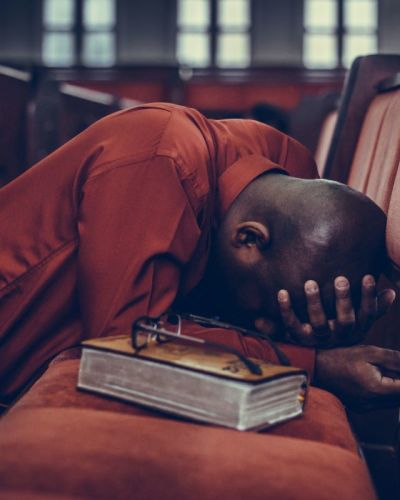
Most people ask why God allows suffering that drives people to their knees. But why would a loving God allow so much comfort that it robs a person of desperation, truth-seeking and dependence on Him? Suffering gives people the opportunity to kneel, rather than being smothered in so much comfort that they never kneel at all. Look no further than some high-profile celebrities and sports stars.
Some people seem to glide through life with little visible pain. They have health, money, popularity, pleasure, and opportunity. They rarely face a crisis large enough to make them ask ultimate questions. They do not cry out to God because they do not feel any need to. Their lives are full enough to distract them, but not deep enough to save them.
From an earthly point of view, such people may appear blessed. But from an eternal point of view, are they?
Jesus warned against mistaking earthly prosperity for spiritual safety: “For what is a man profited, if he shall gain the whole world, and lose his own soul?” (Matthew 16:26, KJV).
If a person’s comfort becomes the very thing that keeps him from seeking God, then comfort is far more dangerous to a person's eternal spirit than temporary physical suffering. Pain at least tells us something is wrong. Prosperity often whispers that everything is fine.
Scripture warns about this repeatedly. Moses told Israel that abundance could become spiritually dangerous: “When thou hast eaten and art full, then thou shalt bless the Lord thy God for the good land which he hath given thee. Beware that thou forget not the Lord thy God” (Deuteronomy 8:10-11, KJV).
That warning is as modern as ever. Success can make people forget God. Good health can make them feel immortal. Wealth can make them feel self-sufficient. Entertainment can keep them numb. Comfort can become spiritual anesthesia.
Mega-rich athletes, celebrities, royal family members and billionaires are often surrounded by wealth, praise, servants, security, private jets, handlers, and applause.
Some wealthy and famous people are humble, generous and responsible. Wealth itself is not a sin. Fame itself is not sin. But we have seen enough scandals, tantrums, recklessness, entitlement, and moral collapse to recognize a pattern: when people are insulated from ordinary hardship, correction, consequences and dependence, the soul can become distorted.
Even ordinary people, when given a silver spoon, can become ungrateful. Think of the Hebrew people, emancipated from slavery, walking through the desert with clothes that never wore out and being fed miraculous food from Heaven. Instead of gratitude, they complained about manna and demanded meat. They were given what they craved, and it became judgment.
Entitlement is what happens when comfort is mistaken for deserved superiority. A person who rarely hears “no” may begin to believe he is above ordinary rules. A person constantly admired may confuse fame with virtue. A person who can buy almost anything may forget that the most important things cannot be bought.
That is why suffering, limitations, and ordinary struggles can sometimes become forms of mercy. They remind us that we are not gods. They teach us that other people matter. They reveal dependence. They interrupt the fantasy that life exists merely to satisfy our appetites.
The danger is not only poverty, sickness or grief. The danger can also be too much insulation from pain. A life with no friction may produce not peace, but arrogance. A life with no need may produce not gratitude, but entitlement. A life with no suffering may produce not holiness, but complacency.
Proverbs says, “Give me neither poverty nor riches; feed me with food convenient for me: Lest I be full, and deny thee, and say, who is the Lord?” (Proverbs 30:8-9, KJV). That is a startling prayer. It recognizes that abundance can make a person forget dependence on God.
Even Solomon, who first asked only for wisdom, received wisdom and riches, yet was given so much comfort and power that he eventually turned from godly wisdom. He married foreign women and tolerated religious practices that included child sacrifice to false gods. The wisest man who ever lived still fell when there was too little back pressure and too few consequences.
Suffering, by contrast, often breaks the illusion. It reminds us that we are fragile. It exposes false gods. It strips away pride. It teaches compassion. It forces questions we would rather avoid: Who am I? Why am I here? What matters? What happens after death? Is there a God? Do I need forgiveness? Is there hope beyond this world?
C.S. Lewis famously described pain as God’s “megaphone” to awaken a deaf world. He was not saying pain is pleasant. He was saying pain gets our attention when pleasure, success and self-sufficiency have made us spiritually deaf.
So perhaps God, in His mercy, permits enough suffering to wake us up, but not so much that we are destroyed by it.
This reverses the usual accusation. People often assume that if God were loving, He would simply maximize human comfort. But what if a loving God is more concerned with saving souls than preserving illusions? What if His goal is not to help us enjoy a temporary world while forgetting an eternal one?
Parents understand this in a smaller way. A loving parent does not give a child everything he wants. A good father may allow discipline, struggle, work, disappointment and correction, not because he hates the child, but because he sees a future the child cannot yet see.
Scripture says, “Now no chastening for the present seemeth to be joyous, but grievous: nevertheless afterward it yieldeth the peaceable fruit of righteousness” (Hebrews 12:11, KJV).
The Christian view is not that suffering is meaningless. It is that suffering is temporary, and God can use even what He hates to accomplish what He loves. The cross is the greatest example. If judged only by Friday afternoon, the crucifixion looked like defeat, injustice and abandonment. By Sunday morning, it became the doorway to redemption.
Paul wrote, “For our light affliction, which is but for a moment, worketh for us a far more exceeding and eternal weight of glory” (2 Corinthians 4:17, KJV). That does not trivialize suffering. It places suffering against the scale of eternity.
If pain causes a person to cry out to God, repent, seek truth, become humble, love others more deeply and prepare for eternity, then that pain may prove to be severe mercy.
If comfort causes a person to ignore God, worship self, avoid truth, neglect the soul and drift toward eternal separation, then that comfort may become a beautiful trap with a slippery slide descending straight into Hell.
So maybe the question is not only, “Why does a loving God allow suffering?”
Maybe the question is also, “Why does a loving God allow so many people to remain comfortable enough to forget Him?”
God is good. God is perfect. He will not waste suffering.
If eternity is real, comfort is not the highest good. And if the spirit matters more than the body, then the greatest danger may not be pain. The greatest danger may be never needing God badly enough to seek Him.
Jerry McGlothlin serves as the CEO of Special Guests, a publicity agency known for representing guests who are dedicated to helping preserve and advance our Constitutional Republic, and maintaining a Judeo-Christian ethic.