Is Islam or secularism more dangerous to the world?
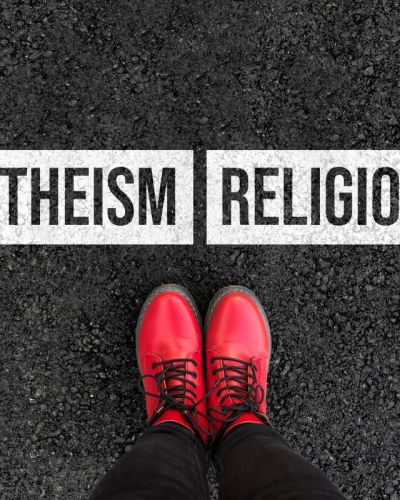 iStock / Getty Images Plus/mirsad sarajlic
One of my many duties as a husband is serving as my wife's Director of Entertainment. That means it's my job to find shows she'll actually want to watch and have them queued up every night so she's properly "entertained."
Sounds easy. It's not.
My wife can binge-watch like a professional, which keeps me in a perpetual hunt for the next great series and helps me avoid the question I've heard countless times as we settle down for a little chill-time at night: "So, what are we watching tonight?"
Nothing gives me more relief than finding a show with multiple seasons and many episodes, which gives me lots of breathing room. Most recently, I got her hooked on Homeland, a political thriller packed with spies, terrorists, traitors, and enough plot twists to keep her guessing.
What struck me about the show wasn't just its portrayal of radical Islamic terrorism. Running alongside that storyline was something else: the destructive power of secular ideologies. Watching it raised a question I couldn't shake: Which poses the greater threat to humanity – Islam or secularism?
For many critics of religion, the answer is obvious. Religion.
Atheist neuroscientist and philosopher Sam Harris once remarked, “If I could wave a magic wand and get rid of either rape or religion, I would not hesitate to get rid of religion. I think more people are dying as a result of our religious myths than as a result of any other ideology.”
It's a provocative claim.
And to be fair, Islam's history contains no shortage of political violence, terrorism, oppression, and cruelty. Former Muslim, atheist, and now political activist Ayaan Hirsi Ali doesn't mince words in describing what she sees as Islam's darker side. In her book Infidel, she writes:
“When people say that the values of Islam are compassion, tolerance, and freedom, I look at reality, at real cultures and governments, and I see that it simply isn’t so. People in the West swallow this sort of thing because they have learned not to examine the religions or cultures of minorities too critically, for fear of being called racist…Wishful thinking about the peaceful tolerance of Islam cannot interpret away this reality: hands are still cut off, women still stoned and enslaved, just as the Prophet Muhammad decided centuries ago.”
Her point is straightforward: whatever ideals are claimed in theory must ultimately be judged by their real-world outcomes.
But if we're measuring danger by one simple metric—the number of bodies left behind—then secularism wins the contest by a landslide.
Yes, terrible atrocities have been committed in the name of religion. ISIS. The Crusades. The Inquisitions. History records them all. But compared to the bloodshed produced by secular ideologies, they barely move the needle on history's Geiger counter of human violence.
Non-religious historians Philip and Axelrod make an observation that surprises many people. In their three-volume Encyclopedia of Wars, they found that of the 1,763 wars fought throughout human history, only 123 were religious in nature. That's just 6.98 percent.
Take Islam's conflicts out of the equation, and the number drops to an astonishingly low 3.23 percent. In other words, every other religion combined—including Christianity—accounts for less than four percent of humanity's wars and violent conflicts.
That's a statistic worth sitting with. And for those convinced that Christianity or religious belief represents the greatest threat facing the modern world, it should serve as a wake-up call.
The real heavyweight champion of human destruction isn't religion. It's secular ideology armed with political power.
Political scientist R. J. Rummel spent years documenting what governments have done to their own people. His conclusion is chilling. In Death by Government, he writes:
“Almost 170 million men, women and children have been shot, beaten, tortured, knifed, burned, starved, frozen, crushed or worked to death; buried alive, drowned, hung, bombed or killed in any other of a myriad of ways governments have inflicted death on unarmed, helpless citizens and foreigners. The dead could conceivably be nearly 360 million people. It is though our species has been devastated by a modern Black Plague. And indeed it has, but a plague of Power, not germs.”
That's not a footnote in history. That's a civilization-sized graveyard.
And notably, the worst offenders weren't religious states. They were aggressively secular regimes—Stalin's Soviet Union, Mao's China, Pol Pot's Cambodia, and others that treated human beings as expendable raw material in service of an ideological vision.
Which raises an uncomfortable question:
If secularism is simply the absence of religion, why does it so often inspire religious-like devotion?
Many have argued that secularism—or humanism by another name—functions much like a religion. Ironically, even the IRS recognizes secular humanism as a religious belief system in legal contexts.
Modern secularism often begins with two assumptions. First, post-truth thinking—the idea that objective facts matter less than personal feelings, experiences, and narratives. Second, pragmatism untethered from moral absolutes—the belief that whatever achieves a desired outcome is therefore justified.
Mix those ingredients, and you get a potent ideological cocktail. And millions are drinking it by the gallon, especially those on the political Left.
Theologian Reinhold Niebuhr saw this decades ago. In his essay, "The Christian Church in a Secular Age," he argued that true secularism doesn't actually exist: “Strictly speaking, there is no such thing as secularism. An explicit denial of the sacred always contains some implied affirmation of a holy sphere.”
His point was simple: human beings are worshipers by nature. If we reject God, we don't stop worshiping. We simply find something else to worship.
Nation. Race. Politics. Sexual identity. Money. Science. The state.
The object changes. The impulse doesn't.
That's why it's hard to watch political activists on either the Left or the Right and not recognize unmistakably religious behavior. Sacred values. Heretics. Rituals. Blasphemy. Evangelism. Excommunication.
From a biblical perspective, the line between ideology and idolatry can become very thin indeed.
So, which is more dangerous: Islam or secularism?
From a Christian standpoint, that's actually the wrong question. Biblically speaking, both become equally dangerous when they demand ultimate allegiance.
Both can become substitutes for the one true God. And both can separate a person from the gospel.
Scripture paints that reality in vivid colors.
In Revelation 17 and 18, John describes “Mystery Babylon”, a force that has operated throughout history as both a spiritual and political engine of rebellion against God. Babylon is more than an ancient empire and more than a future city. It is the recurring pattern of organized humanity attempting to build a world without God.
False religion. Corrupt politics. Godless ideology. Spiritual deception.
They all converge there. Babylon represents humanity's collective declaration that it can flourish apart from its Creator. And that declaration has left a trail of destruction across history.
Which means the greatest danger isn't ultimately Islam. Nor is it secularism.
The greatest danger is anything that captures our ultimate loyalty and persuades us to place it above God. Whether wrapped in religious devotion or secular certainty, every false worldview leads to the same destination.
That's why God's warning in Revelation remains as urgent today as when it was first written:
“Come out of her, my people” (Rev. 18:4).
Robin Schumacher is an accomplished software executive and Christian apologist who has written many articles, authored and contributed to several Christian books, appeared on nationally syndicated radio programs, and presented at apologetic events. He holds a BS in Business, Master's in Christian apologetics and a Ph.D. in New Testament. His latest book is, A Confident Faith: Winning people to Christ with the apologetics of the Apostle Paul.