Best-preserved early image of Jesus unearthed in Turkey amid wave of Christian discoveries
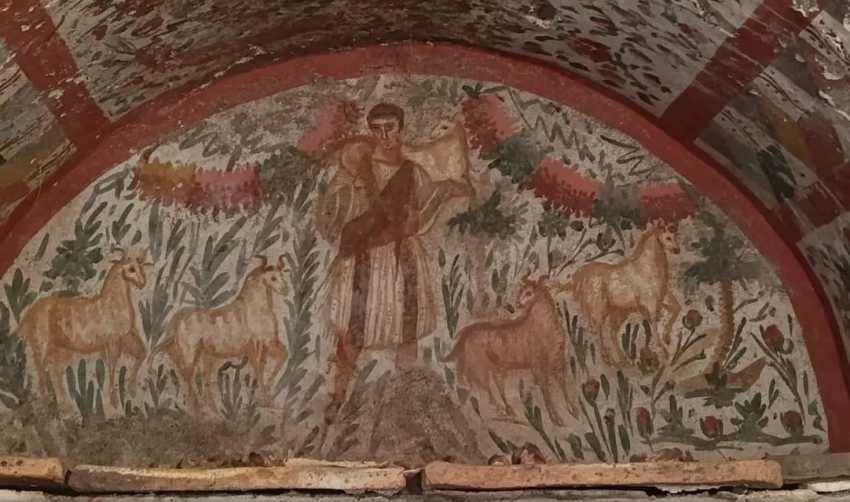 A fresco inside a third century tomb in Nicaea where a rare early Christian depiction of Jesus as the “Good Shepherd” was discovered in Iznik, Turkey. | Turkish Culture and Tourism Ministry
Archaeologists working across Turkey have uncovered a series of discoveries that are offering new insight into the earliest centuries of Christianity, including what researchers describe as the best-preserved early image of Jesus ever found.
The discoveries, made in recent years throughout Anatolia — modern-day Turkey — include newly identified churches, Christian tombs, inscriptions and artifacts that researchers say prove the region's importance in the growth of Christianity after the death and resurrection of Jesus.
“The large number of recent early Christian archaeological discoveries in Turkey are of very substantial significance,” Professor Candida Moss of the University of Birmingham recently told The Independent, adding that Turkey “was in many ways the cradle of early Christianity.
Among the most significant finds is a third-century fresco discovered in the western Turkish city of Iznik, depicting Jesus as the Good Shepherd. Archaeologists say the painting ranks among the oldest known images of Christ as an adult and is exceptionally well preserved due to its location inside a sealed, oxygen-depleted family tomb.
The fresco, which dates to the early-to-mid third century, depicts Jesus with short hair and without a beard, dressed in Roman-style clothing. Researchers say the preservation of the artwork provides an unusually detailed look at how some early Christians may have envisioned Christ nearly 1,800 years ago.
The discoveries come as scholars continue to examine how Christianity expanded from a small, often persecuted religious movement into the official religion of the Roman Empire within a few centuries.
Archaeological work has also revealed new evidence related to the Roman imperial cult, which centered on the worship of emperors. Researchers say the expansion of emperor worship throughout Anatolia helped shape Christianity's development as a movement that often stood in opposition to imperial authority.
In recent years, excavations have uncovered statues and fragments associated with Roman emperors, including Marcus Aurelius and Hadrian at several sites across Turkey. According to scholars, understanding the spread of emperor worship provides important context for portions of the New Testament, particularly the Book of Revelation.
Several of the seven churches referenced in Revelation have also produced notable discoveries. In Laodicea, archaeologists uncovered a fourth-century house church, one of only a handful known worldwide. Researchers in Sardis have continued studying a large sixth-century church that may have influenced later Byzantine architectural traditions.
In Smyrna, now known as Izmir, experts have examined Christian graffiti and inscriptions dating to the second century. Some researchers believe the markings may represent some of the earliest surviving Christian writings.
Meanwhile, archaeologists in Pergamon have identified what appears to be one of the earliest known depictions of Saint George, found on a fifth-century pilgrim flask. Excavations there have also focused on an amphitheater associated with the martyrdom of early Christians.
Additional discoveries in Ephesus have shed light on daily life in the Byzantine Christian era. Excavations of a district buried beneath ash from a major fire have revealed thousands of artifacts, including pottery, food remains and items linked to Christian pilgrimage.
Despite its strong Christian history in Turkey, 99% of the population is Muslim, according to official reports. In recent years, reports have emerged of Christians being denied re-entry to the country after being designated as national security threats.
The Association of Protestant Churches’ 2024 Human Rights Violation Report also noted an increase in the number of hate crimes despite Turkey's official claim of protecting religious freedom.