Reports: Trump OKs Saudi Arabia Nuclear Deal
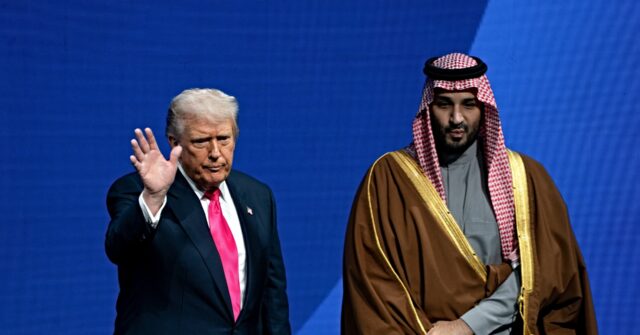
Multiple reports citing anonymous officials on Wednesday claimed that the administration of President Donald Trump is in varying stages of approving a deal to share nuclear technology with Saudi Arabia.
The Saudi news agency Al-Arabiya reported on various of these claims in American establishment media, including a report by the Wall Street Journal that Trump had already formally approved a nuclear agreement with the country and one by Reuters stating that the Trump administration was planning to seeking congressional approval for the deal. The White House at press time has not commented on the reports, nor has the Saudi government.
If it moves forward, the agreement would reportedly grant Saudi Arabia the ability to build and sustain nuclear power plants, potentially moving the country away from its dependence on fossil fuels. It would also put the country on par with the neighboring United Arab Emirates (UAE), home to the only active nuclear plant in the Arab world, and Iran, whose development of nuclear energy has long alarmed both Washington and its Middle East neighbors.
The de facto leader of Saudi Arabia, Crown Prince Mohammed bin Salman, included the development of civilian nuclear energy sources in his “Vision 2030” plan to diversify the nation’s economy and officials openly stated their intention to become “self-sufficient” in nuclear energy. Reports during the first Trump term indicated that the administration was considering an agreement to share nuclear technology with Riyadh, but no formal deal materialized, in part due to sustained opposition by Israel.
Al Arabiya reported on Wednesday, citing the American media outlets, that some reports suggested Trump’s administration had already formally approved a deal to help Saudi Arabia enrich uranium. The agreement was reportedly to last 30 years and involve American private industry aiding the Saudis in their development. While the Wall Street Journal report claimed that Trump had approved the deal, Reuters reported that the administration was planning to submit such an agreement to congressional approval, not that it had already been approved. The reports also did not indicate that the United States would demand Saudi Arabia not enrich its own uranium, a potentially controversial issue as having enrichment capacity could place Saudi Arabia on track to generate its own fissile material for a nuclear weapon.
The Times of Israel, citing a variety of reports in American media, noted that none mentioned the agreement requiring Saudi Arabia to normalize its relationship with Israel, a longtime Trump goal. Saudi Arabia’s policy has long been to condition normalization with Israel to the creation of a state of “Palestine,” but the crown prince had previously suggested that he may be open to dropping such a requirement. In an interview in September 2023, Mohammed bin Salman said he had hoped for a “good life” for Palestinians, but did not explicitly demand a sovereign Palestinian state. Saudi Arabia reverted to firm support for the creation of a “Palestine” following the Hamas atrocities of October 7 that year, frustrating attempts to expand Trump’s “Abraham Accords” normalization agreements to the home of the world’s holiest Islamic sites.
As a result of the absence of Israel in many of the reports on the alleged deal, the Times of Israel reported that politicians across the political spectrum in the country were likely to vocally oppose such an agreement. Some have already raised concerns publicly, such as former Defense Minister Avigdor Liberman, who wrote in a social media statement, “Everyone needs to understand that the Saudi civilian nuclear program will end up with nuclear weapons and lead to a mad arms race across the entire Middle East.”
The Saudi government has for over a decade openly flirted with the idea of becoming a nuclear power. In 2015, prior to the passage of the failed “Joint Comprehensive Plan of Action” (JCPOA) nuclear deal with its rival power Iran, Saudi officials warned that they would pursue nuclear weapons in the event that Iran was confirmed to have them. Iran and Saudi Arabia have long suffered from an acrimonious relationship, fueled by Sunni-Shia distinctions and Iran’s sustained terrorist threats and attacks against the Saudi government and oil industry in particular. Chinese mediation that resulted in the normalization of diplomatic relations between the two countries in 2023 has not stopped Iran from bombing Saudi targets during the current war.
In 2016, then-Saudi Foreign Minister Adel al-Jubeir suggested that Riyadh would not rule out possessing nuclear weapons. Asked if the country would indeed develop them if Iran possessed nuclear bombs, he responded, “whatever we need to do in order to protect our people.”
Following Mohammed bin Salman’s rise to the crown prince position and the launch of his “Vision 2030” initiative, the Saudi government adopted “self-sufficiency in producing nuclear fuel” as a long-term goal. The “Vision 2030” plan reportedly included the goal of “building some 17.6 gigawatts of nuclear capacity by 2032, the equivalent of about 17 reactors.”
Reports began surfacing during the first Trump administration that the president was negotiating a nuclear technology agreement with Saudi Arabia. Those reports resulted in loud protests from Israel and from several members of Congress, even as the crown prince again publicly reiterated Saudi Arabia’s stance that it would develop nuclear weapons if Iran did.
More recently, in 2024, Saudi energy officials described civilian nuclear energy as pivotal to the development of the nation.
“Given the importance of nuclear energy in social and economic development, the Kingdom is moving towards benefiting from nuclear energy and its radiation applications for peaceful purposes,” Minister of Energy Prince Abdulaziz bin Salman said that year, “and it continues to implement its national nuclear energy project with all its components, including the construction of the first nuclear power plant in the Kingdom.”