Kurds Accuse Syrian Army of War Crimes in Aleppo
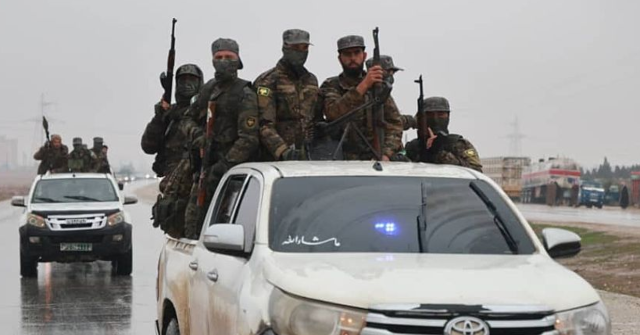
The semi-autonomous Kurdish government in northeastern Syria on Sunday accused the Syrian Army and its affiliated militias of committing “war crimes” against Kurdish communities in the city of Aleppo.
Aleppo has been torn by sporadic fighting since December, when long-simmering tensions between the Kurds and forces loyal to interim president Ahmed al-Sharaa boiled over. Each side accused the other of firing the first shots and provoking armed conflict.
After a brief respite, fighting resumed and intensified last week. The Syrian Army ordered evacuations from several Kurdish neighborhoods in Aleppo last Thursday in advance of heavy shelling intended to drive armed Kurdish units out of the city for good. Thousands of Kurdish civilians fled the city.
Once again, the city settled down for a little while over the weekend but, as before, renewed clashes broke out in Aleppo’s Kurdish precincts on Tuesday. The independent UK-based Syrian Observatory for Human Rights (SOHR) estimated at least 82 fatalities on Tuesday, including 43 civilians.
The Kurds refer to the region around Aleppo as Rojava and also use that name for their semi-autonomous statelet. The proper name of the civilian government is the Democratic Autonomous Administration of North and East Syria (DAANES). The Kurdish military organization is known as the Syrian Democratic Forces (SDF) — a major military ally of the United States and Western powers during the war against the Islamic State.
The SDF maintains an “internal security force,” or paramilitary police force, called the Asayish, which was assigned to police Aleppo after the SDF withdrew its military forces from the city in March under a deconfliction agreement with Damascus. The Asayish were involved in the December skirmishes that kicked off the current round of unrest in December.
Lined up against them is the Syrian Army and its own paramilitary allies, including jihadi and terrorist groups that are severely distrusted by the Kurds. The presence of these forces in Sharaa’s ruling coalition has made the Kurds very reluctant to accept demands from Damascus for full integration of their armed forces.
Watching the conflict with deep suspicion is Turkey, which distrusts the Kurds even more than the Kurds distrust the jihadis. Turkey considers all armed Kurdish factions in Syria to be allies, or even secretly members, of the Kurdistan Workers Party (PKK), a violent Kurdish separatist group in Turkey. Turkey’s enthusiastic support for Sharaa’s government comes with expectations that Sharaa will disarm and control the Kurds.
DAANES issued a statement on Sunday in which it expressed “great concern and condemnation” over the “ongoing severe violations, amounting to war crimes, committed by the factions affiliated with the Transitional Syrian Government in Damascus.”
The Kurdish administration said it had “a lot of evidence” to show that some of the paramilitary groups affiliated with the Syrian Army “are composed of former Islamic State members” who committed “crimes against our civilian population.”
“These actions represent a clear and flagrant breach of previous agreements, which included guarantees for the protection of the safety and security of civilians, whether those who were forced to flee the neighborhoods or those who remained in their homes,” DAANES said, referring to a ceasefire agreement in March between the SDF and militias loyal to Damascus.
“Despite these agreements, violations and war crimes continue systematically, with recorded instances of arbitrary arrests, insults, humiliation, and degradation of civilians,” the statement said.
The Kurds backed up these allegations with videos purporting to show jihadi groups arbitrarily taking Aleppo’s Kurdish civilians prisoner and humiliating them:
DAANES asked the United Nations to “form an independent international committee to investigate all violations and crimes” against the Kurdish community in Aleppo.
On Monday, senior SDF commander Sipan Herno said the abuse of Aleppo’s Kurds was a “politically-driven” assault that was planned “outside Syria.”
“Certain officials of different states had gone to Damascus and told them, ‘Come for this, everything is ready for you.’ Support was taken from outside, and the declaration of war was made,” he charged.
Herno did not keep his interviewer in suspense for very long before naming Turkey as the hostile outside power calling the shots in Aleppo.
“Let me be explicit: the drones over Sheikh Maqsood and the tanks used against it were all Turkish. They belonged to them. But they did not declare it,” he said. Sheikh Maqsood is one of the two Kurdish districts in Aleppo where most of the violence has taken place.
“The plot is against the existence of the Kurdish people. Sheikh Maqsood is the fortress of democracy in Syria,” he said.
SDF media chief Farhad Shami made similar accusations on Monday, claiming the skies over Aleppo were filled with “suicide drones belonging to factions affiliated with the Damascus government,” as well as Turkish military aircraft. Turkish officials denied providing either drones or air support to the Syrian Army or its militias.
“Turkish warplanes continue to fly intensively over the area. Our forces are closely monitoring the situation,” he said.
The SDF withdrew the last of its fighters from Aleppo on Sunday, as required by a ceasefire deal with the central government in Damascus. The last positions abandoned by the SDF were in the Sheikh Maqsood neighborhood, and many of the civilian residents left with them. Sunday marked the first day since the Syrian civil war began in 2011 that Kurdish military forces have not been present in Aleppo.