Justice Alito: Birthright Citizenship Is 'Grotesque'
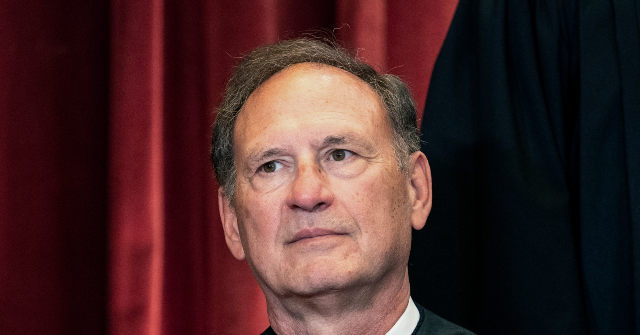
“This is one of the most important decisions in the history of the Court, and in my judgment, the Court has made a serious mistake,” Justice Samuel Alito wrote in his dissent to the Supreme Court’s 5-4 decision to insert birthright citizenship into Americans’ Constitution.
He continued in plain language to show how the decision endorses birth tourism, which would automatically grant full citizenship to foreign adults who have never lived a full day in the United States:
The Court’s interpretation is not only contrary to the original meaning of the Fourteenth Amendment, it produces grotesque results. While foreigners who wish to immigrate lawfully must sometimes wait for many years, a child born here to a birth tourist is automatically a citizen.
The Court’s interpretation also has national-security implications… Suppose that a person’s only connection to this country is that he was born here to a mother who was present just long enough to give birth and then quickly returned to her native country. Suppose that country is a strategic adversary or enemy of the United States. Suppose the child never visited the United States while growing up and was inculcated with hatred of this country. According to the Court, that person is a citizen of the United States. He can enter and leave the country as he pleases. He can travel the world on a United States passport. Even if he plots to harm this country, he cannot be deprived of his status as a citizen, at least under current precedent.
“We should not adopt an erroneous interpretation of the Fourteenth Amendment simply out of fear of the consequences of ‘rocking the boat’ or as a reaction to current immigration policy,” he wrote.
Many children are born to foreign parents who are “subject to a foreign power,” which should make their children ineligible for citizenship, Alito noted:
A great many persons who are born here to illegal immigrant parents fail this [subject to foreign power] test because at birth they are automatically made nationals of their parents’ native country and, as a result, incur duties to that country. This means that they are “subject to a foreign power” and are thus not “subject to the jurisdiction” of the United States within the meaning of the Fourteenth Amendment.
This is illustrated by the laws of countries on the list of those from which the greatest number of illegal immigrants come. Mexico is at the top of that list, and under Mexico’s constitution, the child of a Mexican parent can become a Mexican national at birth and acquires certain duties to the government. See Political Constitution of the United Mexican States… Among these are the obligation to receive military training and to join the National Guard.
Alito explained his views:
Careful analysis of the text of the Fourteenth Amendment and the process that led to its adoption shows that it does not degrade the concept of United States citizenship in this way. Instead, the Fourteenth Amendment confers citizenship on only those children who, at birth, owe allegiance solely to this country.
Respecting this interpretation would not require uprooting the millions of children who were born here to mothers who entered or remained in this country illegally. Those children are not responsible for their parents’ violation of our immigration laws, and their plight is the result of a long period during which a coterie of actors — Executive Branch officials, States and cities, and a variety of private groups — sent the message to would-be immigrants that our dissenting immigration laws should not be taken too seriously.
Alito’s dissent echoed the dissent of Justice Clarence Thomas, who argued that the court’s majority’s imposition is a “political project” built on medieval feudal laws from pre-modern Europe. Alito similarly wrote:
United States citizenship is precious. Anyone who has attended a ceremony where citizens are naturalized can see that message on the faces of those who take the citizenship oath. Before saddling the Nation with a medieval rule, we had better be certain the Constitution requires it.
…
This theory of monarchical power and the status of the people provided the foundation on which the rule of birthright subjecthood stood. Just as a person automatically acquires at birth all that is entailed by the relationship between parent and child, a person born within the King’s dominion automatically became the King’s subject.
…
The Court does not confront these problems because it pays little attention to the constitutional text. Instead of performing its own textual analysis, the Court leans on precedent that glosses the text.
Recent U.S. governments have allowed mass illegal migration and abuse of the birthright citizenship clause by refusing to enforce the nation’s immigration laws, Alito said, adding:
Congress’s failure to act, the Executive Branch’s enforcement policies and frequent opposition to state solutions, and some jurisdictions’ policies have resulted in a massive increase in the number of illegal immigrants living in this country… Between July 2023 and March 2024, the overall foreign-born population of the United States increased from 48.5 million to 51.6 million — “an unprecedented increase of 3 million immigrants in nine months. Much of this growth was driven by the admission of unauthorized immigrants with temporary deportation protections.”
As a result of the events of the past 50 years, the United States now has a huge contingent of people who entered or remained in this country illegally, as well as a large group of people who were born here to such parents. The Court’s interpretation of the Fourteenth Amendment makes all the members of this latter group citizens.
“The Fourteenth Amendment does not include the rule the Court now imposes on the country,” Alito wrote, adding, “In my judgment, the Court has made a mistake that will seriously affect the country’s future.”